

Snowflake Taps Context for AI Trust

Snowflake's new Horizon Context feature aims to unify business logic for AI and BI, addressing trust issues caused by scattered data definitions.

Snowflake logo with abstract data cloud background
Snowflake introduces Horizon Context to unify business logic for AI and BI.· Snowflake
Visual TL;DR
Scattered Business LogicDriver
definitions and calculations fragmented across tools, causing AI trust issues
From the article 2 mentionsDiscrepancies in AI-generated revenue figures between sales and finance highlight a critical problem: business logic is too often scattered across disparate tools.
Metric Drift & MistrustDriver
discrepancies in AI-generated figures erode confidence in initiatives
From the articleThis fragmentation leads to metric drift and erodes trust in AI initiatives.
Snowflake Horizon ContextCore
From the article 5 mentionsSnowflake is tackling this head-on with the introduction of Snowflake Horizon Context, a new capability designed to act as a governed context layer for AI, Business Intelligence (BI), and enterprise applications.
Collects & Enriches MetadataContext
gathers data definitions and relationships from across the organization
System of UnderstandingContext
transforms Snowflake from record keeper to meaning maker
From the article 3 mentionsThis expansion of Horizon Catalog aims to transform Snowflake from a system of record into a system of understanding.
Unified Business LogicEffect
centralizes definitions and calculations for consistent AI and BI
From the article 2 mentionsBy enforcing semantics within the governance engine at query time, agents can be trusted to act upon governed, consistent business logic, paving the way for more reliable autonomous AI.
Enhanced AI TrustOutcome
enables reliable AI insights by ensuring data consistency
From the articleThis fragmentation leads to metric drift and erodes trust in AI initiatives.

Discrepancies in AI-generated revenue figures between sales and finance highlight a critical problem: business logic is too often scattered across disparate tools. Snowflake is tackling this head-on with the introduction of Snowflake Horizon Context, a new capability designed to act as a governed context layer for AI, Business Intelligence (BI), and enterprise applications.

This expansion of Horizon Catalog aims to transform Snowflake from a system of record into a system of understanding. The core issue it addresses is the fragmentation of context, definitions, calculations, and business rules, across various databases, BI tools, and LLM prompts. This fragmentation leads to metric drift and erodes trust in AI initiatives.

From Metadata to Meaning

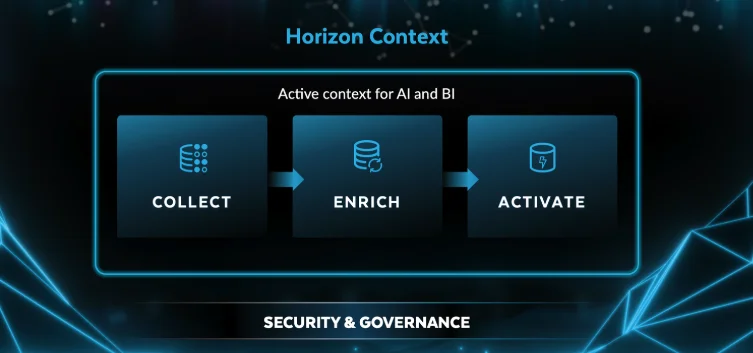
Horizon Context works by collecting metadata from across an organization's data estate, both within and outside Snowflake. It enriches this raw data with business definitions and relationships, making it actively discoverable and usable by AI agents and BI tools.

The system addresses three key problems: scattered context, raw context, and inactive context. By collecting and enriching metadata, Snowflake aims to provide a complete picture for AI, turning raw data assets into meaningful, actionable business insights.

Key features include expanded metadata connectors for external systems like PostgreSQL and Tableau, and support for the OpenLineage API. This allows for end-to-end lineage tracking and uses popularity signals from access logs to identify authoritative data assets.

Activating Context for Agents

Making context usable is paramount. Horizon Context enables automatic discovery and application of trusted logic. CoCo, Snowflake's AI agent, will leverage Universal Search to retrieve relevant context across the entire data estate. Furthermore, AI agents will automatically search for and query relevant semantic views when answering data questions, falling back to tables only if necessary.

This native integration within Snowflake ensures that governance frameworks are enforced at the meaning level, not just the table level. Role-based access control and data masking policies follow context across all tools and AI interactions, maintaining consistency.

Snowflake is also enhancing its Semantic Views, allowing for advanced calculations and AI-assisted creation from existing SQL, Tableau, and Power BI files. This move aims to solidify a single source of truth, eliminating metric discrepancies and building confidence for scaling AI-driven analytics.

The company emphasizes that this native integration prevents the sync and drift issues common with bolted-on context layers. By enforcing semantics within the governance engine at query time, agents can be trusted to act upon governed, consistent business logic, paving the way for more reliable autonomous AI.

© 2026 StartupHub.ai. All rights reserved. You may not republish this article in full without a license. Search engines and AI research tools may crawl and summarize for reference. Bulk reproduction or model training requires a license. See our terms.
Daniel Singer

Written by

Daniel Singer

Editor, StartupHub.ai

Daniel Singer is the editor of StartupHub.ai, a technology expert and thought leader on AI and its applications across sectors, from fintech and healthcare to developer tooling and consumer software. He writes and tests the tools covered here thoroughly and regularly, and built StartupHub.ai to give founders, operators and buyers a clearer read on what they are actually being sold.