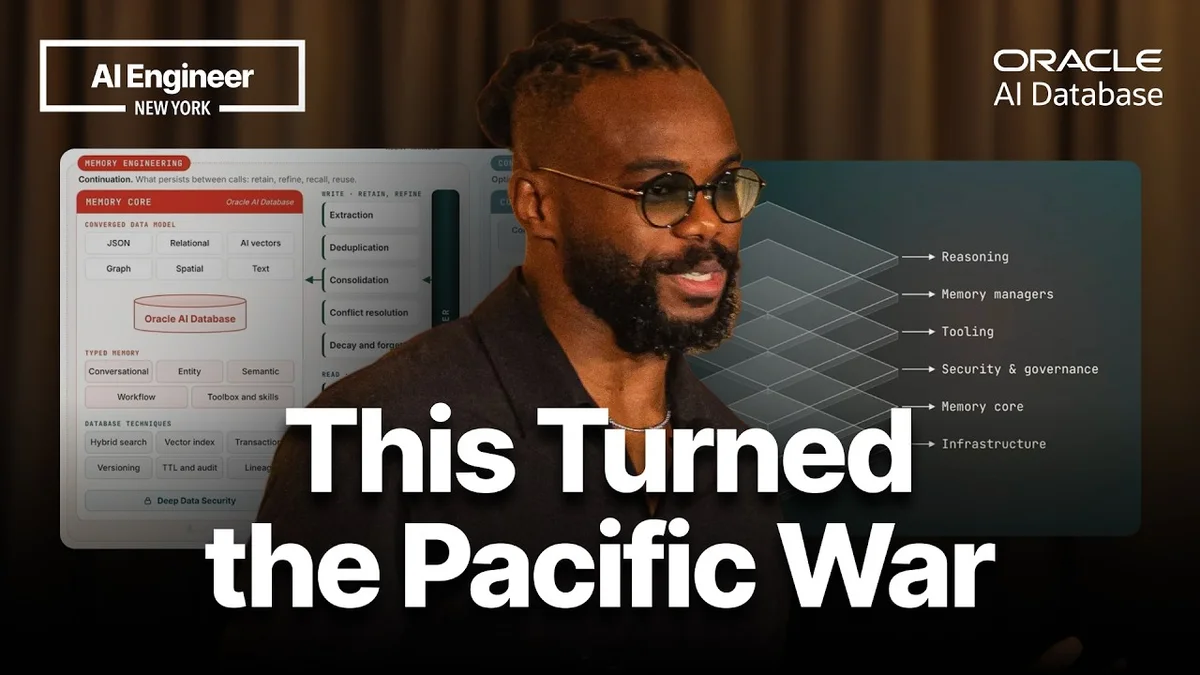
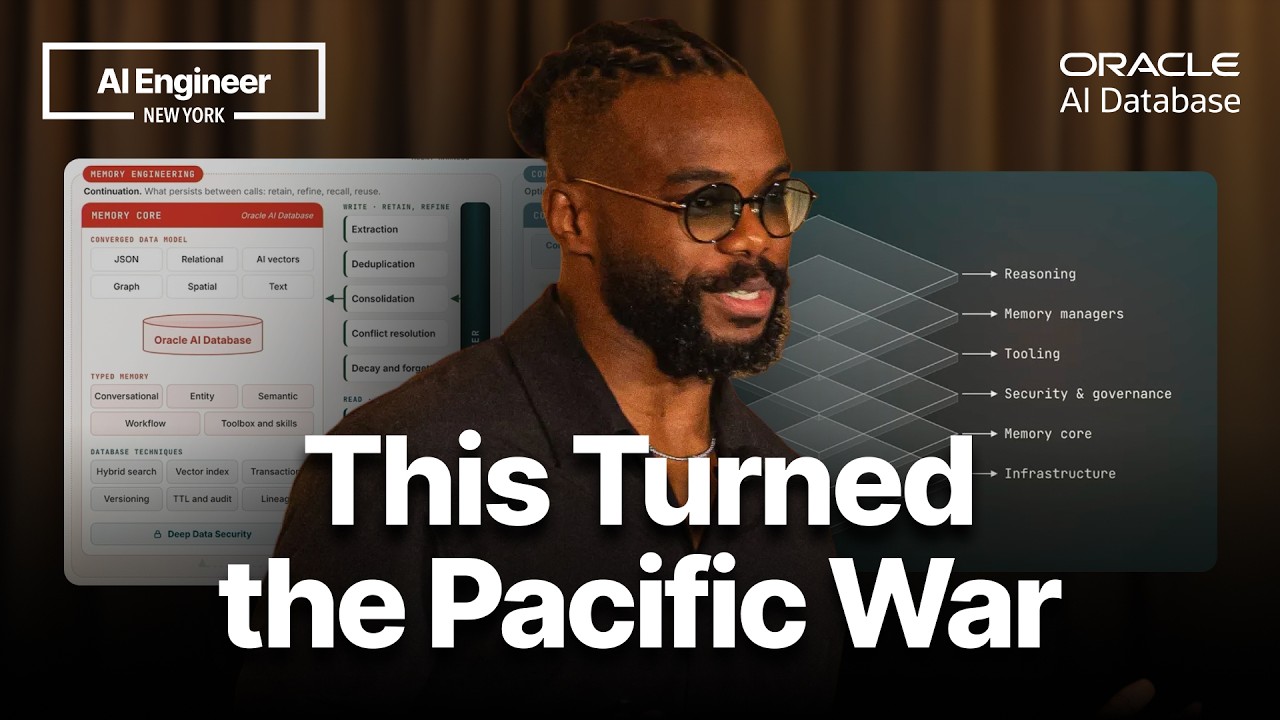
AI Engineer hosted Richmond Alake of Oracle to demo agent memory as a Python package and a no-code Private Agent Factory that run on Oracle Cloud, Oracle AI Database and Private AI Service Container. Alake showed a governed analyst using an intelligence plane that burned 32,000 tokens against 200,000 for a naive agent, with 5% lower margin of error, and said the stack uses Oracle Deep Data Security so agents inherit the identity and data permissions of the user they act for. That means access still requires an authenticated user context, not an anonymous remote call, and any misconfigured governance would be a local privilege problem before it becomes a data leak.
He put it on a timeline. Bob Bemer coined "software factory" in 1968 at General Electric, Alake said, and he has spent the past 3 years teaching a taxonomy of memory. He gave a prior talk on agent memory about a year ago at AI Engineers San Francisco, according to the presentation, and framed this update as what would put teams 6 months ahead. The release formalizes two planes he now pushes in production.
Control is governance plus security, Alake said, essentially a centralized management system for tools and permissions. Intelligence is knowledge plus memory plus learning, which he argued acts as a multiplier. The company packages that as control plane and intelligence plane, where the intelligence plane covers what the agent should know, what it should remember, what it is allowed to see and how it gets better through continual learning. Information does not equal intelligence, he said, and agent equals model plus harness only gets you so far without those planes.
In the demo the intelligence plane cut cost and latency on what Alake calls tokenomics while adding accuracy via ontology and semantic layers. He said the ontology layer beats keyword search on accuracy and that decision models make memory routing very easy and very cheap. Embeddings and re-ranking are the lowest hanging fruit teams can ship today, he said. For mission-critical workloads he pointed to small accuracy gains that avoid large penalties, citing a hypothetical $100 million fine for mishandling fraudulent transactions as the kind of error the semantic layer is meant to prevent.
That's the field reality. Memory routing works until traces are noisy, permissions drift, or recall returns stale facts, and then you pay in retries and hallucinations. Alake's answer is blunt: memory is basically your moat, you need to own your own memory, and teams need to engineer trace capture into a system that allows continual learning. He also built Memories as an open-source tool before the Oracle package, which is how many teams have prototyped this. Oracle's own docs now show the operational surface, noting you can enable automatic summarization in your agent's Stored Memory tab and configure long-term memory including which model extracts memories and whether memories are shared across sessions, according to Oracle's AI Data Platform blog.
The daily brief
Get the free daily brief with the day's AI news, new AI startups and funding rounds every morning.
Join 11,995 subscribers.
What had to be true was shared models and shared harnesses. What still has to happen is owned memory with learning loops that actually close. You can start with routing and re-ranking, but the security line stays the same: if the Deep Data Security identity binding fails, the agent sees too much.