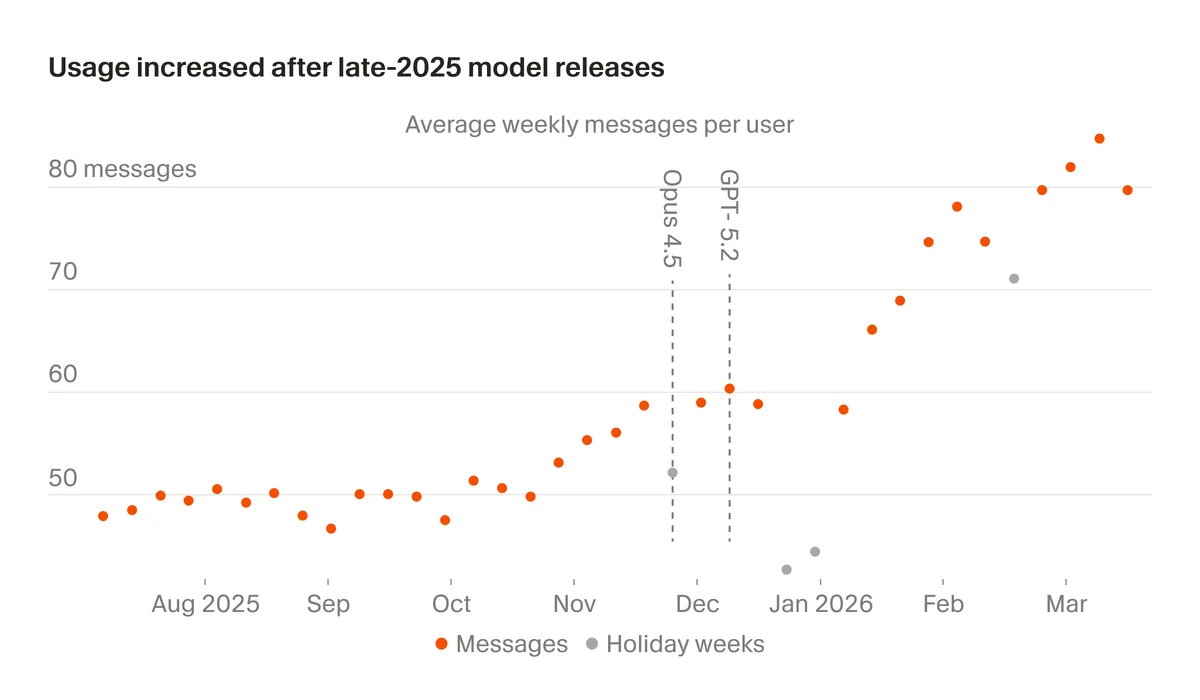
The latest advancements in AI models, including OpenAI's GPT-5.2, are not just making developers more efficient; they are fundamentally changing the nature of their work and enabling previously out-of-reach projects. A recent study analyzing eight months of developer activity on Cursor AI models, spanning July 2025 to March 2026 and incorporating the release of models like Opus 4.5 and GPT-5.2, reveals a significant surge in AI adoption.
This period saw average weekly AI messages per user jump by 44%, a phenomenon consistent with the Jevons paradox, where efficiency gains lead to increased overall usage. The findings, detailed in research conducted with Professor Suproteem Sarkar from the University of Chicago Booth School of Business, indicate that developers first leverage enhanced AI for existing tasks before tackling more complex challenges.
Industry Adoption Spikes
The impact of these AI upgrades is not uniform across sectors. Media and advertising led the charge with a 54% increase in AI interaction, followed closely by software and developer tools (47%) and finance/fintech (45%).
In finance, this could be an AI arms race, where firms adopt AI to gain a competitive edge. Media and advertising, conversely, may be exploring new opportunities unlocked by more capable AI.
Complexity Curve
Initially, developers used improved AI models to perform more of the same tasks. However, a lag of four to six weeks preceded a significant shift towards more complex problem-solving.
The daily brief
Get the free daily brief with the day's AI news, new AI startups and funding rounds every morning.
Join 64,000 other subscribers.
While low-complexity messages rose 22%, high-complexity messages surged by 68%, primarily in the study's final weeks. This delay suggests it takes time for developers to discover new AI capabilities and for organizations to adapt workflows.
Task Distribution Evolves
As AI excels at code generation, developer roles are shifting towards managing that output. Documentation saw a 62% increase in usage, architecture 52%, and code review 51%. Tasks like UI styling, however, grew only 15%.
This indicates a growing need for developers to document, understand, and review larger, AI-generated codebases. Managing complex, interconnected systems also demands more architectural oversight.
More advanced AI agents are also facilitating these cross-system tasks.
Expanding the Frontier
The study suggests that AI is not merely streamlining existing work but also opening new avenues for productivity and economic activity. This expansion into novel opportunities may become AI's most significant long-term contribution.