

AgentStop Sips AI Battery Life

Brave's AgentStop system tackles the significant battery drain of local AI agents by predicting and terminating unproductive processes early.

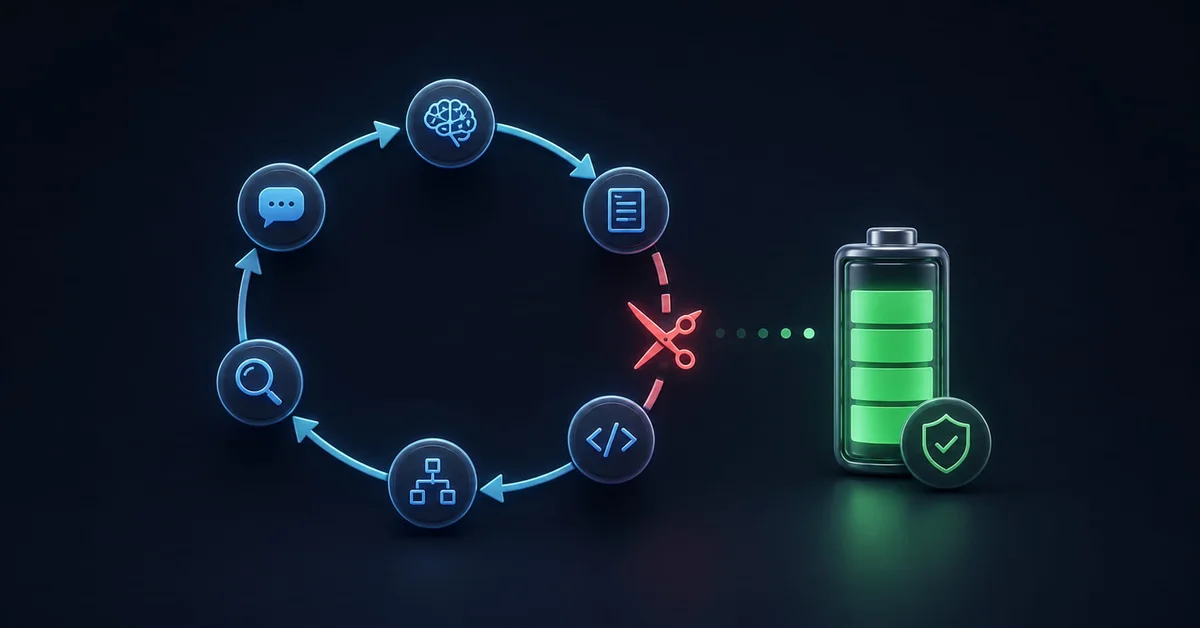
Diagram showing AgentStop concept for AI energy efficiency
AgentStop monitors AI agent processes to prevent unnecessary energy consumption.· Brave
Visual TL;DR
Local AI Battery DrainDriver
running large language models locally consumes significant device power
From the article 2 mentionsBrave has developed a solution called AgentStop, a lightweight supervisor designed to curb this battery drain by preemptively terminating AI agent processes that are unlikely to yield results.
Privacy BenefitsEffect
keeps sensitive data on-device, no cloud upload needed
From the article 2 mentionsRunning large language models (LLMs) locally on consumer devices offers a privacy advantage, keeping sensitive data on-device.
Iterative AI ProcessesContext
multi-step LLM inference and tool calls drain energy
From the article 2 mentionsUnlike simple chat interactions, AI agents operate through iterative, multi-step processes.
AgentStop SystemCore
Brave's intelligent termination for AI efficiency
From the article 7 mentionsThis research is set to be presented at the 1st ACM Conference on AI and Agentic Systems (ACM CAIS 2026).

Predicts Unproductive AgentsContext
identifies and stops AI processes unlikely to yield results
From the articleBy training a lightweight gradient-boosted decision tree on labeled successful and failed runs, AgentStop can predict unproductive paths early.
Quantifiable Energy SavingsOutcome
reduces battery consumption with minimal impact on functionality
ACM CAIS 2026Context
From the articleThis research is set to be presented at the 1st ACM Conference on AI and Agentic Systems (ACM CAIS 2026).
Contents(4)

Running large language models (LLMs) locally on consumer devices offers a privacy advantage, keeping sensitive data on-device. However, this comes with a significant energy cost. Brave has developed a solution called AgentStop, a lightweight supervisor designed to curb this battery drain by preemptively terminating AI agent processes that are unlikely to yield results. This research is set to be presented at the 1st ACM Conference on AI and Agentic Systems (ACM CAIS 2026).

StartupHub data

Companies working on this

Profiles of the companies named in this story, with funding and a one-liner from our database.

Brave
$980M
A privacy-focused browser and search engine that blocks ads and trackers, rewarding users with cryptocurrency.

Local AI agents are increasingly viable thanks to advancements in model efficiency, enabling powerful models to run on standard hardware. This shift is crucial for privacy, as it eliminates the need to send sensitive data like codebases to cloud servers. It also reduces reliance on internet connectivity and avoids API costs.

The Hidden Energy Tax of Local AI

Unlike simple chat interactions, AI agents operate through iterative, multi-step processes. Each step requires LLM inference, tool calls, and outcome analysis, leading to vastly higher resource consumption. Crucially, a significant portion of this compute is often wasted on inference chains that are destined to fail.

Testing on a MacBook Pro M1 Max revealed that a single coding task could trigger over 30 LLM inference calls, pushing power draw and temperatures to extremes for extended periods. A single failed coding attempt can deplete roughly 3% of a laptop's battery, and multiple failures can significantly drain power before any useful output is generated. This constant energy expenditure exacerbates battery anxiety, a well-documented concern for mobile users.

AgentStop: Intelligent Termination for AI Efficiency

AgentStop functions by monitoring an agent's real-time behavior. It analyzes subtle patterns in the model's output, such as token log-probabilities, token counts per step, and token overlap between steps. These signals, already generated during normal inference, indicate when an agent is struggling or looping.

By training a lightweight gradient-boosted decision tree on labeled successful and failed runs, AgentStop can predict unproductive paths early. The supervisor itself consumes negligible energy, costing less than 0.01 mWh per inference. This efficiency is paramount, as the supervisor must not negate its own savings. It provides a simple 'keep going' or 'stop now' verdict after each agent step.

Quantifiable Energy Savings with Minimal Impact

Evaluations on web-based question answering tasks (FRAMES and SimpleQA) and coding tasks (SWE-Bench Verified) demonstrated AgentStop's effectiveness. For web-based tasks, it achieved approximately 22-23% energy wastage reduction with less than a 2% drop in task utility. In coding, it reduced energy wastage by about 19% with a ~3% utility drop. This efficiency is particularly impactful as roughly 60% of total energy consumption in coding tasks occurs within the first 10 agent steps, highlighting the value of early intervention.

AgentStop recovers 15-20% of wasted energy while maintaining task completion rates above 95%. As local AI agents become more sophisticated, efficiency becomes as critical as intelligence. AgentStop represents a significant step toward making on-device agents not only private and capable but also energy-conscious. The project's open-source implementation is available on GitHub.

© 2026 StartupHub.ai. All rights reserved. You may not republish this article in full without a license. Search engines and AI research tools may crawl and summarize for reference. Bulk reproduction or model training requires a license. See our terms.
Daniel Singer

Written by

Daniel Singer

Editor, StartupHub.ai

Daniel Singer is the editor of StartupHub.ai, a technology expert and thought leader on AI and its applications across sectors, from fintech and healthcare to developer tooling and consumer software. He writes and tests the tools covered here thoroughly and regularly, and built StartupHub.ai to give founders, operators and buyers a clearer read on what they are actually being sold.

More from Daniel Singer