

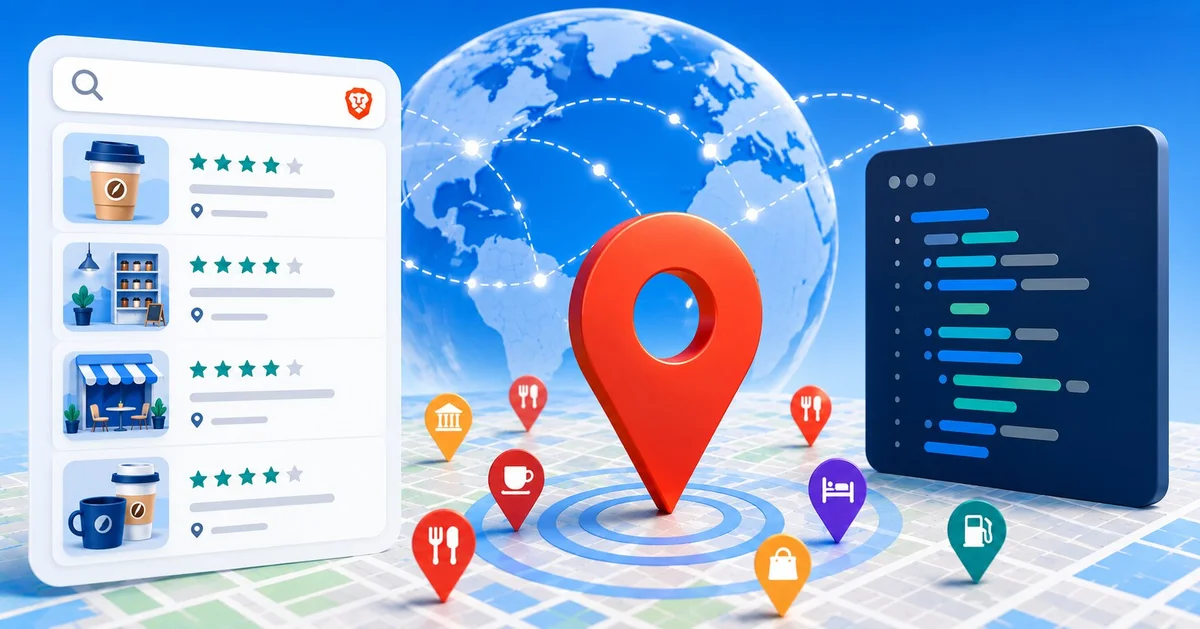
Brave API Undercuts Google Maps Pricing

Brave's Place Search API offers a Google Maps alternative at $5 per 1,000 requests, undercutting Google by 6-7x while maintaining quality and an independent index.

A comparison chart showing Brave Place Search API pricing vs. Google Maps API pricing, highlighting the significant cost difference.
Brave's Place Search API offers a 6-7x cost advantage over Google Maps.· Brave
Visual TL;DR
Google Maps PricingDriver
From the article 3 mentionsThis aggressive Brave Place Search API pricing contrasts sharply with Google Maps, which charges $32 to $35 per 1,000 requests for comparable services, making Brave 6 to 7 times cheaper.
Brave Place Search APICore
Brave launches enhanced Place Search API on July 8, 2026, publicly available
From the article 9 mentionsBrave has significantly enhanced its Place Search API, positioning it as a direct and substantially more affordable competitor to Google Maps.
Undercuts Google PricingEffect
From the articleThis aggressive Brave Place Search API pricing contrasts sharply with Google Maps, which charges $32 to $35 per 1,000 requests for comparable services, making Brave 6 to 7 times cheaper.
Comprehensive DataContext
single endpoint for 200 million global points of interest with rich attributes
From the article 5 mentionsUnlike Google, which often charges extra for additional data fields, Brave includes all these attributes within its flat $5 per 1,000 request fee.
No Extra ChargesEffect
From the article 2 mentionsUnlike Google, which often charges extra for additional data fields, Brave includes all these attributes within its flat $5 per 1,000 request fee.
Monthly CreditEffect
From the article 2 mentionsEach Brave plan also includes a $5 monthly credit.
Cost-Efficient AlternativeOutcome
Brave positions itself as a significantly more affordable competitor to Google Maps
Contents(3)

Brave has significantly enhanced its Place Search API, positioning it as a direct and substantially more affordable competitor to Google Maps. The improved API, launched on July 8, 2026, is now publicly available on the Brave Search API's Search plan, featuring a flat rate of $5 per 1,000 requests.

StartupHub data

Companies working on this

Profiles of the companies named in this story, with funding and a one-liner from our database.

Google
$9.1B
Global technology leader in search, advertising, cloud, AI, and consumer electronics.
Brave
$980M
A privacy-focused browser and search engine that blocks ads and trackers, rewarding users with cryptocurrency.

This aggressive Brave Place Search API pricing contrasts sharply with Google Maps, which charges $32 to $35 per 1,000 requests for comparable services, making Brave 6 to 7 times cheaper. Each Brave plan also includes a $5 monthly credit.

API Capabilities and Cost Efficiency

The Brave Place Search API provides a single endpoint for accessing approximately 200 million points of interest globally. It returns ranked results with essential attributes like name, URL, coordinates, full address, ratings, review counts, price range, categories, opening hours, phone, email, timezone, photos, and distance from the search center.

Unlike Google, which often charges extra for additional data fields, Brave includes all these attributes within its flat $5 per 1,000 request fee. This unified pricing model simplifies cost prediction for developers.

The API powers the Brave Search map, which handles over 2.2 billion queries monthly. It supports various use cases, from "near me" discovery and travel guides to business directories and AI agent data.

Performance and Independence

While Google Maps is a more mature product, Brave's internal testing suggests its Place Search API offers comparable quality. A comparison of 1,000 real, global, and multilingual queries showed Brave achieving a 6.4 out of 10 overall quality score against Google's 7.3. Brave demonstrated superior recall (7.2 vs. 6.8) and better handling of ambiguous names and specific street queries.

Brave's API is built on one of only three independent, global-scale search indexes in the Western world not owned by Big Tech. This independence eliminates the risks associated with scraping Google's data, such as service throttling or discontinuation. It also ensures Zero Data Retention, meaning queries are not stored, logged, or tied to user identities, and there are no conflicts of interest regarding model training.

For developers leveraging AI, the API provides structured, current place data crucial for grounding frontier models. This is available on the same Search plan as Brave's LLM Context API, offering a unified subscription for web and world knowledge.

© 2026 StartupHub.ai. All rights reserved. You may not republish this article in full without a license. Search engines and AI research tools may crawl and summarize for reference. Bulk reproduction or model training requires a license. See our terms.
Daniel Singer

Written by

Daniel Singer

Editor, StartupHub.ai

Daniel Singer is the editor of StartupHub.ai, a technology expert and thought leader on AI and its applications across sectors, from fintech and healthcare to developer tooling and consumer software. He writes and tests the tools covered here thoroughly and regularly, and built StartupHub.ai to give founders, operators and buyers a clearer read on what they are actually being sold.

More from Daniel Singer