

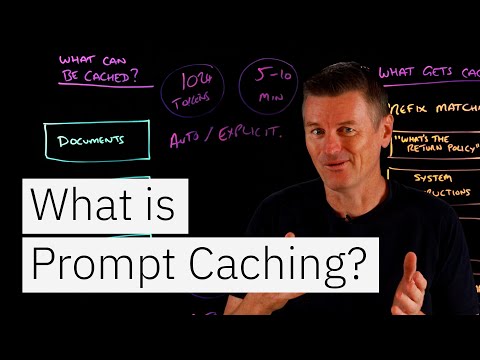
Prompt Caching: Turbocharging AI Transformers

Prompt caching dramatically reduces LLM latency and costs by storing and reusing intermediate computations, making AI transformers faster for applications like chatbots.

Prompt Caching: Turbocharging AI Transformers
Key Takeaways
  • 1
    Prompt caching stores repeated computations in LLMs to reduce latency and costs.

  • 2
    This technique optimizes transformer-based AI models for faster responses.

  • 3
    It's crucial for applications requiring real-time AI interactions, like chatbots.
Contents(5)

Large Language Models (LLMs) are the engine behind much of today's generative AI, but their computational demands can lead to frustratingly slow response times. A new technique, known as prompt caching, is emerging as a critical method to address this latency issue, making AI transformers more efficient and cost-effective. This approach, detailed in resources from IBM, offers a tangible solution for optimizing AI performance.

Understanding Prompt Caching

At its core, prompt caching is a strategy to avoid redundant calculations within LLMs. When an AI model processes a prompt, it performs a series of complex computations, especially within its transformer architecture. If the same or a very similar prompt is encountered again, re-computing the entire sequence is inefficient.

Prompt caching works by storing the results of these computations. It essentially creates a lookup table, or cache, where previously computed intermediate states or final outputs associated with specific input prompts are saved. When a familiar prompt arrives, the system can retrieve the cached result instead of running the full inference process.

Prompt Caching: Turbocharging AI Transformers - Video
YouTube Video

How It Optimizes Transformers

Transformer models, the backbone of modern LLMs, rely on attention mechanisms that involve extensive matrix multiplications. These operations are computationally intensive. Prompt caching targets these bottlenecks by saving the key-value pairs generated during the attention calculation for specific prompt segments.

By reusing these cached key-value pairs, the model significantly speeds up the processing of subsequent, identical, or similar token sequences within a prompt. This is particularly effective for conversational AI where users might repeat phrases or ask follow-up questions that share common contextual elements.

Reducing Latency and Costs

The primary benefit of prompt caching is a dramatic reduction in latency. Faster responses mean a more fluid and engaging user experience, which is critical for real-time applications. Chatbots that can answer questions instantly, or summarization tools that deliver results in seconds, are direct beneficiaries.

Beyond speed, prompt caching also translates to lower operational costs. LLM inference requires substantial computing power. By reducing the number of computations performed, organizations can decrease their cloud computing bills and make AI deployments more economically viable. This efficiency gain is crucial as AI adoption scales across industries.

Applications and Impact

The impact of prompt caching extends across various AI-powered applications. For chatbots and virtual assistants, it ensures immediate and natural interactions, mimicking human conversation speed. In content generation and summarization tools, it allows for quicker turnaround times, enhancing productivity.

Furthermore, prompt caching can improve the performance of AI systems used in code generation, data analysis, and complex question-answering systems. Any application that relies on the rapid processing of text by LLMs stands to benefit from this optimization technique.

The Future of Efficient AI

As LLMs continue to grow in complexity and capability, techniques like prompt caching will become indispensable. They represent a pragmatic approach to managing the performance and cost challenges inherent in deploying advanced AI models at scale. The ongoing development in AI efficiency, including innovations in prompt engineering and model architecture, promises even faster and more accessible AI in the near future.

© 2026 StartupHub.ai. All rights reserved. You may not republish this article in full without a license. Search engines and AI research tools may crawl and summarize for reference. Bulk reproduction or model training requires a license. See our terms.
Daniel Singer

Written by

Daniel Singer

Editor, StartupHub.ai

Daniel Singer is the editor of StartupHub.ai, a technology expert and thought leader on AI and its applications across sectors, from fintech and healthcare to developer tooling and consumer software. He writes and tests the tools covered here thoroughly and regularly, and built StartupHub.ai to give founders, operators and buyers a clearer read on what they are actually being sold.