CAG vs. Long Context: AI's Memory Explained

IBM's Martin Keen explains how AI models use Long Context and Cache Augmented Generation (CAG) to process information, highlighting the trade-offs and efficiency gains of each approach.

8 min read
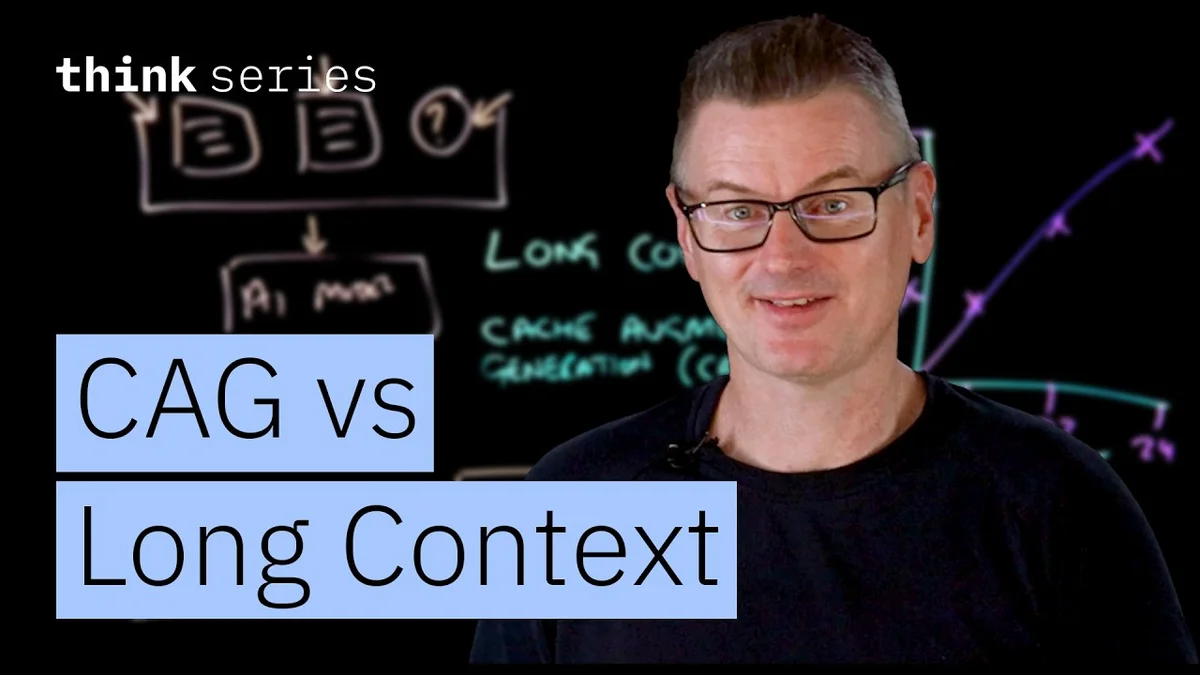
Martin Keen from IBM explaining "Long Context" versus "Cache Augmented Generation (CAG)" with diagrams on a black background.
Martin Keen, Master Inventor at IBM, illustrates the concepts of Long Context and Cache Augmented Generation (CAG) for AI models.· IBM

Martin Keen, a Master Inventor at IBM, breaks down two fundamental approaches to how AI models access and remember information: Long Context and Cache Augmented Generation (CAG). In this insightful video, Keen illustrates the distinct mechanisms and trade-offs of each method, offering a clear understanding of how AI models can effectively process and recall information from extended data sources.

Visual TL;DR. AI Needs Memory uses Long Context. AI Needs Memory uses Cache Augmented Gen (CAG). Long Context leads to Lost in Middle. Cache Augmented Gen (CAG) offers CAG Efficiency. Lost in Middle hinders AI Processes Info. Cache Augmented Gen (CAG) enables AI Processes Info.

  1. AI Needs Memory: LLMs inherently rely on their training data for knowledge
  2. Long Context: feeding the model large amounts of information directly in prompt
  3. Lost in Middle: significant challenge with long context, information gets overlooked
  4. Cache Augmented Gen (CAG): relevant information retrieved and then provided to the model
  5. CAG Efficiency: more sophisticated process with better efficiency and scalability
  6. AI Processes Info: enables AI models to effectively process and recall information
Visual TL;DR
Visual TL;DR — startuphub.ai AI Needs Memory uses Long Context. AI Needs Memory uses Cache Augmented Gen (CAG). Long Context leads to Lost in Middle. Lost in Middle hinders AI Processes Info. Cache Augmented Gen (CAG) enables AI Processes Info uses uses leads to hinders enables AI Needs Memory Long Context Lost in Middle Cache Augmented Gen (CAG) AI Processes Info From startuphub.ai · The publishers behind this format
Visual TL;DR — startuphub.ai AI Needs Memory uses Long Context. AI Needs Memory uses Cache Augmented Gen (CAG). Long Context leads to Lost in Middle. Lost in Middle hinders AI Processes Info. Cache Augmented Gen (CAG) enables AI Processes Info uses uses leads to hinders enables AI Needs Memory Long Context Lost in Middle Cache AugmentedGen (CAG) AI Processes Info From startuphub.ai · The publishers behind this format
Visual TL;DR — startuphub.ai AI Needs Memory uses Long Context. AI Needs Memory uses Cache Augmented Gen (CAG). Long Context leads to Lost in Middle. Lost in Middle hinders AI Processes Info. Cache Augmented Gen (CAG) enables AI Processes Info uses uses leads to hinders enables AI Needs Memory LLMs inherently rely on their trainingdata for knowledge Long Context feeding the model large amounts ofinformation directly in prompt Lost in Middle significant challenge with long context,information gets overlooked Cache Augmented Gen (CAG) relevant information retrieved and thenprovided to the model AI Processes Info enables AI models to effectively processand recall information From startuphub.ai · The publishers behind this format
Visual TL;DR — startuphub.ai AI Needs Memory uses Long Context. AI Needs Memory uses Cache Augmented Gen (CAG). Long Context leads to Lost in Middle. Lost in Middle hinders AI Processes Info. Cache Augmented Gen (CAG) enables AI Processes Info uses uses leads to hinders enables AI Needs Memory LLMs inherentlyrely on theirtraining data for… Long Context feeding the modellarge amounts ofinformation… Lost in Middle significantchallenge with longcontext,… Cache AugmentedGen (CAG) relevantinformationretrieved and then… AI Processes Info enables AI modelsto effectivelyprocess and recall… From startuphub.ai · The publishers behind this format
Visual TL;DR — startuphub.ai AI Needs Memory uses Long Context. AI Needs Memory uses Cache Augmented Gen (CAG). Long Context leads to Lost in Middle. Cache Augmented Gen (CAG) offers CAG Efficiency. Lost in Middle hinders AI Processes Info. Cache Augmented Gen (CAG) enables AI Processes Info uses uses leads to offers hinders enables AI Needs Memory LLMs inherently rely on their trainingdata for knowledge Long Context feeding the model large amounts ofinformation directly in prompt Lost in Middle significant challenge with long context,information gets overlooked Cache Augmented Gen (CAG) relevant information retrieved and thenprovided to the model CAG Efficiency more sophisticated process with betterefficiency and scalability AI Processes Info enables AI models to effectively processand recall information From startuphub.ai · The publishers behind this format
Visual TL;DR — startuphub.ai AI Needs Memory uses Long Context. AI Needs Memory uses Cache Augmented Gen (CAG). Long Context leads to Lost in Middle. Cache Augmented Gen (CAG) offers CAG Efficiency. Lost in Middle hinders AI Processes Info. Cache Augmented Gen (CAG) enables AI Processes Info uses uses leads to offers hinders enables AI Needs Memory LLMs inherentlyrely on theirtraining data for… Long Context feeding the modellarge amounts ofinformation… Lost in Middle significantchallenge with longcontext,… Cache AugmentedGen (CAG) relevantinformationretrieved and then… CAG Efficiency more sophisticatedprocess with betterefficiency and… AI Processes Info enables AI modelsto effectivelyprocess and recall… From startuphub.ai · The publishers behind this format

Understanding Long Context and CAG

Keen begins by explaining that LLMs inherently rely on their training data. However, to utilize external knowledge, they employ two main strategies. The first, Long Context, involves feeding the model a large amount of information directly within its input prompt. The second, Cache Augmented Generation (CAG), involves a more sophisticated process where relevant information is retrieved and then provided to the model.

Related startups

The "Lost in the Middle" Problem with Long Context

Keen highlights a significant challenge with the long context approach: the "lost in the middle" phenomenon. He explains that when an LLM processes a very long context window, its ability to accurately recall information from the middle of that context can degrade. The model tends to remember information presented at the beginning and end of the prompt more effectively than information buried in the middle. This is visualized on a graph where context size increases over time, showing a dip in recall accuracy for the middle sections of very large contexts.
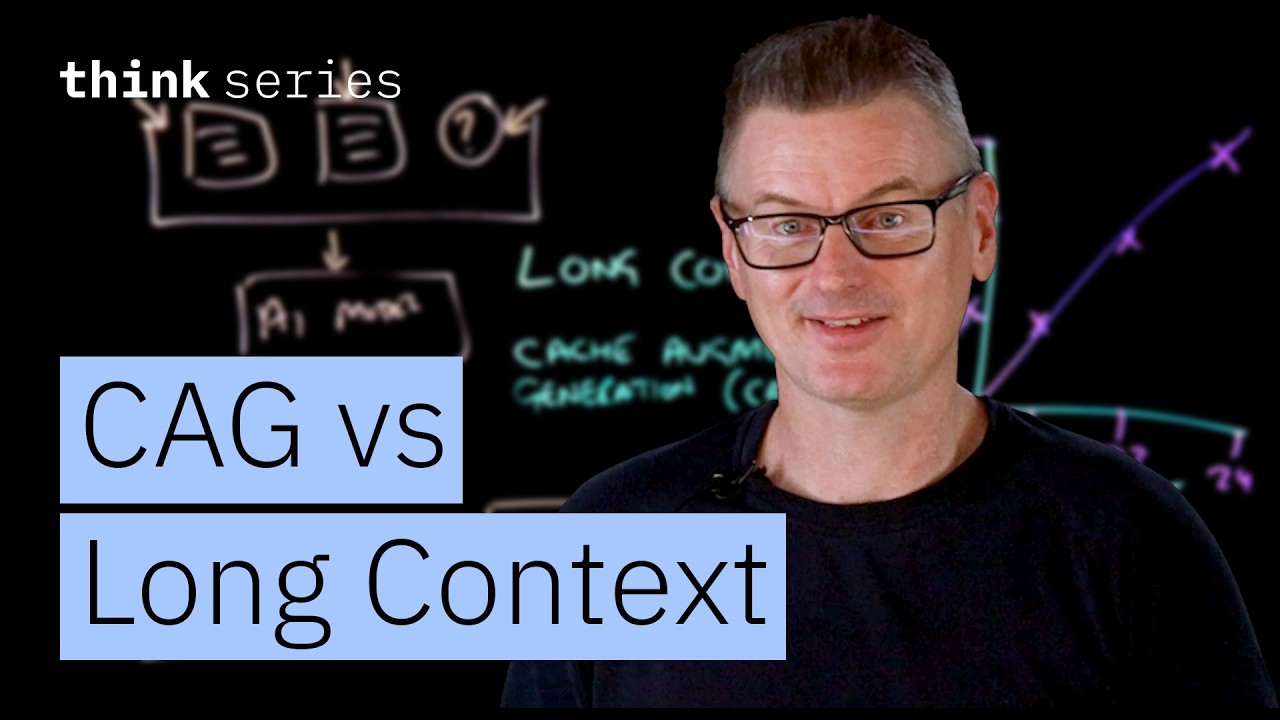
The full discussion can be found on IBM's YouTube channel.

CAG vs Long Context: How AI Models Use and Remember Information - IBM
CAG vs Long Context: How AI Models Use and Remember Information — from IBM

How Cache Augmented Generation (CAG) Works

In contrast, Keen introduces CAG as a more refined method. This approach involves three key phases:

  • Knowledge Preparation: Relevant documents are first processed and formatted to fit the model's context window.
  • Pre-computation: The model then computes and stores the internal representation, or KV cache, of this prepared knowledge.
  • Inference: When a query is made, the pre-computed KV cache is used, allowing the model to quickly access and process the information without needing to re-read the entire document set for every query.

This pre-computation and caching mechanism significantly speeds up the inference process, especially for repeated queries that leverage the same knowledge base. Keen notes that this can lead to substantial performance gains, potentially a 10x to 40x speedup compared to processing the entire context from scratch for every request.

The Efficiency and Scalability of CAG

Keen emphasizes that while the long context window method is simpler to implement, it comes with inherent limitations, particularly regarding computational cost and the "lost in the middle" issue. CAG, by contrast, offers a more scalable and efficient solution. By pre-processing and caching information, CAG ensures that relevant data is readily available and consistently accessible to the LLM, leading to more reliable and faster responses, especially when dealing with frequently accessed or dynamic information sources.

Key Differences Summarized

The video summarizes the core differences: Long Context involves processing every document on every query, which is simple but can be inefficient and suffer from recall issues. CAG, on the other hand, processes all documents once during pre-computation and then efficiently retrieves cached information for subsequent queries, making it faster and more reliable for repeated requests or stable knowledge bases. The concept of "prompt caching" is central to CAG's efficiency, allowing developers to integrate this powerful capability into their AI applications without complex infrastructure management.

© 2026 StartupHub.ai. All rights reserved. Do not enter, scrape, copy, reproduce, or republish this article in whole or in part. Use as input to AI training, fine-tuning, retrieval-augmented generation, or any machine-learning system is prohibited without written license. Substantially-similar derivative works will be pursued to the fullest extent of applicable copyright, database, and computer-misuse laws. See our terms.