

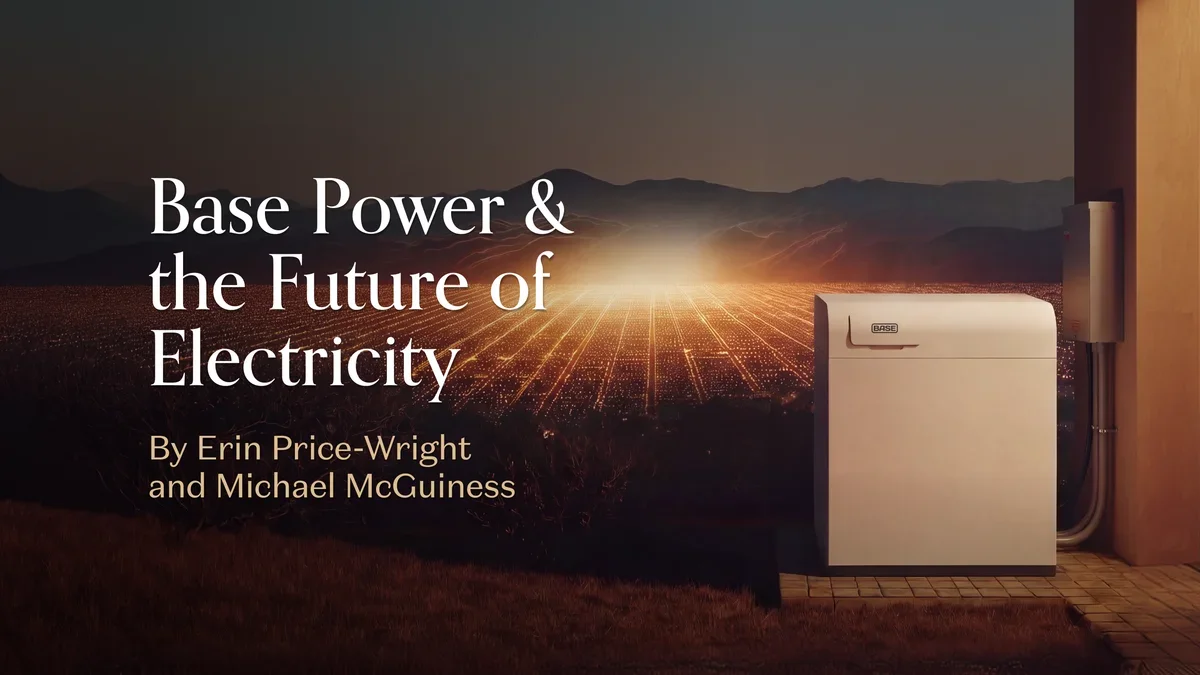
Base Power Tackles Grid's Cost Problem

Base Power is deploying distributed battery storage to fix a grid hampered by rising delivery costs and renewable intermittency.

9 min read
Zach Dell and Justin Lopas, co-founders of Base Power.
a16z Blog

Visual TL;DR. Grid delivery costs surge drives Base Power founded. Renewable intermittency issues also drives Base Power founded. Cheaper generation costs paradox with Grid delivery costs surge. Base Power founded deploys Distributed battery storage. Distributed battery storage enables Modernize grid. Modernize grid leads to Lower consumer power costs.

  1. Grid delivery costs surge: delivery costs for electricity have surged despite cheaper generation
  2. Renewable intermittency issues: intermittency of solar and wind power challenges grid stability
  3. Base Power founded: Zach Dell and Justin Lopas founded Base Power to modernize the grid
  4. Distributed battery storage: deploying distributed battery storage to fix grid cost and intermittency
  5. Cheaper generation costs: solar and wind generation costs have plummeted over the last decade
  6. Modernize grid: rethinking energy storage and delivery to modernize the existing grid
  7. Lower consumer power costs: aiming to translate generation savings into cheaper power for consumers
Visual TL;DR
Visual TL;DR, startuphub.ai Grid delivery costs surge drives Base Power founded. Base Power founded deploys Distributed battery storage. Distributed battery storage enables Modernize grid drives deploys enables Grid delivery costs surge Base Power founded Distributed battery storage Modernize grid From startuphub.ai · The publishers behind this format
Visual TL;DR, startuphub.ai Grid delivery costs surge drives Base Power founded. Base Power founded deploys Distributed battery storage. Distributed battery storage enables Modernize grid drives deploys enables Grid deliverycosts surge Base Powerfounded Distributedbattery storage Modernize grid From startuphub.ai · The publishers behind this format
Visual TL;DR, startuphub.ai Grid delivery costs surge drives Base Power founded. Base Power founded deploys Distributed battery storage. Distributed battery storage enables Modernize grid drives deploys enables Grid delivery costs surge delivery costs for electricity have surgeddespite cheaper generation Base Power founded Zach Dell and Justin Lopas founded BasePower to modernize the grid Distributed battery storage deploying distributed battery storage tofix grid cost and intermittency Modernize grid rethinking energy storage and delivery tomodernize the existing grid From startuphub.ai · The publishers behind this format
Visual TL;DR, startuphub.ai Grid delivery costs surge drives Base Power founded. Base Power founded deploys Distributed battery storage. Distributed battery storage enables Modernize grid drives deploys enables Grid deliverycosts surge delivery costs forelectricity havesurged despite… Base Powerfounded Zach Dell andJustin Lopasfounded Base Power… Distributedbattery storage deployingdistributed batterystorage to fix grid… Modernize grid rethinking energystorage anddelivery to… From startuphub.ai · The publishers behind this format
Visual TL;DR, startuphub.ai Grid delivery costs surge drives Base Power founded. Renewable intermittency issues also drives Base Power founded. Cheaper generation costs paradox with Grid delivery costs surge. Base Power founded deploys Distributed battery storage. Distributed battery storage enables Modernize grid. Modernize grid leads to Lower consumer power costs drives also drives paradox with deploys enables leads to Grid delivery costs surge delivery costs for electricity have surgeddespite cheaper generation Renewable intermittency issues intermittency of solar and wind powerchallenges grid stability Base Power founded Zach Dell and Justin Lopas founded BasePower to modernize the grid Distributed battery storage deploying distributed battery storage tofix grid cost and intermittency Cheaper generation costs solar and wind generation costs haveplummeted over the last decade Modernize grid rethinking energy storage and delivery tomodernize the existing grid Lower consumer power costs aiming to translate generation savingsinto cheaper power for consumers From startuphub.ai · The publishers behind this format
Visual TL;DR, startuphub.ai Grid delivery costs surge drives Base Power founded. Renewable intermittency issues also drives Base Power founded. Cheaper generation costs paradox with Grid delivery costs surge. Base Power founded deploys Distributed battery storage. Distributed battery storage enables Modernize grid. Modernize grid leads to Lower consumer power costs drives also drives paradox with deploys enables leads to Grid deliverycosts surge delivery costs forelectricity havesurged despite… Renewableintermittency… intermittency ofsolar and windpower challenges… Base Powerfounded Zach Dell andJustin Lopasfounded Base Power… Distributedbattery storage deployingdistributed batterystorage to fix grid… Cheapergeneration costs solar and windgeneration costshave plummeted over… Modernize grid rethinking energystorage anddelivery to… Lower consumerpower costs aiming to translategeneration savingsinto cheaper power… From startuphub.ai · The publishers behind this format

The U.S. electrical grid, a marvel of 20th-century engineering, is struggling to keep pace with the demands of the 21st. While the cost of generating electricity has plummeted thanks to cheap solar and wind power, the expense of delivering it has surged. This paradox is the central problem Base Power, a startup founded by Zach Dell and Justin Lopas, aims to solve. Their ambitious mission is to modernize the grid by fundamentally rethinking energy storage and delivery, as detailed in a recent a16z Blog post.

Dell, who previously studied the utility-scale battery market at Blackstone, recognized early on that the marginal cost of solar plus storage was set to undercut traditional fossil fuels. His observation proved prescient: solar is now the fastest-growing electricity source globally, and lithium-ion battery prices have dropped over 90% since 2010. Yet, this cost reduction in generation hasn't translated to cheaper power for consumers. American utilities now invest more in transmission infrastructure, wires, poles, and substations, than in generation plants. In 2025 alone, electricity prices rose more than twice the rate of inflation.

A Grid Built for a Different Era

The core issue lies in the grid's inherent design. Developed in an era of centralized, dispatchable power plants like coal and natural gas, it was built to move electricity through space from power stations to consumers. Nikola Tesla's development of alternating current (AC) enabled this long-distance transmission, allowing massive power plants to serve entire regions. However, the grid was never designed for significant energy storage or for handling the real-time fluctuations inherent in renewable energy sources.

This real-time dependency means supply must instantaneously match demand. Too little power causes frequency drops leading to blackouts; too much can overload the system. For decades, the ability of coal and gas plants to ramp up and down quickly masked this flaw. But the energy landscape is shifting dramatically. Renewables like solar and wind are increasingly volatile, while demand is skyrocketing due to the electrification of transportation, massive data centers powering AI, and resurgent manufacturing. U.S. electricity demand is projected to grow at 5.7% annually from 2025 to 2030, a rate six times faster than in recent years. This creates a critical bottleneck, turning energy into a national security concern.

Base Power's Decentralized Solution

Dell and Lopas, who met at defense startup Anduril (StartupHub score 61/100), saw an opportunity to apply lessons from aerospace and defense innovation to the energy sector. Their central insight is that batteries can perform a function similar to transmission lines: moving power from where it's less valuable to where it's more valuable. Transmission moves power through space; batteries move it through time, storing cheap solar energy from midday for use during peak evening demand.

Traditional utility-scale battery farms face two major hurdles. First, the interconnection queue, the waiting list for projects seeking grid connection, has ballooned. Projects that once took under two years now take nearly five, with over 2,600 gigawatts of generation and storage capacity awaiting approval, more than double the grid's existing capacity. Second, even when projects clear the queue, they often face transmission congestion, meaning their power can't efficiently reach demand centers. Base Power's approach circumvents these issues by distributing thousands of small battery units directly into homes. Since homes are already connected to the grid, they bypass the interconnection queue. Installing batteries at the point of consumption also eliminates the need for new, large-scale transmission infrastructure and reduces grid load by allowing homes to draw from their local battery rather than the crowded main grid.

The primary challenge for this distributed model is economies of scale. While utility-scale farms have singular sites and construction, a fleet spread across thousands of homes presents thousands of individual points for installation and connection. Base Power believes it has developed a way to overcome this cost barrier. The company has attracted significant talent, including an engineer from Starlink's laser mesh network and a Tesla veteran involved with the original Powerwall. Investors have placed substantial bets on their vision, recognizing the immense market opportunity.

Challenging the Incumbent Model

The energy sector, much like defense contracting, is often characterized by regulated monopolies that operate on a cost-plus model. Utilities are guaranteed a return on investment, creating little incentive to adopt cost-saving innovations. This "incentive to build but not innovate" has led to record rate increases and stagnating grid modernization. Base Power's model, by contrast, thrives on efficiency and cost reduction.

Texas, with its deregulated energy market (ERCOT), serves as a prime testbed for Base Power's strategy. The state's unbundling of generation, transmission, and retail operations into competitive segments has fostered innovation, making it a leader in wind and solar deployment. By proving its distributed storage model in Texas, Base Power could set a precedent for a more dynamic and cost-effective energy future across the nation.

StartupHub.ai data indicates that Base Power currently has a StartupHub score of 54/100. This places it in a competitive bracket alongside other emerging players in defense and infrastructure-adjacent technology, such as Helsing (55/100) and Arondite (53/100). For comparison, established defense giants like Northrop Grumman score higher at 68/100, while market leader Palantir Technologies holds a score of 85/100. This suggests Base Power is navigating a challenging but potentially high-reward sector.

© 2026 StartupHub.ai. All rights reserved. Do not enter, scrape, copy, reproduce, or republish this article in whole or in part. Use as input to AI training, fine-tuning, retrieval-augmented generation, or any machine-learning system is prohibited without written license. Substantially-similar derivative works will be pursued to the fullest extent of applicable copyright, database, and computer-misuse laws. See our terms.