


Content Syndication Tool: Publish Once to 30+ Platforms Without Losing SEO

StartupHub.ai's Article Distribution offers an SEO-safe, AI-powered solution for automating long-form content syndication across diverse platforms.

7 min read
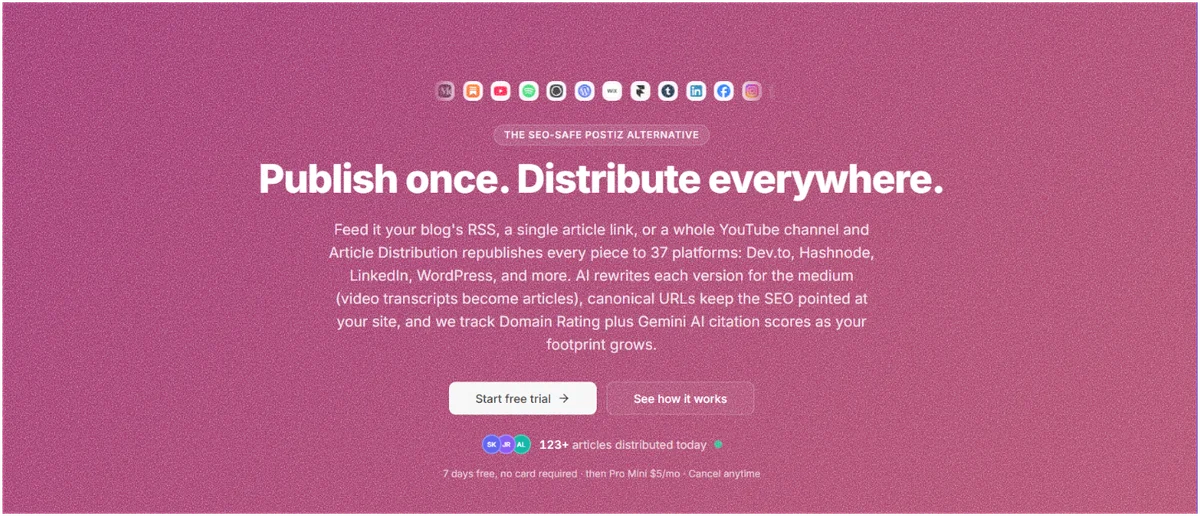
StartupHub.ai logo with 'Article Distribution' text, symbolizing automated content syndication
StartupHub.ai's new 'Article Distribution' feature streamlines content syndication for creators.
Key Takeaways
  • 1
    StartupHub.ai's Article Distribution automates content syndication across 30+ platforms, adapting content for SEO safety.

  • 2
    The platform ingests content from RSS, YouTube, or direct entry, then rewrites it using AI for platform-specific optimization.

  • 3
    It features advanced controls for AI rewrite styles, interlinking strategies, multilingual translation, and specialized LinkedIn publishing.

  • 4
    Analytics track traditional search rank, backlink generation, and AI assistant citations (GEO Score).
Contents(8)

Content creators face a dilemma: high-quality long-form content demands significant effort, yet distributing it across diverse platforms often takes just as long. Traditional methods risk duplicate content penalties. StartupHub.ai addresses this with Article Distribution, an automated content syndication engine designed for SEO-safe, long-form distribution.

This tool, an alternative to social media schedulers, ingests content, adapts it via AI for each platform, and sets canonical tags. It monitors both search rank and AI assistant citations.

Flexible Content Ingestion

Article Distribution offers three ingestion channels. RSS Feed Monitoring allows users to input any standard RSS or Atom feed, with options for historical lookback or real-time publishing. A YouTube Transcript Engine pulls video transcripts and converts them into structured blog posts as new videos are released. For single pieces, users can paste a URL for auto-extraction or directly enter text.

Platform Matrix and Integration Mechanics

The system supports over 30 destinations across categories like Tech & Developer, CMS & Blogs, Closed Platforms, Social & Video, and Search & Doc Assets. Integration methods vary by platform API availability. OAuth/API keys facilitate standard integrations for open platforms like Dev.to and WordPress. For platforms without public APIs, such as Medium or Substack, a local Chrome Browser Agent publishes cloud-queued drafts in the background. A Multimedia Conversion Engine also transforms articles into visualizer videos for YouTube or audio posts for Spotify.

Advanced Syndication and AI Settings

Users maintain granular control over AI rewriting and publishing. They can select between Gemini 2.5 Flash-Lite for speed or Gemini 2.5 Flash for complex content. Writing styles range from Brief and Professional to Elaborate, with an option for branded keyword targeting. For an SEO content strategy AI, users define syndication goals: 'Both' for balanced reach with a single backlink, 'SEO' for full interlinking to build cross-domain link equity, or 'Distribution' to strip body links, leaving only canonical tags.

Multilingual auto-translation publishes articles in the source language plus up to three target languages. Blog and document platforms receive native translated rewrites for regional search engine ranking. Google Search Console data informs language recommendations based on uncaptured search impressions.

Publishing safeguards include a review window for AI rewrites and per-wire rate limits to prevent over-publishing.

Multi-Format LinkedIn Publishing Engine

LinkedIn publishing receives specialized attention, offering multiple formats beyond standard text posts. Users can auto-rotate between text posts, rendered vertical videos with AI narration and subtitles, multipage PDF document carousels, or animated GIFs. These options leverage LinkedIn's algorithm preferences.

Article to Video: Automated YouTube and Instagram Distribution

Publishing a blog post as text is one distribution event. Publishing the same post as a narrated video adds a second discovery surface: YouTube search, which Google indexes separately from web results. A well-optimized video version of your article can rank for the same query on two different Google properties simultaneously.

Article Distribution automates this with its Multimedia Conversion Engine. When you connect an RSS feed, each new article triggers a text distribution run and, optionally, a video render. The engine reads your article, generates a narration script, and produces a Ken-Burns style video with synchronized text overlays and AI narration. The 16:9 cut publishes to YouTube; the 9:16 cut publishes to Instagram Reels. Titles, descriptions, and tags are platform-adapted automatically.

This addresses a genuine gap in the content tool landscape. StartupHub.ai data shows that of the major social media management platforms we track, none (including Buffer at score 54, Hootsuite at score 56, and Postiz at score 37) offer automated article-to-video conversion as part of a distribution workflow. The video wire is unique to purpose-built article distribution tools.

For bloggers and content-first startups, this means one RSS feed drives text syndication across 30 or more platforms and video publication to YouTube and Instagram, all from the same trigger and the same Article Distribution workflow.

Analytics, SEO Tracking, and GEO Performance

The Analytics tab tracks cross-platform metrics, including views, likes, comments, and shares, highlighting top-performing content. It also monitors Domain Rating (DR) deltas and backlinks generated through syndication. Crucially, the system includes Generative Engine Optimization (GEO) tracking, which measures how often generative AI assistants like ChatGPT and Gemini cite your domain and articles in search results, providing a clear metric for AI visibility alongside traditional Google indexing. This is a critical development in the evolving search landscape, particularly given recent industry shifts like Adobe's acquisition of Semrush.

Article Distribution offers scalable plan tiers based on daily publishing allowances, all including unlimited wires, custom domain support, and up to three translation languages. Whether you are a solo blogger or an agency managing dozens of clients, our Article Distribution tool handles the full publish-once-distribute-everywhere workflow automatically.

SEO-Safe Cross-Posting: Canonical Tags and Why Generic Tools Miss Them

Every republished article carries a risk: if the destination platform indexes a copy of your text without proper attribution, Google splits link equity between the original and the copy and sometimes demotes both. The solution is a canonical tag, a single HTML directive placed in the head of the republished page that tells Google exactly which URL is the authoritative version.

StartupHub.ai data shows that among the content scheduling platforms we track, including Buffer (score 54), Hootsuite (score 56), and Postiz (score 37), none include canonical-tag injection for republished long-form articles. This is a structural gap, not a missing checkbox: social schedulers are built around link-sharing, not full-text republication to indexable blogging platforms. Canonical tags only matter when a full copy of your text lives on another domain, so tools that never post the full text never need the feature.

Article Distribution is built specifically for full-text republication. Every destination in the 30-plus platform matrix that supports canonical links, including Dev.to, Hashnode, Ghost, and WordPress, receives the correct canonical URL automatically. The platform logs confirmation for each wire so you have a permanent record of compliant syndication. For closed platforms like Medium and Substack, which do not expose their canonical-tag field via public API, the local browser agent verifies the tag is set before the article goes live.

The result: publish once to 30+ platforms knowing every copy points back to your original domain and strengthens rather than cannibalizes your search presence. Set up our Article Distribution tool once and every future article distributes automatically with full canonical hygiene intact.

Frequently Asked Questions

What is an article distribution tool?

An article distribution tool automatically republishes your content to multiple platforms after you write and publish once. Quality tools apply canonical tags to each republished copy so search engines credit the original source, eliminating duplicate-content penalties while multiplying reach.

How do I avoid duplicate content when syndicating articles?

The safest method is canonical tagging: every syndicated copy carries a rel="canonical" link pointing back to your original URL. A purpose-built content syndication tool handles this automatically for every destination platform that supports it, so you never split your link equity by accident.

Which platforms can I distribute articles to automatically?

StartupHub's Article Distribution supports 30+ destinations including Dev.to, Medium, Substack, Hashnode, Ghost, WordPress, LinkedIn, and YouTube (as narrated Ken-Burns videos). Each platform receives a platform-adapted version of your article, not a straight copy.

Does content syndication hurt SEO?

Only if canonical tags are missing or misapplied. When every syndicated copy points back to your original URL via canonical, Google consolidates link equity to the source. The risk comes from tools that blast identical copies without proper canonical markup.

How is article distribution different from social media scheduling?

Social schedulers post snippets or links. Article distribution republishes the full piece, natively formatted, to long-form platforms like Medium, Hashnode, or Dev.to, building backlinks and domain authority across the web instead of just driving clicks from a social feed.

© 2026 StartupHub.ai. All rights reserved. You may not republish this article in full without a license. Search engines and AI research tools may crawl and summarize for reference. Bulk reproduction or model training requires a license. See our terms.