Varick Agents: AI for Enterprise Workflow Automation

Varick Agents founder Vasuman Moza explains how forward-deployed AI agents automate enterprise workflows without disruptive migrations.

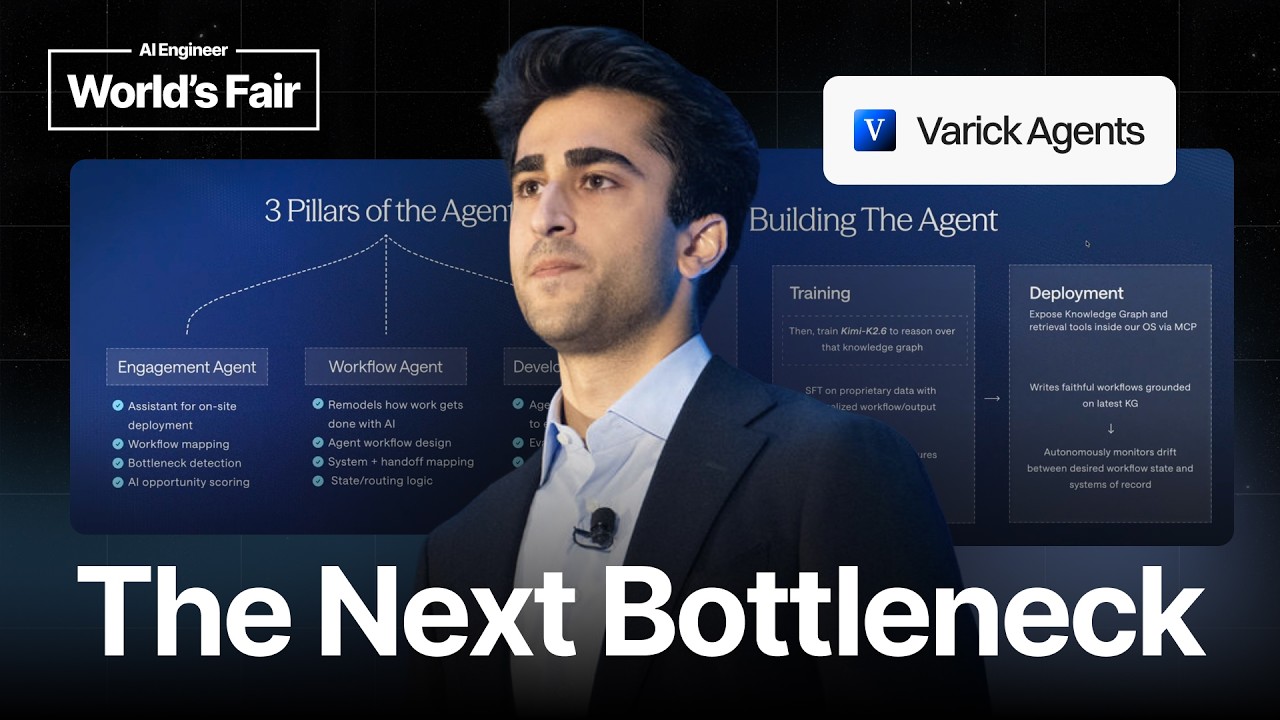
Vasuman Moza speaking at a conference about Varick Agents' AI solutions
AI Engineer
Visual TL;DR
Enterprise AI AdoptionDriver
high failure rate of AI projects, most never reaching production
From the article 5 mentionsThis targeted approach ensures that automation efforts are focused on areas with the highest potential impact, making the adoption of AI more efficient and effective for large organizations.
Disruptive MigrationsDriver
avoiding massive, expensive system overhauls like a $5M SAP migration
From the articleThis method eliminates the need for massive, expensive migrations, a significant hurdle for companies that have invested heavily, like one customer’s $5 million, five-year SAP migration.
Varick AgentsCore
From the article 9 mentionsVasuman Moza, founder of Varick Agents, addresses this critical bottleneck by proposing a novel approach: forward-deployed agents that work on top of existing infrastructure.
Automate WorkflowsEffect
automating complex, often undocumented enterprise processes as they are
From the article 4 mentionsVarick’s strategy is built around the constraint of avoiding further disruption, aiming to automate processes as they are, rather than forcing a system overhaul.
No System OverhaulOutcome
eliminates need for disruptive migrations, preserving legacy investments
From the article 3 mentionsVarick’s strategy is built around the constraint of avoiding further disruption, aiming to automate processes as they are, rather than forcing a system overhaul.
Context Problem SolvedContext
understanding customer's actual workflow instead of generic AI tools
ROI & ScalabilityOutcome
enabling successful AI adoption and measurable business value
From the articleBy automating these real-world processes end-to-end, Varick aims to deliver tangible ROI.
Contents(4)

Enterprises often face the daunting challenge of integrating new technologies without disrupting deeply entrenched legacy systems. Vasuman Moza, founder of Varick Agents, addresses this critical bottleneck by proposing a novel approach: forward-deployed agents that work on top of existing infrastructure. This method eliminates the need for massive, expensive migrations, a significant hurdle for companies that have invested heavily, like one customer’s $5 million, five-year SAP migration. Varick’s strategy is built around the constraint of avoiding further disruption, aiming to automate processes as they are, rather than forcing a system overhaul.

Varick Agents: AI for Enterprise Workflow Automation - AI Engineer
Varick Agents: AI for Enterprise Workflow Automation, from AI Engineer

The Challenge of enterprise AI adoption

A core problem Varick Agents tackles is the high failure rate of AI projects in enterprise settings, often cited as most projects never reaching production. Moza argues this stems from starting with generic AI tools instead of understanding the customer's actual, often complex and undocumented, workflows. Varick’s agents are designed to map how a department truly functions, including the intricacies of reconciliations between purchase orders and invoices, and the undocumented handoffs between teams. By automating these real-world processes end-to-end, Varick aims to deliver tangible ROI.

StartupHub data

SAP and Claude

Global leader in enterprise software, specializing in ERP, cloud solutions, and business intelligence.

Founded
2026
Location
Germany

Anthropic is an AI safety and research company that develops reliable, interpretable, and steerable AI systems, including the Claude family of large language...

Location
San Francisco, United States
Funding
$4.0B

Forward Deployed Engineers and Their Tools

Making a single forward-deployed engineer exceptionally productive requires specialized tooling. Varick builds a workflow specification from raw inputs like meeting notes and Slack threads. Engineers can then shape these workflows using large language models such as Claude or Codex. The process relies on a single source of truth, which can reside in a PostgreSQL database. This approach allows for rapid development and iteration, empowering a small team to tackle complex enterprise automation.

Solving the Context Problem with Post-Training

A significant hurdle for frontier AI models is navigating the complexity and ambiguity of enterprise data. Identifying that person A and person B in different systems refer to the same entity is a non-trivial task. Varick addresses this by post-training its own models. This fine-tuning process extracts the correct context and strips away redundancy, ensuring the agents operate with accurate information. Only after this crucial context extraction step do the agents run autonomously, performing their automated tasks reliably.

ROI and Scalability

The platform aims to deliver department-wide return on investment by identifying and addressing bottlenecks. Each engagement begins by pinpointing the most critical bottleneck, and the solution then grows outwards from that point. This targeted approach ensures that automation efforts are focused on areas with the highest potential impact, making the adoption of AI more efficient and effective for large organizations.

© 2026 StartupHub.ai. All rights reserved. You may not republish this article in full without a license. Search engines and AI research tools may crawl and summarize for reference. Bulk reproduction or model training requires a license. See our terms.
Daniel Singer

Written by

Daniel Singer

Editor, StartupHub.ai

Daniel Singer is the editor of StartupHub.ai, a technology expert and thought leader on AI and its applications across sectors, from fintech and healthcare to developer tooling and consumer software. He writes and tests the tools covered here thoroughly and regularly, and built StartupHub.ai to give founders, operators and buyers a clearer read on what they are actually being sold.

More from Daniel Singer