

Reed Hastings on AI and the Future of Education

Reed Hastings explains why individualized AI tutoring is the future of education and how we should prepare for an AI-driven economy.

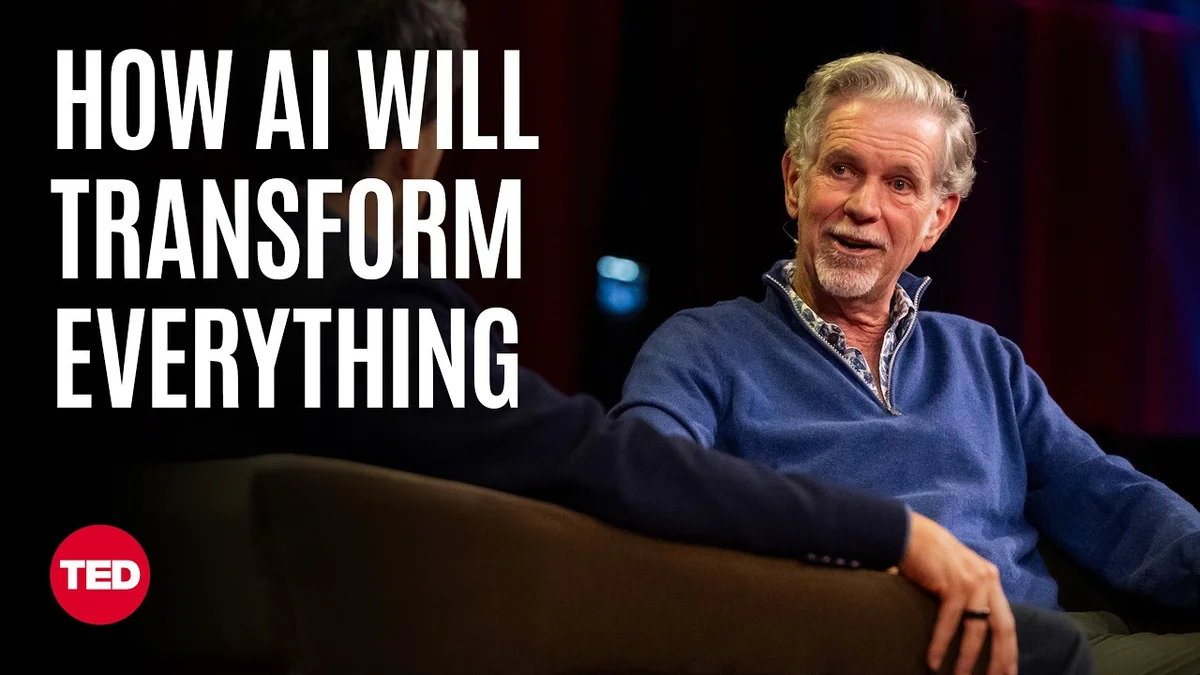
Reed Hastings in conversation at TED
Reed Hastings discussing the future of AI and education.· YouTube
Visual TL;DR
Current Education InefficientDriver
modern schooling's one-size-fits-all model is fundamentally inefficient, like old factories
From the article(NASDAQ:GOOGL)-supported Khan Academy and the AI safety-focused company Anthropic, argues that our current classroom structure is fundamentally inefficient.
Reed HastingsCore
board member at Khan Academy and AI safety company Anthropic, advocates change
From the article 8 mentionsIn a recent conversation at TED, Reed Hastings discussed the intersection of education and artificial intelligence, offering a candid look at the challenges inherent in modern schooling.
AI-Driven EconomyContext
prepare for future job markets by overhauling education for an AI-driven world
Students MismatchedDriver
one-third bored, one-third struggling, only one-third taught appropriately in K-12
From the article 3 mentionsHastings identified the primary friction in K-12 education as the practice of keeping 25 students at the same level.
Structural Shift NeededContext
From the articleMuch like the transition from steam power to electricity in 18th-century factories, which only yielded productivity gains after the power distribution system was overhauled, Hastings believes education requires a similar structural shift away from the one-size-fits-all model.
Individualized AI TutoringCore
AI-driven education is the future, adapting to each student's specific needs
From the article 2 mentionsDrawing on research from Benjamin Bloom, Hastings contends that individualized tutoring is the key to significantly better learning outcomes.
Future of EducationOutcome
AI will enable personalized learning, moving beyond the current classroom structure
From the article 4 mentionsBeyond education, Hastings addressed his role on the board of Anthropic.

In a recent conversation at TED, Reed Hastings discussed the intersection of education and artificial intelligence, offering a candid look at the challenges inherent in modern schooling. Hastings, a board member at both Alphabet Inc. (NASDAQ:GOOGL)-supported Khan Academy and the AI safety-focused company Anthropic, argues that our current classroom structure is fundamentally inefficient. Much like the transition from steam power to electricity in 18th-century factories, which only yielded productivity gains after the power distribution system was overhauled, Hastings believes education requires a similar structural shift away from the one-size-fits-all model.

The Case for Individualized Education

Hastings identified the primary friction in K-12 education as the practice of keeping 25 students at the same level. He noted that roughly one-third of students are bored, one-third are struggling, and only one-third are being taught at an appropriate level. Drawing on research from Benjamin Bloom, Hastings contends that individualized tutoring is the key to significantly better learning outcomes. While human tutoring is currently cost-prohibitive at roughly $100,000 per student per year, he expects AI to eventually bridge this gap.

"Current AI is not good enough to do that. But in three years, we have gone from ChatGPT 3.5 and barely being able to do high-school math to just incredible intelligence," Hastings said. He anticipates that AI will eventually match or exceed human tutors, allowing the role of the teacher to evolve from a traditional lecturer to a facilitator of social-emotional learning, values clarification, and interpersonal development.

Anthropic and the AI Portal

Beyond education, Hastings addressed his role on the board of Anthropic. He emphasized that the company is not focused on maximizing profits but on helping humanity navigate the transition into the age of AI. He highlighted the potential for AI to drive massive advancements in fields like autonomous driving, gene editing, and cancer research. While acknowledging the risks, he maintains that the infusion of AI into science will likely lead to abundant energy and better health outcomes.

Addressing concerns about job displacement, Hastings pointed to the historical precedent of technological shifts. He drew a parallel to the field of radiology, where experts once predicted AI would eliminate the need for radiologists. Instead, increased productivity and lower costs led to more scans and an even higher demand for radiologists. While acknowledging the uncertainty of the pace of development, he suggested that if AI leads to high productivity and GDP growth, governments should consider structures similar to the Alaska or Norwegian sovereign wealth funds to share the economic rewards with citizens.

© 2026 StartupHub.ai. All rights reserved. You may not republish this article in full without a license. Search engines and AI research tools may crawl and summarize for reference. Bulk reproduction or model training requires a license. See our terms.
Daniel Singer

Written by

Daniel Singer

Editor, StartupHub.ai

Daniel Singer is the editor of StartupHub.ai, a technology expert and thought leader on AI and its applications across sectors, from fintech and healthcare to developer tooling and consumer software. He writes and tests the tools covered here thoroughly and regularly, and built StartupHub.ai to give founders, operators and buyers a clearer read on what they are actually being sold.