

NYT Explores Local AI for Accessible Mobile Games

The New York Times' Shafik Quoraishee and Joanne Song discuss their work on local agentic AI for accessible mobile games, highlighting on-device benefits and future challenges.

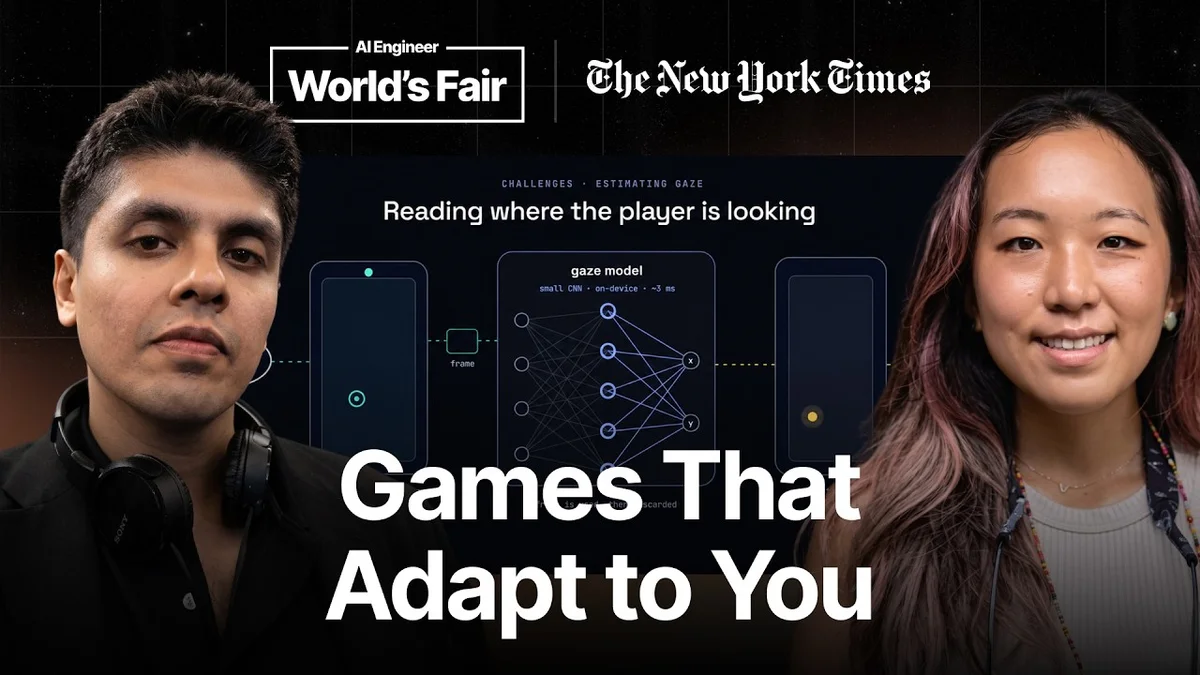
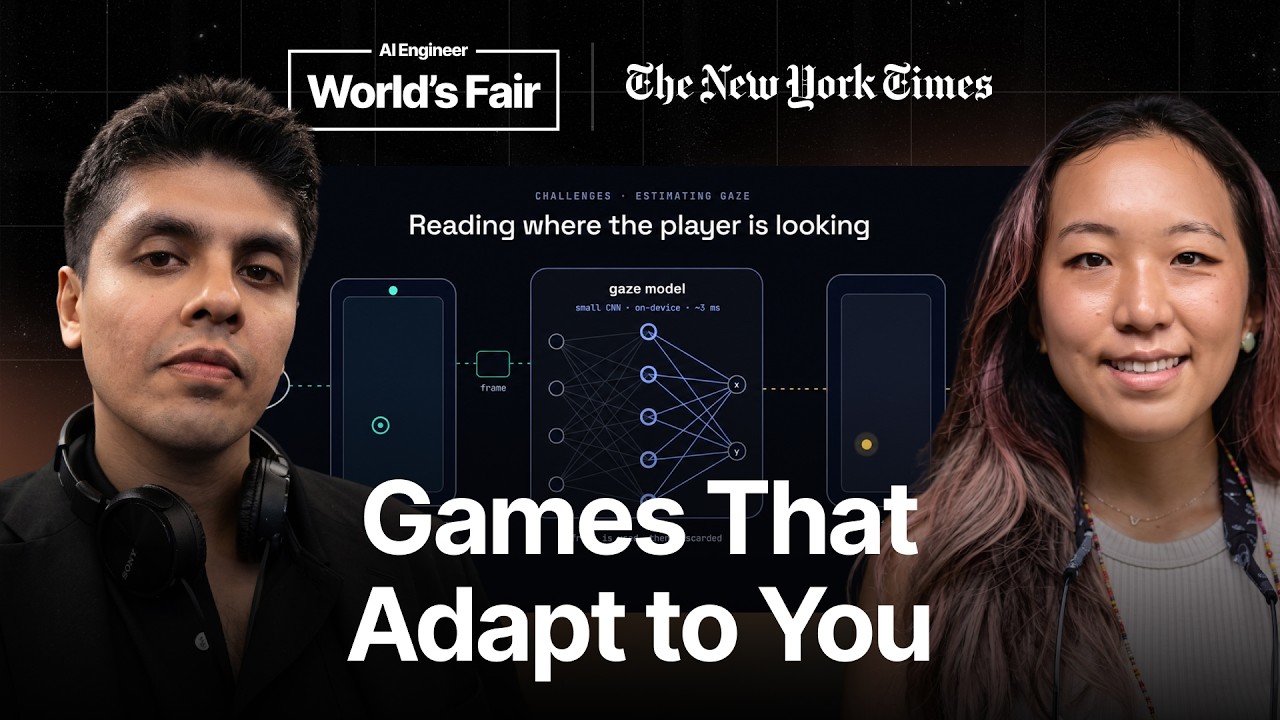
Shafik Quoraishee and Joanne Song presenting on Local Agentic Theory for Accessible Mobile Games at AI Engineer World's Fair.
AI Engineer
Visual TL;DR
NYT Local AI GamesCore
From the article 2 mentionsShafik Quoraishee and Joanne Song from The New York Times presented their experimental work on "Local Agentic Theory for Accessible Mobile Games" at the AI Engineer World's Fair.
On-Device AIContext
shift from cloud-based to local processing for mobile game improvements
From the article 3 mentionsThe core thesis of their presentation revolves around the shift from cloud-based AI infrastructure to on-device AI.
Future ChallengesDriver
research explores benefits and future hurdles for local AI implementation
From the articleSeveral challenges were identified in deploying AI agents on mobile devices.
Faster ResponsesEffect
eliminates cloud round trips, leading to quicker game interactions
From the article 2 mentionsQuoraishee highlighted that running AI computations locally can lead to faster responses, as it eliminates the need for round trips to the cloud.
Enhanced PrivacyEffect
AI processing remains within the device's secure zone, protecting user data
From the articleThis approach also enhances privacy, as the AI processing remains within the device's secure zone.
Offline PlayEffect
games function without internet, crucial for poor connectivity areas
Improved AccessibilityOutcome
AI agents directly on devices enhance playability and user experience
From the article 4 mentionsLooking ahead, the team identified key areas for development: faster agents capable of planning within a 16ms frame, predictive models to anticipate the impact of UI changes, long-term memory for personalized adaptations, a shared game state language for cross-game agent functionality, and improved hardware coupled with rigorous testing to validate agent effectiveness.
PersonalizationEffect
From the articlePersonalization is another key benefit of on-device AI, allowing game experiences to be tailored to individual players.

Contents(5)

Shafik Quoraishee and Joanne Song from The New York Times presented their experimental work on "Local Agentic Theory for Accessible Mobile Games" at the AI Engineer World's Fair. They emphasized that while The New York Times' puzzles are human-made, their research explores how AI agents running directly on mobile devices can improve game experiences, particularly focusing on playability and accessibility.

StartupHub data

Companies working on this

Profiles of the companies named in this story, with founding year, headquarters, and a short description from our database.

A leading global news organization dedicated to independent, deeply reported journalism.

Location
New York, United States
NYT Explores Local AI for Accessible Mobile Games - AI Engineer
NYT Explores Local AI for Accessible Mobile Games, from AI Engineer

On-Device AI for Enhanced Gaming

The core thesis of their presentation revolves around the shift from cloud-based AI infrastructure to on-device AI. Quoraishee highlighted that running AI computations locally can lead to faster responses, as it eliminates the need for round trips to the cloud. This approach also enhances privacy, as the AI processing remains within the device's secure zone. Furthermore, on-device AI enables games to function even without an internet connection, crucial for areas with poor connectivity.

Personalization is another key benefit of on-device AI, allowing game experiences to be tailored to individual players. Quoraishee noted that this capability is amplified when the AI's features are local to the device.
Agentic AI vs. Reinforcement Learning

The presentation delved into the evolution of AI in gaming, from early finite state machines in games like Pac-Man to modern reinforcement learning (RL) techniques. Quoraishee introduced "EfficientZero" and "EfficientZero V2" as state-of-the-art RL models known for their sample efficiency. He then contrasted these with agentic systems, where AI agents, often leveraging language models and in-context learning, reason about the game's state. While RL modifies the AI model itself through weight changes and reward systems, agentic systems reason over the game's state and adapt to new situations through tool calls and local device functionality, making them more dynamic.

An example of an agentic-based game was demonstrated with an AI playing Space Invaders, showcasing how the agent perceives the scene, predicts enemy movements, makes decisions, and acts accordingly within a continuous loop.

Challenges and Constraints

Several challenges were identified in deploying AI agents on mobile devices. These include:

  • Space constraints: Fitting model weights, compressing state history, and managing planning artifacts within the device's memory.
  • Time constraints: Ensuring agent planning and decision-making occur within the tight budget of a game's refresh rate (e.g., 16ms for 60Hz). Exceeding this budget can lead to noticeable "jank."
  • Energy constraints: Minimizing energy consumption to preserve battery life, as current mobile devices are not yet fully optimized for heavy agentic workloads.

To address these, the team uses a "constraint graph" that balances space, time, and energy, employing techniques like soft constraining to manage trade-offs without compromising user experience.

Accessibility and Future Directions

Joanne Song focused on the accessibility aspect, grounding their approach in WCAG 2.2 guidelines. She highlighted common accessibility pitfalls in games, such as tiny tappable areas, invisible active cell highlights, unforgiving timers, and rigid game mechanics that fail to adapt to individual player needs. Song proposed that AI agents can dynamically adjust game parameters like input tolerance and step granularity in real-time to cater to diverse player needs.

She also discussed how AI can actively monitor player behavior, detect frustration, and adapt the game interface, such as dynamically resizing controls or injecting exit routes in focus traps. This moves towards a more empathetic and responsive gaming experience.

Looking ahead, the team identified key areas for development: faster agents capable of planning within a 16ms frame, predictive models to anticipate the impact of UI changes, long-term memory for personalized adaptations, a shared game state language for cross-game agent functionality, and improved hardware coupled with rigorous testing to validate agent effectiveness.

The presentation concluded with a vision of AI moving beyond a single, centralized brain to a distributed network of "small local brains," each tailored to the individual user it serves.

© 2026 StartupHub.ai. All rights reserved. You may not republish this article in full without a license. Search engines and AI research tools may crawl and summarize for reference. Bulk reproduction or model training requires a license. See our terms.
Daniel Singer

Written by

Daniel Singer

Editor, StartupHub.ai

Daniel Singer is the editor of StartupHub.ai, a technology expert and thought leader on AI and its applications across sectors, from fintech and healthcare to developer tooling and consumer software. He writes and tests the tools covered here thoroughly and regularly, and built StartupHub.ai to give founders, operators and buyers a clearer read on what they are actually being sold.

More from Daniel Singer