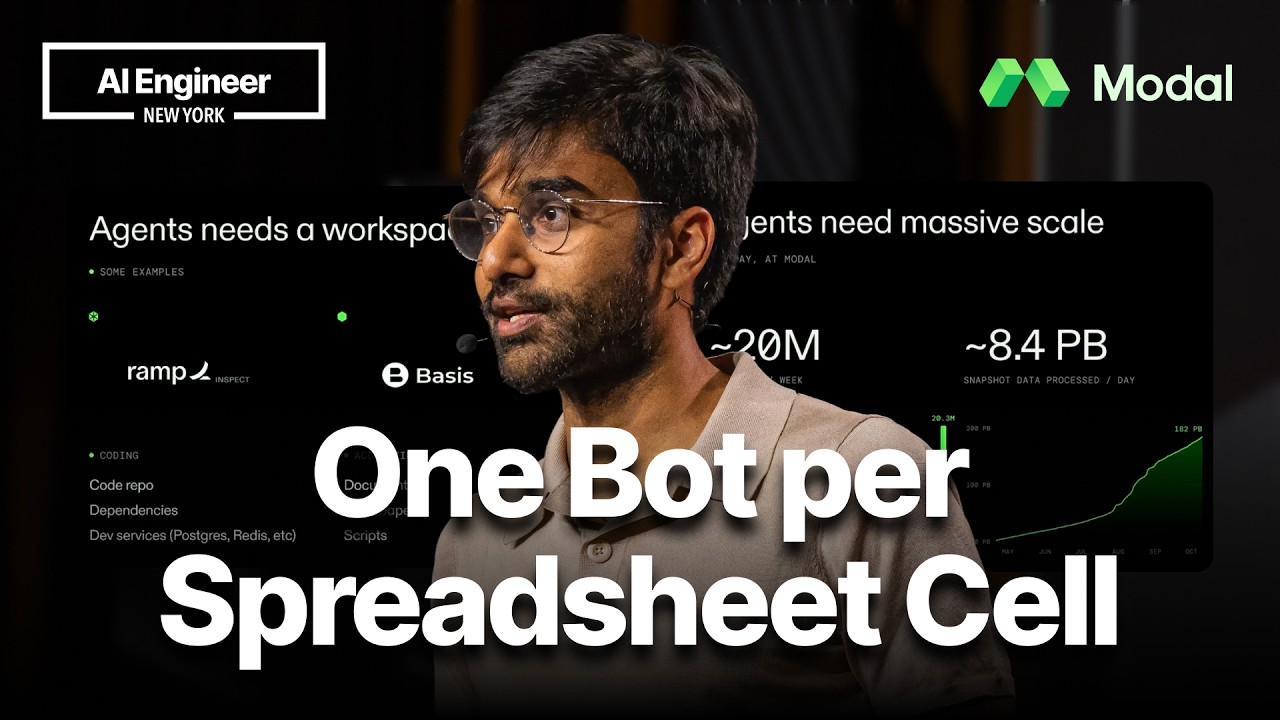
Akshat Bubna, CTO of Modal, told AI Engineer to stop hand building agent runtimes. His example was a finance spreadsheet where every cell runs its own agent. Heavy AI already ships that, he said, with each agent inside a Modal sandbox, which is a secure environment for running untrusted code. A single query can demand thousands of agents that start in under a second and vanish when done.
Vibe coding that layer will break on reliability, security and scale.
A workspace, which is a persistent directory with code, data and dependencies, comes first. Ramp Inspect, Ramp's internal coding agent that Bubna said pushes almost every PR at Ramp, needs repos and dev services in that workspace. Basis, an accounting agent, needs workpapers and scripts to wait days for an accountant and resume where it left off without paying for idle compute. That split forces separation of the harness, which is the agent loop that calls models and tools, from a sidecar, which is a second container where tool calls run under custom rules, with a volume, which is shared storage for collaboration.
Ramp data shows CPU and memory swing wildly across sandboxes and over time inside one sandbox. Provisioning for peak would mean 15 CPU cores and 15 gigs of RAM for every sandbox, which Bubna called uneconomic. Modal lets agents take resources when needed and pay only for that burst, he said, while adding GPUs for science, video, CAD and hill climbing training runs where agents swap cards and run ablations in parallel. Domain allow lists are not enough, so teams write lightweight proxies to control exact paths on GitHub or Datadog and inject credentials the agent cannot see.
Agents also need logs, GPU utilization and budget data to debug a failed training run and retry with new parameters. Modal reports 20 million snapshots a week, 8 petabytes of snapshot data a day and almost 2.6 million volumes a week, he said. One personal assistant workload needs 10,000 sandboxes a second and close to a million live sandboxes that last two to three minutes. No single cloud can supply that CPU crunch, so Modal aggregates capacity across hyperscalers and neo clouds.
Control Plane notes Modal picks gVisor or a VM runtime with its own Linux kernel by default and runs GPU sandboxes on gVisor only. Bubna's bet is that harnesses, or brains, will separate from sandboxes, or hands, and spin up, snapshot and discard environments as needed. He called the end state an ocean of microbes, crediting Six for the analogy, not pets turned to cattle. Watch whether primitives for compute, storage and networking stay solid enough for agents to manage that chaos themselves.