Daytona vs E2B vs Modal vs Vercel Sandbox: A 2026 Comparison

Cold start latency, isolation tech, GPU support, and per-second pricing compared head-to-head across the four leading AI agent sandboxes shipping in 2026.

7 min read
Daytona, E2B, Modal, and Vercel Sandbox compared for AI agent code execution
Cover: daytona.io homepage. Image credit: StartupHub.ai· StartupHub.ai

The "give my agent a sandbox" market got crowded fast. Four runtimes, four philosophies, four pricing models. Here is what each one actually optimizes for in 2026.

Every AI agent that writes code, runs tests, or processes a CSV needs an isolated execution environment that boots in under a second and dies when the task is done. As of 2026, four serious contenders own that workload: Daytona, E2B, Modal, and Vercel Sandbox. They look interchangeable on a feature page. They are not.

The headline numbers

Cold start latency, isolation technology, and per-second pricing are the three axes most teams will care about. Here is how the four stack up, with figures pulled from each provider's own documentation and Northflank's 2026 sandbox pricing comparison.

Metric Daytona E2B Modal Vercel Sandbox
Cold start ~90 ms ~150 ms Sub-second Fast (not published)
Isolation Containers (Docker / Kata / Sysbox) Firecracker microVMs gVisor Vercel infrastructure (proprietary)
GPU inside sandbox Yes No Yes (T4 to H100) No
Languages Python, TypeScript Python, JS/TS, R, Java, Bash Python, JS/TS (beta), Go (beta) TypeScript, Python (limited)
CPU pricing $0.0504 / vCPU-hr $0.0504 / vCPU-hr $0.1419 / core-hr (3x sandbox premium) $0.128 / vCPU-hr (active CPU only)
Memory pricing $0.0162 / GiB-hr $0.0162 / GiB-hr $0.0242 / GiB-hr $0.0212 / GB-hr
Free tier $200 compute credit $100 credit, 20 concurrent Monthly free compute Hobby allotment

Daytona: the speed leader

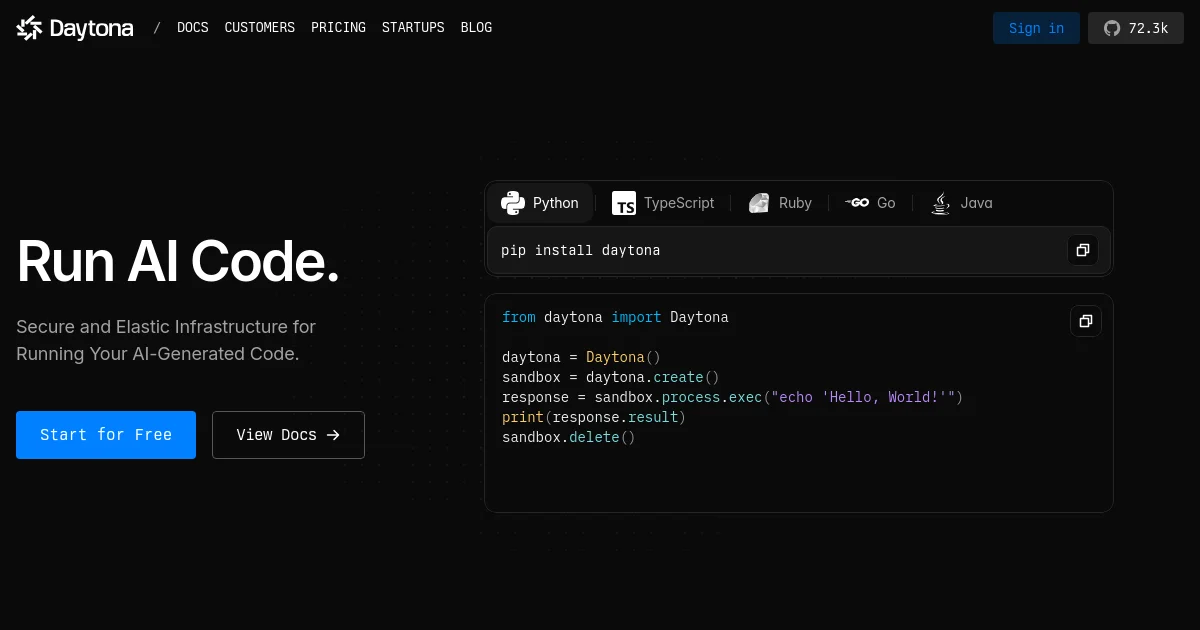
Daytona homepage
daytona.io homepage. Screenshot taken 8 May 2026.

Daytona's pitch is the fastest cold start in the category. The company quotes sub-90 millisecond cold starts in marketing collateral, with optimized configurations hitting 27 milliseconds. The architecture is container-based by default, with optional Kata or Sysbox for stronger isolation when teams need workload separation closer to a microVM.

Pricing reflects the open-source and dev-environment heritage rather than a serverless premium: $0.0504 per vCPU-hour and $0.0162 per GiB-hour, putting it at the low end of the market. There is no public self-serve plan above the $200 of free compute, but the SDK and CLI are open enough that teams already running Daytona for cloud development environments can re-purpose the same orchestration for agent code execution.
The trade-off is a smaller surface of pre-built integrations compared to E2B's code interpreter SDK and an enterprise-leaning sales motion that may not suit hobby projects.

E2B: the code-interpreter veteran

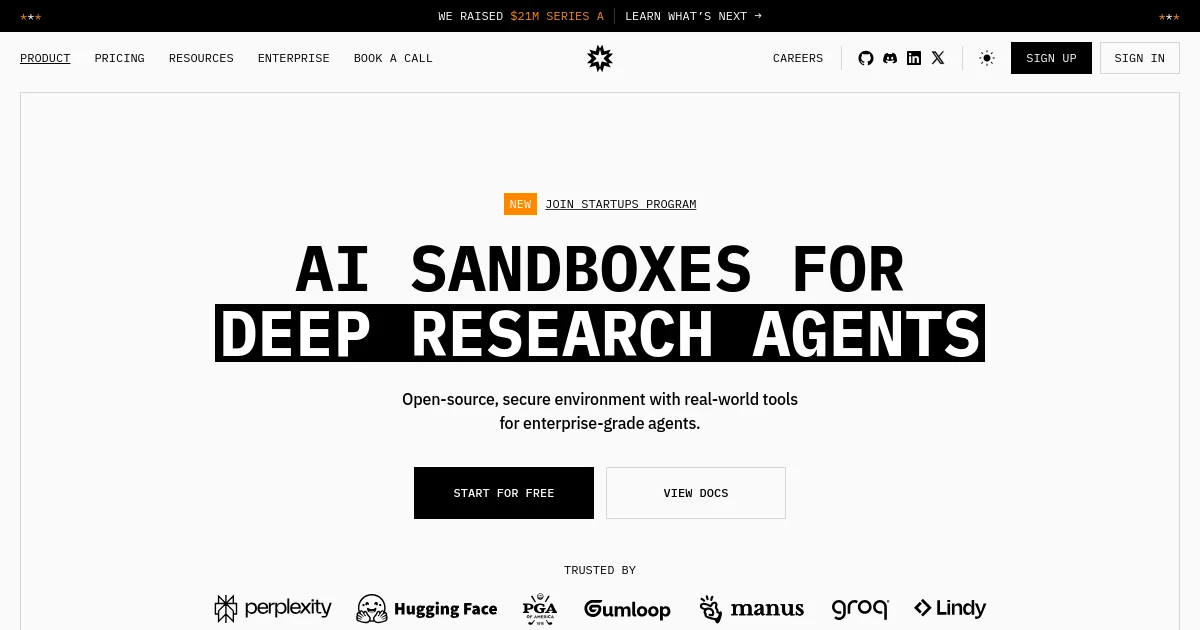
E2B homepage
e2b.dev homepage. Screenshot taken 8 May 2026.

E2B was the first sandbox built specifically around the OpenAI Code Interpreter pattern. Every runCode() call shares state with the previous one, so an agent can iteratively build up variables, dataframes, and trained models across turns within the same session. Five language runtimes ship out of the box: Python, JavaScript/TypeScript, R, Java, and Bash.

Related startups

Isolation runs on Firecracker microVMs with a dedicated kernel per sandbox, the strongest hardware-level boundary in the category. Cold start clocks in at roughly 150 ms, slower than Daytona but faster than anything pre-2025.

Pricing matches Daytona at $0.0504 per vCPU-hour, with a Hobby tier that includes a one-time $100 credit and 20 concurrent sandboxes, no credit card required. The Pro tier is $150 per month and lifts session length to 24 hours.

If an agent's primary loop is "write Python, execute, observe, repeat", E2B remains the path-of-least-resistance integration.

Modal: the only one with GPUs inside the sandbox

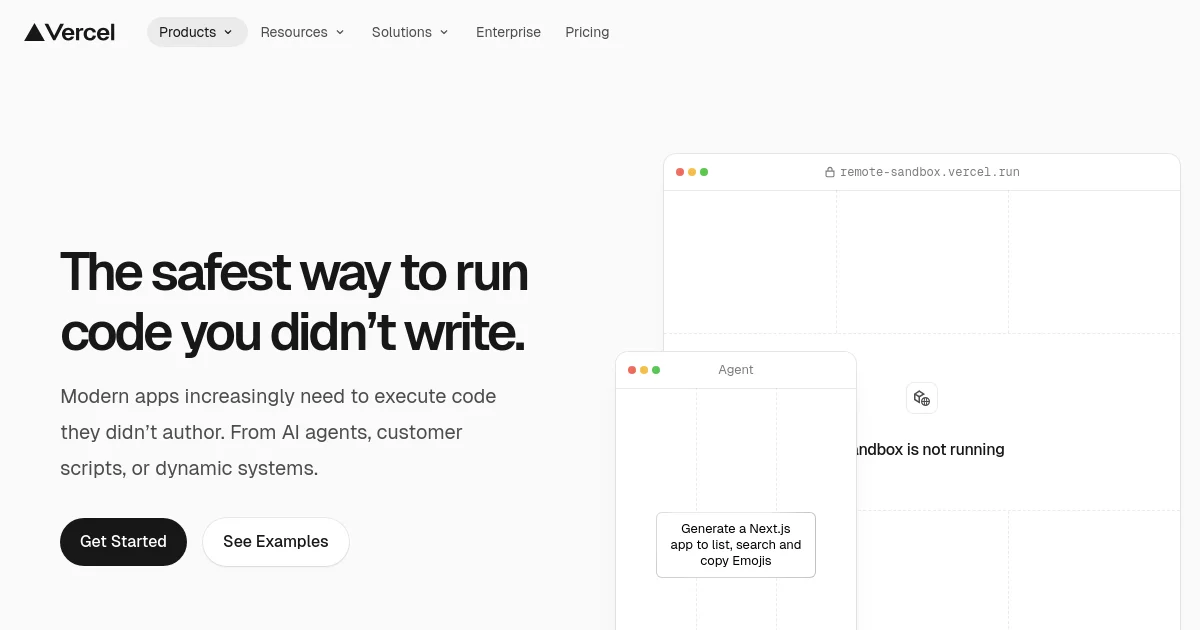
Modal Sandboxes use-case page
modal.com/use-cases/sandboxes. Screenshot taken 8 May 2026.

Modal is the outlier in this comparison because it is the only platform where a sandbox can hold a GPU. If an agent needs to run inference, fine-tune, or process images inside the same isolated process that runs the model's tool calls, Modal is presently the only serious option. Sub-second cold starts apply to GPU sandboxes too, and Modal claims autoscaling to 50,000 concurrent sessions.

The price of GPU access inside a sandbox is, well, the price. Modal Sandbox CPU rates carry a 3x premium over standard Modal Functions: $0.00003942 per CPU core-second versus $0.0000131 for general serverless. GPU rates do not get the multiplier (an A100 40 GB inside a sandbox is still $2.10 per hour), but US non-preemptible workloads pick up additional regional and preemption multipliers totalling 3.75x base rates. Real production numbers reported by third parties: an advertised $471.60 monthly base cost for 10,000 CPU-hours becomes $1,768.50 once multipliers are applied.

For pure CPU sandbox workloads, Modal is the most expensive of the four. For anything that needs a GPU on the same side of the isolation boundary as the agent's code, it is the only choice that ships today.

Vercel Sandbox: bursty, I/O-heavy, already on Vercel

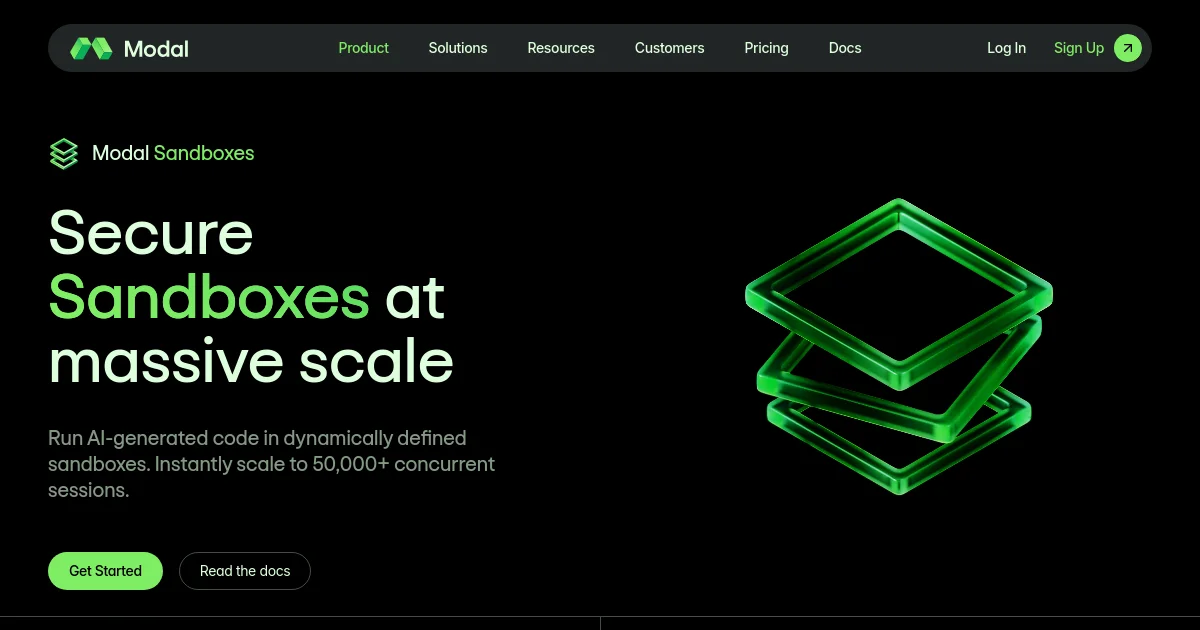
Vercel Sandbox product page
vercel.com/sandbox. Screenshot taken 8 May 2026.

Vercel was last to ship in this category and uses that timing to introduce the most opinionated billing model: Active CPU. Time spent waiting for I/O (network calls, database queries, model API responses) does not count against the CPU meter. Vercel claims up to 95% lower cost than per-wall-clock pricing for I/O-bound workloads, which is what most agent loops actually look like.

Headline rate is $0.128 per vCPU-hour for active CPU only, $0.0212 per GB-hour for provisioned memory, plus $0.023 per GB-month for snapshots. Sandbox creation is a billable line item, which matters for ephemeral one-shot patterns. There is no GPU support today and Python is listed as limited.

The structural sell: if an agent already lives in a Vercel-deployed Next.js app, the sandbox lives one import away with shared auth, observability, and bandwidth pooling. For teams not on Vercel, the integration premium has less leverage.

How to pick

The decision matrix in 2026 is less about which platform is "best" and more about which constraint dominates the workload.

Pick Daytona if cold start latency is the bottleneck. Agent loops that spin up a fresh sandbox per turn pay the cold-start tax on every iteration, and shaving 60 ms per turn compounds into seconds across a long-running task.

Pick E2B if the agent runs Python iteratively with shared state, needs Firecracker-grade isolation between users, or wants the largest catalog of community-built sandbox templates.

Pick Modal if any GPU work happens on the sandbox side of the wire. The 3x sandbox multiplier on CPU is the cost of having that capability at all, and there is no comparable substitute today.

Pick Vercel Sandbox if the application already ships on Vercel and the workload is bursty and I/O-heavy. Active CPU pricing eats into infra spend faster than any of the others when waits dominate compute.

Note that none of the four publish an SLA stronger than "best effort" for sandbox availability today. For agent products that depend on sandbox liveness for revenue, a fallback to a second provider is worth the integration weight.

The wider context

The interesting question is not which sandbox wins on a benchmark page. It is whether sandboxes remain a discrete primitive or get absorbed into the platforms above them: agent frameworks, orchestrators, and the new generation of "agent runtime" services. Daytona and E2B both ship full SDKs. Modal positions sandboxes as one product inside a broader serverless GPU platform. Vercel positions sandbox as a primitive inside the Vercel AI Cloud.

The price floor at $0.0504 per vCPU-hour suggests a maturing market with shrinking margin, and that historically pulls infrastructure into the layer above. Whichever platform a team picks today, the integration should tolerate being swapped. Most agent frameworks already abstract sandbox calls behind a runner interface for exactly this reason, and the teams that win the next two years will be the ones whose product moat sits at the orchestration layer rather than the runtime.

© 2026 StartupHub.ai. All rights reserved. Do not enter, scrape, copy, reproduce, or republish this article in whole or in part. Use as input to AI training, fine-tuning, retrieval-augmented generation, or any machine-learning system is prohibited without written license. Substantially-similar derivative works will be pursued to the fullest extent of applicable copyright, database, and computer-misuse laws. See our terms.