

MCP Apps: The Future of AI Interaction

Ido Salomon and Liad Yosef discuss MCP Apps, a protocol enabling interactive UI components in AI chats, heralding the 'agentic web'.

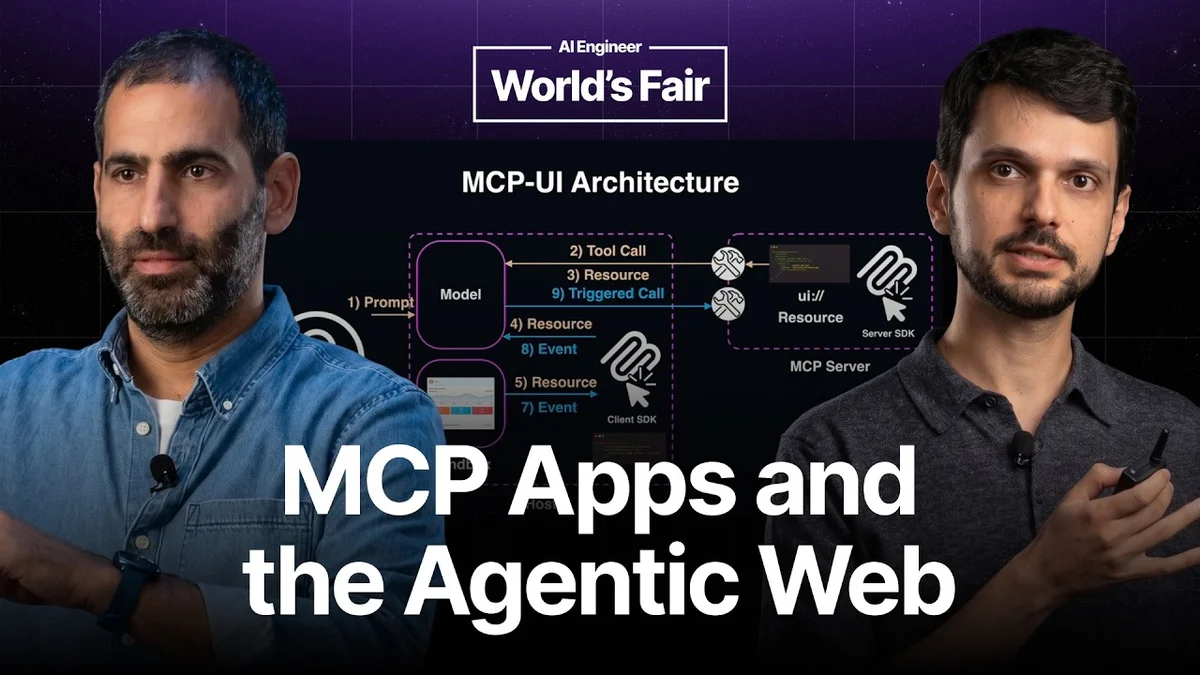
Ido Salomon and Liad Yosef presenting MCP Apps at AI Engineer World's Fair
Ido Salomon and Liad Yosef discuss MCP Apps.· AI Engineer
Visual TL;DR
UI GapDriver
text-only chat interfaces lose brand identity and interactivity for services
MCP Apps ProtocolCore
protocol enabling interactive UI components directly within AI chat interfaces
From the article 9+ mentionsAt the AI Engineer World's Fair, Ido Salomon and Liad Yosef unveiled MCP Apps, a protocol designed to revolutionize how users interact with applications through AI chat interfaces.
Beyond Text WallsEffect
From the articleThis aims to solve the problem of "walls of text" that often hinder user engagement and brand identity in traditional chat interactions.
Rich InteractionEffect
services send actual UI components, not just text, for a richer experience
From the article 2 mentionsThis aims to solve the problem of "walls of text" that often hinder user engagement and brand identity in traditional chat interactions.
New MindsetContext
requires a shift in how users and developers think about application control
From the articleMCP Apps also introduces a new interaction mindset where applications no longer solely control the user journey.
Agentic WebOutcome
MCP Apps ushers in a new era of AI-driven, interactive web experiences
From the articleSalomon and Yosef posited that this technology ushers in the era of the "agentic web." Instead of users navigating multiple browser tabs and services, their personal AI assistants will be able to fetch and compose UI "atoms" from various services.
Community DevContext
future development and broader adoption driven by community contributions
From the article 2 mentionsThe MCP Apps ecosystem is actively growing, with community contributions to plugins, integrations, and courses.
Contents(6)

At the AI Engineer World's Fair, Ido Salomon and Liad Yosef unveiled MCP Apps, a protocol designed to revolutionize how users interact with applications through AI chat interfaces. The core idea behind MCP Apps is to move beyond text-only responses in conversations, allowing services and brands to send their actual user interfaces directly into the chat. This aims to solve the problem of "walls of text" that often hinder user engagement and brand identity in traditional chat interactions.

The UI Gap and the MCP Solution

Salomon and Yosef highlighted the limitations of purely textual interfaces, especially for companies that invest heavily in user experience and brand identity. They explained that reducing a service to a textual database in a chat can lead to a loss of visual appeal and interactivity. MCP Apps, built on MCP-UI and an SDK, addresses this by enabling applications to transmit their UI components directly into the chat. This allows for a richer, more interactive experience, where users can engage with applications like Shopify or Hugging Face without leaving their chat interface.

Key Features and Early Adopters

The MCP Apps protocol standardizes the transmission of UI and the communication between the UI and the host application. This allows for interactive elements, such as buttons, to trigger actions and tools within the application's backend. The presenters showcased examples, including a Spotify playlist interface and a PostHog analytics dashboard, demonstrating how these interactive components can be seamlessly integrated into chat conversations. Early adopters of MCP-UI and MCP Apps include 11 Labs, Shopify, Postman, and Goose, with recent support from Cursor, GitHub Copilot, and ChatGPT.

The Agentic Web and the Future of Interaction

Salomon and Yosef posited that this technology ushers in the era of the "agentic web." Instead of users navigating multiple browser tabs and services, their personal AI assistants will be able to fetch and compose UI "atoms" from various services. This means an assistant could proactively suggest actions, like planning an anniversary, by pulling relevant UI components from Google Calendar, Amazon, and booking services, all without the user needing to interact with each service's full interface. The key is that the assistant, armed with context about the user, can intelligently assemble these UI pieces.

New Interaction Mindset and Control

MCP Apps also introduces a new interaction mindset where applications no longer solely control the user journey. When a user interacts with an app's UI within a chat, the host (the AI assistant) manages the flow. This is achieved through defined action types: "notify," "tool," and "prompt." An app can notify the host of an event, request the host to run a prompt, or call a tool, with the host retaining control and ensuring auditability through the chat interface. This shift promises a more integrated and user-centric experience.

Community and Future Development

The MCP Apps ecosystem is actively growing, with community contributions to plugins, integrations, and courses. The official repository, X apps, serves as a hub for proposing ideas and extending the specification. A workgroup convenes tri-weekly to discuss the protocol's future, ensuring it serves both large applications and the broader community. The presenters highlighted upcoming features like reusable views and app tools, emphasizing the open and collaborative nature of the MCP Apps development.

Broader Implications and Adoption

The reach of platforms like ChatGPT, with its massive user base, positions MCP Apps as a powerful new distribution channel for applications. The ability to "write once, run everywhere" across various AI-enabled platforms is a significant advantage. The presenters concluded with an optimistic outlook, suggesting that with MCP Apps, the vision of a "Jarvis-like" AI assistant is closer than ever, fundamentally changing how we interact with the digital world.

© 2026 StartupHub.ai. All rights reserved. You may not republish this article in full without a license. Search engines and AI research tools may crawl and summarize for reference. Bulk reproduction or model training requires a license. See our terms.
Daniel Singer

Written by

Daniel Singer

Editor, StartupHub.ai

Daniel Singer is the editor of StartupHub.ai, a technology expert and thought leader on AI and its applications across sectors, from fintech and healthcare to developer tooling and consumer software. He writes and tests the tools covered here thoroughly and regularly, and built StartupHub.ai to give founders, operators and buyers a clearer read on what they are actually being sold.