

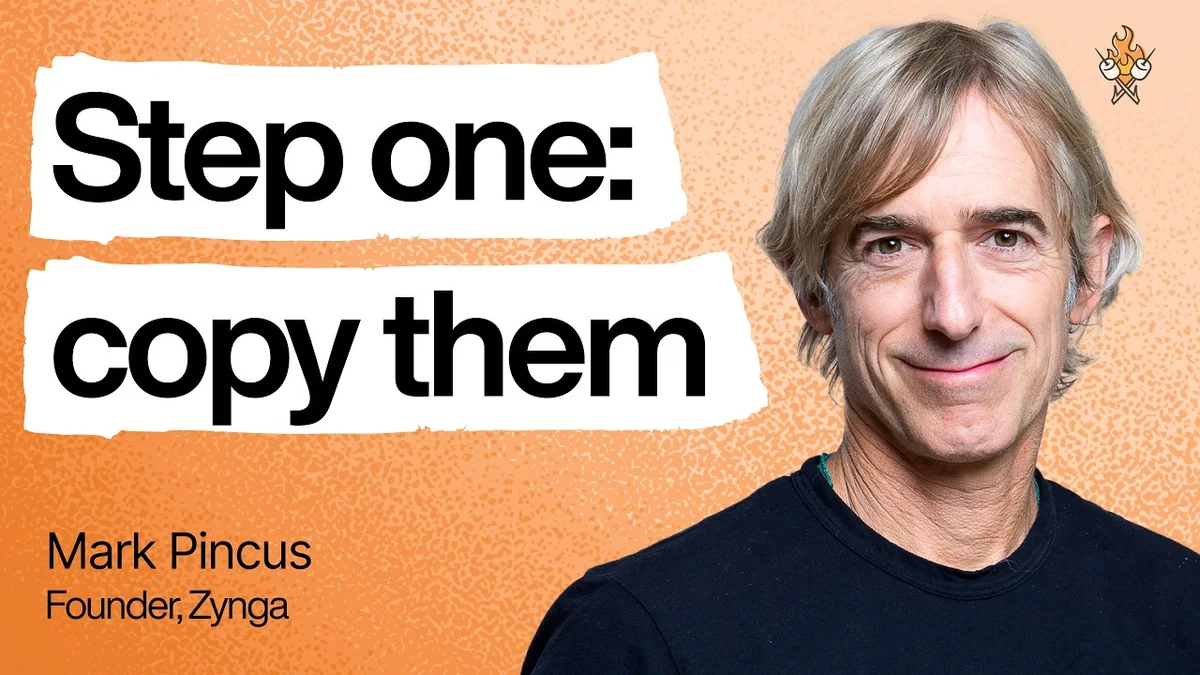
Mark Pincus: The Pattern Behind Product Success

Mark Pincus, founder of Zynga, shares his framework for creating successful products, emphasizing iteration and understanding consumer desires.

Mark Pincus speaking at a panel
Mark Pincus, founder of Zynga, discusses the patterns behind successful product creation.· Lenny's Podcast
Visual TL;DR
Mark Pincus's FrameworkCore
From the article 2 mentionsMark Pincus, the visionary founder behind Zynga, a company that redefined social gaming with hits like FarmVille and Words with Friends, recently shared his insights on the hidden patterns behind successful products.
Learning from PastContext
using historical data to inform future products
The 'Why'Context
understanding the core motivation behind the product
Proven Better NewContext
improve existing successful products, not just invent
From the articlePincus advocates for a strategy he calls "proven better new." This involves not necessarily inventing a product from scratch, but rather identifying existing successful products or concepts that resonate with a large audience, and then improving upon them.
Understand Consumer DesiresDriver
deep understanding of user behavior and needs
From the articleHe stated, "You're trying to win the hearts and minds of nurses in Indiana, for FarmVille, you're not trying to win awards and respect from your peers." This underscores the importance of focusing on the consumer and their actual needs and desires, rather than on accolades or perceived novelty.
Instinct and IterationContext
power of refinement and continuous improvement
From the article 3 mentionsIn a compelling discussion, Pincus articulated a framework for identifying and building products that resonate with consumers, emphasizing the power of iteration and a deep understanding of user behavior.
Product SuccessOutcome
creating widely played games and resonating products
From the article 8 mentionsHe emphasized that success often comes from understanding the underlying human motivations that drive behavior and then building products that cater to those motivations more effectively than anything that came before.
Contents(4)

Mark Pincus, the visionary founder behind Zynga, a company that redefined social gaming with hits like FarmVille and Words with Friends, recently shared his insights on the hidden patterns behind successful products. In a compelling discussion, Pincus articulated a framework for identifying and building products that resonate with consumers, emphasizing the power of iteration and a deep understanding of user behavior.

Mark Pincus: The Pattern Behind Product Success - Lenny's Podcast
Mark Pincus: The Pattern Behind Product Success, Lenny's Podcast

Pincus, who has been instrumental in creating some of the most widely played games in history, offered a pragmatic approach to product development, suggesting that founders often overemphasize pure invention and underappreciate the impact of refinement.

The "Proven Better New" Framework

Pincus advocates for a strategy he calls "proven better new." This involves not necessarily inventing a product from scratch, but rather identifying existing successful products or concepts that resonate with a large audience, and then improving upon them. He argues that many of the most successful products in history, from the iPhone to streaming services, didn't create entirely new markets but rather revolutionized existing ones by offering a superior user experience or greater accessibility.

He elaborated on this by referencing the early days of social media, noting that while platforms like Facebook and Twitter were innovative, they built upon the fundamental human desire for connection and sharing. Pincus suggested that by understanding what people already want and enjoy, founders can identify significant opportunities for improvement and innovation.

The Importance of Instinct and Iteration

While acknowledging the role of instinct in entrepreneurship, Pincus cautioned against relying solely on gut feelings. He shared a stark statistic: "Your instincts are right 95% of the time, your ideas are wrong 75% of the time." This highlights the critical need for founders to test their ideas rigorously and iterate based on real-world feedback. He pointed out that many founders get attached to their initial vision, even when the data suggests a different path.

Pincus also touched upon the common pitfall of founders trying to be purely innovative for innovation's sake. He stated, "You're trying to win the hearts and minds of nurses in Indiana, for FarmVille, you're not trying to win awards and respect from your peers." This underscores the importance of focusing on the consumer and their actual needs and desires, rather than on accolades or perceived novelty.

Learning from the Past to Build for the Future

Pincus's own journey with Zynga is a testament to this philosophy. He didn't invent the concept of a social game; rather, he took existing genres and adapted them for a social, mobile-first audience, adding elements that fostered engagement and retention. He emphasized that success often comes from understanding the underlying human motivations that drive behavior and then building products that cater to those motivations more effectively than anything that came before.

He also shared a personal anecdote about his early career, where he was so focused on being an innovator that he missed opportunities. He learned the hard way that sometimes, the most impactful innovation comes from deeply understanding and improving upon what already exists and is loved by users.

The "Why" Behind the Product

Ultimately, Pincus's advice boils down to a deep empathy for the user and a relentless focus on delivering value. He stressed the importance of asking not just what a product does, but why people will use it, and how it fits into their lives. He believes that the most successful products solve real problems or fulfill genuine desires in a way that is both delightful and indispensable.

© 2026 StartupHub.ai. All rights reserved. You may not republish this article in full without a license. Search engines and AI research tools may crawl and summarize for reference. Bulk reproduction or model training requires a license. See our terms.
Daniel Singer

Written by

Daniel Singer

Editor, StartupHub.ai

Daniel Singer is the editor of StartupHub.ai, a technology expert and thought leader on AI and its applications across sectors, from fintech and healthcare to developer tooling and consumer software. He writes and tests the tools covered here thoroughly and regularly, and built StartupHub.ai to give founders, operators and buyers a clearer read on what they are actually being sold.