

Intelligence vs. Expertise in AI Agents

Yu Su of NeoCognition differentiates AI intelligence from expertise, arguing continual learning is key to unlocking specialized skills for agents in complex "micro-worlds."

9 min read
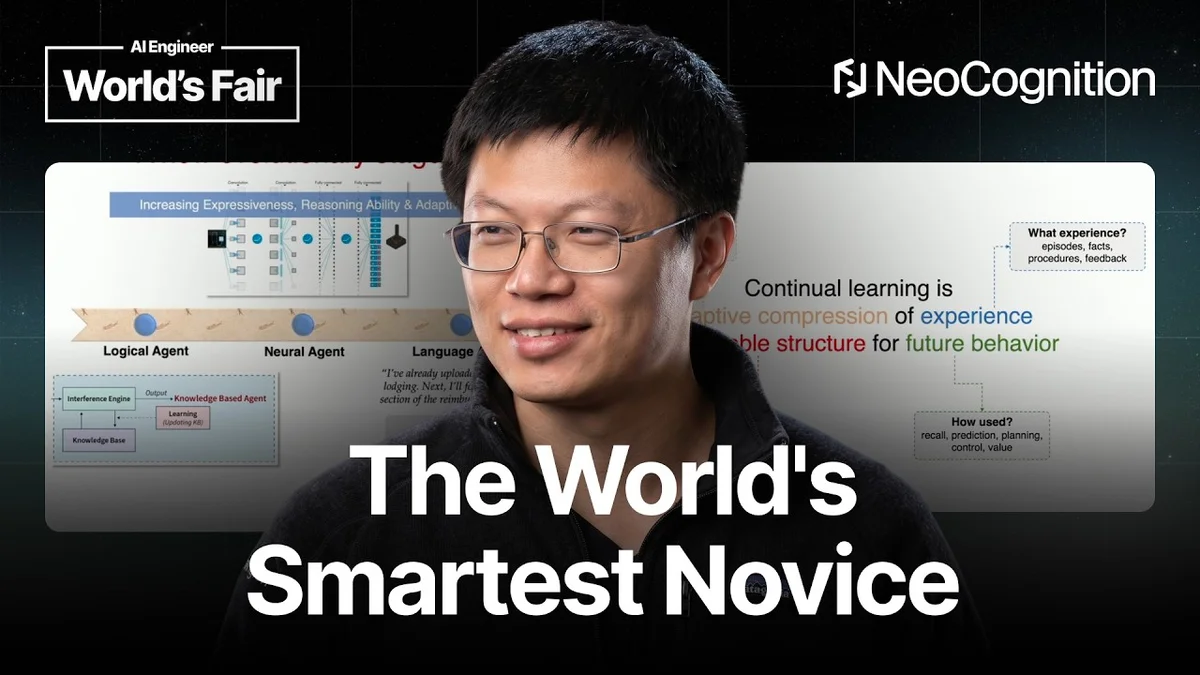
Yu Su speaking at AI Engineer World's Fair with a slide titled 'Intelligence + Continual Learning = Expertise'
AI Engineer

Visual TL;DR. AI Agents Evolve leads to Current AI Limits. Current AI Limits due to Lack Specialized Expertise. Lack Specialized Expertise highlights Intelligence vs. Expertise. Intelligence vs. Expertise requires Continual Learning. Continual Learning enables Unbounded Expertise. Unbounded Expertise raises Open Questions.

  1. AI Agents Evolve: from early logical systems to multi-modal LLMs processing diverse inputs
  2. Current AI Limits: proficient in coding but falter in complex everyday digital work
  3. Lack Specialized Expertise: agents struggle in complex 'micro-worlds' without specific domain skills
  4. Intelligence vs. Expertise: Yu Su differentiates general AI capabilities from specialized, practical skills
  5. Continual Learning: key to acquiring specialized skills for agents in dynamic environments
  6. Unbounded Expertise: vision for agents to gain specialized skills from bounded intelligence
  7. Open Questions: how to effectively implement continual learning for diverse agent tasks
Visual TL;DR
Visual TL;DR, startuphub.ai Current AI Limits due to Lack Specialized Expertise. Lack Specialized Expertise highlights Intelligence vs. Expertise. Intelligence vs. Expertise requires Continual Learning. Continual Learning enables Unbounded Expertise due to highlights requires enables Current AI Limits Lack Specialized Expertise Intelligence vs. Expertise Continual Learning Unbounded Expertise From startuphub.ai · The publishers behind this format
Visual TL;DR, startuphub.ai Current AI Limits due to Lack Specialized Expertise. Lack Specialized Expertise highlights Intelligence vs. Expertise. Intelligence vs. Expertise requires Continual Learning. Continual Learning enables Unbounded Expertise due to highlights requires enables Current AI Limits Lack SpecializedExpertise Intelligence vs.Expertise ContinualLearning UnboundedExpertise From startuphub.ai · The publishers behind this format
Visual TL;DR, startuphub.ai Current AI Limits due to Lack Specialized Expertise. Lack Specialized Expertise highlights Intelligence vs. Expertise. Intelligence vs. Expertise requires Continual Learning. Continual Learning enables Unbounded Expertise due to highlights requires enables Current AI Limits proficient in coding but falter in complexeveryday digital work Lack Specialized Expertise agents struggle in complex 'micro-worlds'without specific domain skills Intelligence vs. Expertise Yu Su differentiates general AIcapabilities from specialized, practicalskills Continual Learning key to acquiring specialized skills foragents in dynamic environments Unbounded Expertise vision for agents to gain specializedskills from bounded intelligence From startuphub.ai · The publishers behind this format
Visual TL;DR, startuphub.ai Current AI Limits due to Lack Specialized Expertise. Lack Specialized Expertise highlights Intelligence vs. Expertise. Intelligence vs. Expertise requires Continual Learning. Continual Learning enables Unbounded Expertise due to highlights requires enables Current AI Limits proficient incoding but falterin complex everyday… Lack SpecializedExpertise agents struggle incomplex'micro-worlds'… Intelligence vs.Expertise Yu Sudifferentiatesgeneral AI… ContinualLearning key to acquiringspecialized skillsfor agents in… UnboundedExpertise vision for agentsto gain specializedskills from bounded… From startuphub.ai · The publishers behind this format
Visual TL;DR, startuphub.ai AI Agents Evolve leads to Current AI Limits. Current AI Limits due to Lack Specialized Expertise. Lack Specialized Expertise highlights Intelligence vs. Expertise. Intelligence vs. Expertise requires Continual Learning. Continual Learning enables Unbounded Expertise. Unbounded Expertise raises Open Questions leads to due to highlights requires enables raises AI Agents Evolve from early logical systems to multi-modalLLMs processing diverse inputs Current AI Limits proficient in coding but falter in complexeveryday digital work Lack Specialized Expertise agents struggle in complex 'micro-worlds'without specific domain skills Intelligence vs. Expertise Yu Su differentiates general AIcapabilities from specialized, practicalskills Continual Learning key to acquiring specialized skills foragents in dynamic environments Unbounded Expertise vision for agents to gain specializedskills from bounded intelligence Open Questions how to effectively implement continuallearning for diverse agent tasks From startuphub.ai · The publishers behind this format
Visual TL;DR, startuphub.ai AI Agents Evolve leads to Current AI Limits. Current AI Limits due to Lack Specialized Expertise. Lack Specialized Expertise highlights Intelligence vs. Expertise. Intelligence vs. Expertise requires Continual Learning. Continual Learning enables Unbounded Expertise. Unbounded Expertise raises Open Questions leads to due to highlights requires enables raises AI Agents Evolve from early logicalsystems tomulti-modal LLMs… Current AI Limits proficient incoding but falterin complex everyday… Lack SpecializedExpertise agents struggle incomplex'micro-worlds'… Intelligence vs.Expertise Yu Sudifferentiatesgeneral AI… ContinualLearning key to acquiringspecialized skillsfor agents in… UnboundedExpertise vision for agentsto gain specializedskills from bounded… Open Questions how to effectivelyimplement continuallearning for… From startuphub.ai · The publishers behind this format

Yu Su, Professor at The Ohio State and COO at NeoCognition, recently presented a compelling conceptual distinction between artificial intelligence and expertise, addressing why AI agents are proficient in coding but falter in broader applications. Su argued that while recent advancements in multi-modal LLMs have propelled AI agents into a new evolutionary stage, their current limitations stem from a lack of "specialized expertise" required for the complex "micro-worlds" of everyday digital work.

Intelligence vs. Expertise in AI Agents - AI Engineer
Intelligence vs. Expertise in AI Agents — from AI Engineer

The Evolution of AI Agents

Su traced the history of AI agents, from early logical and expert systems to recent deep RL-based neural agents. He noted that these earlier iterations could only capture limited facets of human intelligence, such as logical reasoning or single-modality perception. The advent of multi-modal LLMs, however, has enabled AI agents to process diverse inputs into a unified neural representation, facilitating symbolic reasoning and communication, capabilities previously unique to humans.

This leap has led to AI agents finding a significant market in coding, as evidenced by the rapid revenue growth of companies like Anthropic. Su highlighted that code is a "language-native world" with structured data and clear reward signals, making it an ideal domain for current language agents. However, the transition to more complex, real-world applications reveals their fragility.

The Moravec's Paradox and "Micro-Worlds"

Su posited that the current state of AI agents reflects a modern version of Moravec's Paradox: "hard things are easy, easy things are hard." While AI excels at symbolic reasoning tasks like coding and mathematics, it struggles with the nuanced demands of everyday digital work. This difficulty arises because modern society is composed of millions of "micro-worlds", each profession, organization, and even software configuration presents unique structures, constraints, affordances, and dynamics.

These "micro-worlds" are too heterogeneous and dynamic for any single, static model to fully comprehend. Therefore, Su argued, AI agents must "continually learn on the job to acquire what I call specialized expertise for each specific microworld."

Intelligence vs. Expertise

Su defined intelligence as "the capacity to reason through unfamiliar problems from available context." Frontier models are increasingly adept at this, processing given information to solve problems, with each instance being relatively independent. Expertise, conversely, is defined as "accumulated and situated competence", the ability to act reliably, efficiently, and with judgment to achieve superior performance in a particular domain.

Key distinctions Su drew include:

  • Contextual Reliance: Intelligence relies on given context, while expertise brings the right context to the problem.
  • Search Space: Intelligence tends to expand the search space (brute-forcing solutions), whereas expertise compresses it by utilizing learned shortcuts.
  • Cognitive Competencies: Experts "see the world differently," possessing advanced pattern recognition, understanding of deep structures, conditional knowledge, and judgment.

Su emphasized that experts don't just know more facts; they perceive and interact with their domain in a fundamentally different way. This includes understanding when rules can be bent and when to cease an action because it's "good enough."

Continual Learning as the Bridge

Su identified continual learning as the critical bridge between general intelligence and specialized expertise. He offered a definition of continual learning as "adaptive compression of experience into reusable structures for future behavior," encompassing experience, compression methods, structure types, and their utilization.

Illustrating this with a graph, Su showed that raw intelligence and expertise are largely orthogonal. Without continual learning, increased intelligence leads to a "world's smartest novice" that brute-forces every problem. However, effective continual learning algorithms can rapidly increase expertise as intelligence grows.

The Vision: Unbounded Expertise from Bounded Intelligence

Su presented the concept of "unbounded expertise from bounded intelligence." If continual learning algorithms can be developed such that once raw intelligence crosses a certain threshold, further increases in intelligence are not necessary, then continual learning alone can drive unbounded expertise. This vision has significant implications, potentially shifting the focus from training ever-larger models to developing more sophisticated continual learning mechanisms.

Open Questions and a Call to Action

Su outlined several open questions in this domain, including how to define and measure expertise, manage the trade-off between reliability and plasticity, and synergize parametric and non-parametric learning. He also raised the possibility that specialization could lead to better generalization, by learning from the vast, diverse "private worlds" of various companies.
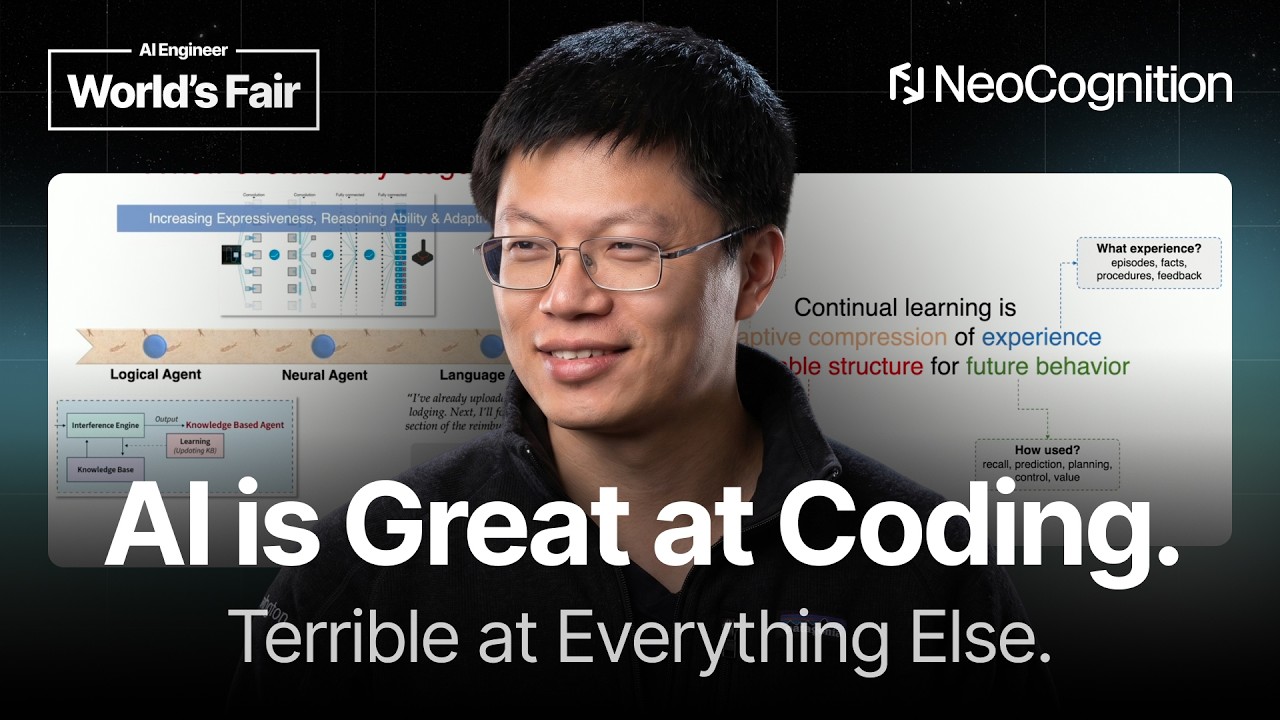
His call to action was to "start scaling expertise." With intelligence becoming abundant and frontier models already surpassing average human intelligence in some aspects, the scarcity of expertise presents a new frontier for AI development. Su envisions a future where expertise is abundant, providing personalized support across healthcare, finance, and education, and enabling companies to build their own learning loops for institutional memory and competitive advantage. This, he believes, will unlock new types of work by lowering friction and making previously unviable opportunities economically feasible.

© 2026 StartupHub.ai. All rights reserved. Do not enter, scrape, copy, reproduce, or republish this article in whole or in part. Use as input to AI training, fine-tuning, retrieval-augmented generation, or any machine-learning system is prohibited without written license. Substantially-similar derivative works will be pursued to the fullest extent of applicable copyright, database, and computer-misuse laws. See our terms.