

Trajectory's Arjun Karanam on Closing the AI "Experience Gap"

Trajectory co-founder Arjun Karanam discusses the 'experience gap' in AI models and how his platform aims to enable continual learning by capturing and utilizing real-world user interactions.

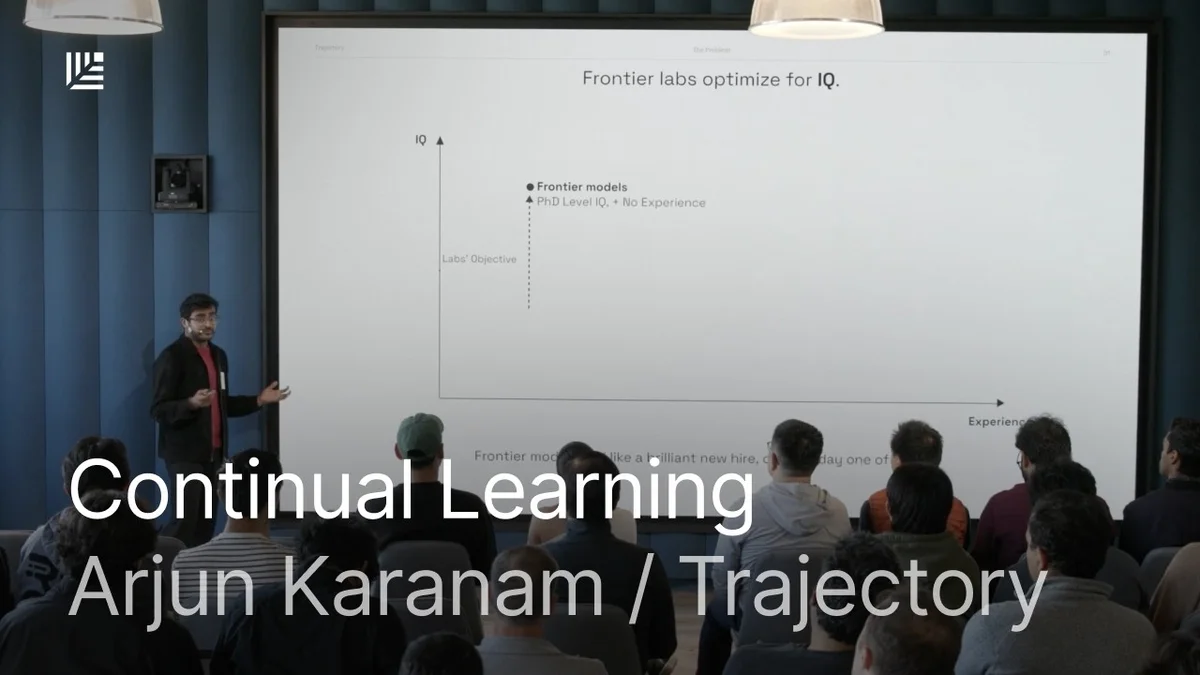
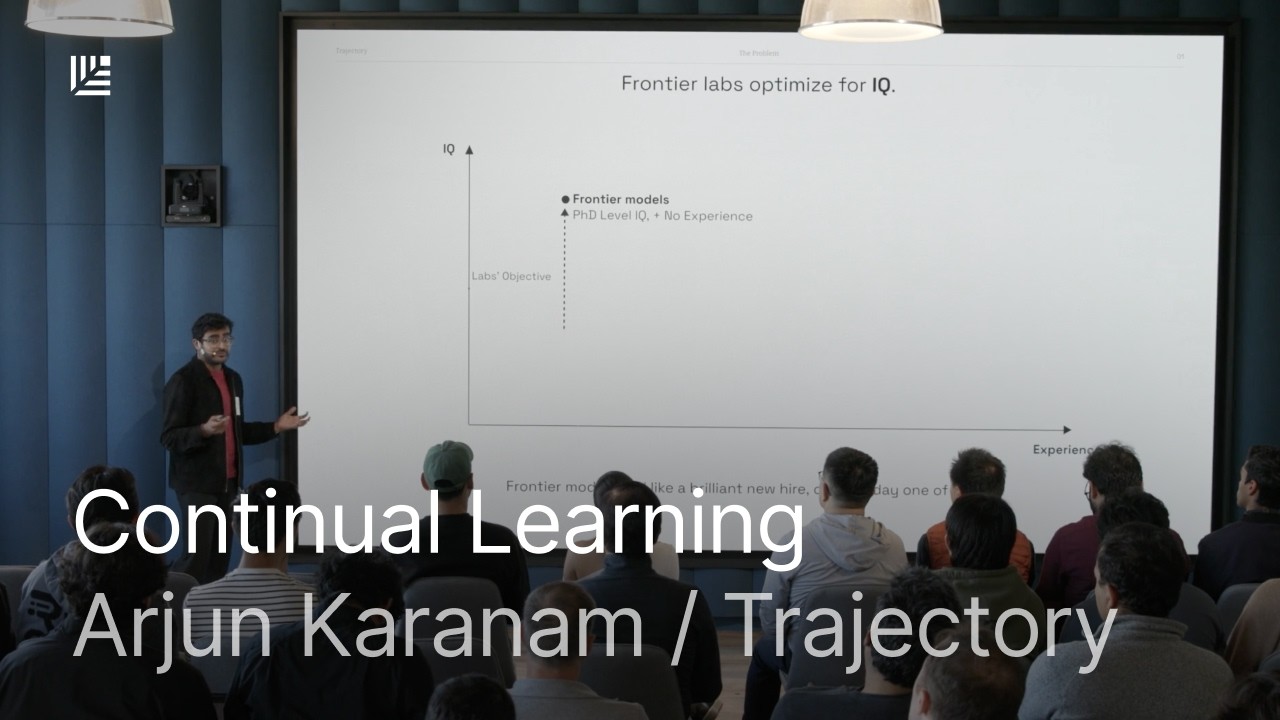
Arjun Karanam of Trajectory presenting on Continual Learning.
Sequoia Capital
Visual TL;DR
AI 'Experience Gap'Driver
models lack practical knowledge from real-world user interactions
From the article 3 mentionsIn the rapidly evolving world of artificial intelligence, models are becoming smarter every week, but they still lack the crucial element of experience.
Models have 'IQ'Context
From the article 9+ mentionsHe argued that while AI models excel in "IQ," they often feel like a brilliant new hire on their first day, lacking the practical knowledge gained from real-world application.
Trajectory PlatformCore
captures and utilizes real-world user interactions for learning
From the article 7 mentionsKaranam, alongside his co-founder Ronak Malde, is building Trajectory, a platform designed to enable what they call "continual learning" for AI agents.
Continual LearningEffect
AI agents learn and adapt through ongoing use, not static models
From the article 8 mentionsKaranam, alongside his co-founder Ronak Malde, is building Trajectory, a platform designed to enable what they call "continual learning" for AI agents.
Traceability & LearningEffect
solution involves capturing and learning from user interactions
From the article 9+ mentionsTraceability: Capturing full interaction traces and product telemetry to understand what happened.
Better Agent EcosystemOutcome
four wishes for improved AI agent development and deployment
From the articleKaranam outlined four key areas for improvement in the agent ecosystem, framed as "wishes":
Bridge Experience GapOutcome
Trajectory's vision to enable AI models to gain practical knowledge
Contents(4)

In the rapidly evolving world of artificial intelligence, models are becoming smarter every week, but they still lack the crucial element of experience. This was the central thesis Arjun Karanam, co-founder of Trajectory, presented at a recent industry talk. He argued that while AI models excel in "IQ," they often feel like a brilliant new hire on their first day, lacking the practical knowledge gained from real-world application.

Trajectory's Arjun Karanam on Closing the AI "Experience Gap" - Sequoia Capital
Trajectory's Arjun Karanam on Closing the AI "Experience Gap", Sequoia Capital

Bridging the "Experience Gap"

Karanam, alongside his co-founder Ronak Malde, is building Trajectory, a platform designed to enable what they call "continual learning" for AI agents. The core idea is to transform how AI models improve over time, moving beyond static, pre-trained models to systems that learn and adapt through ongoing use.

"We are living in an incredible time in human history here," Karanam stated. "Every single week it seems like another model is coming out that is leapfrogging the last one. It's undeniable that models are getting better and better. But we think that they're getting better on one axis and that is IQ. These models are smarter and smarter but always feels like when you're talking to them, it's their first day on the job."

He drew an analogy to a brilliant mathematician, Terence Tao, who, despite possessing high IQ, would likely not be the best accountant on his first day. However, with experience, he would excel. Trajectory aims to provide this "experience" for AI agents by learning from the vast amounts of data generated daily.

The Solution: Traceability and Learning from Interactions

Trajectory's approach centers on capturing and learning from the "stream of real-world signal" generated by AI agents. Karanam highlighted that the 100 billion tokens generated daily by AI agents are often discarded, representing a massive missed opportunity for learning. He believes that learning from these interactions is more akin to how humans become smarter over time.

The platform's solution involves a three-step process:

  • Traceability: Capturing full interaction traces and product telemetry to understand what happened.
  • Model Behavior Specification: Defining what tasks an agent should perform and what good looks like, extracting user interactions and turning them into reward signals.
  • Improvement: Using these signals to improve models and harnesses through techniques like Reinforcement Learning (RL) with algorithms such as SDPO.

Karanam emphasized that models are not the only component that needs to learn. Harnesses, which contain the product's domain knowledge, also need to co-evolve with the models. He proposed a distinction between updating model weights with factual knowledge and providing context to the harness for information that is specific or dynamic.

Four Wishes for a Better Agent Ecosystem

Karanam outlined four key areas for improvement in the agent ecosystem, framed as "wishes":

  1. Traceability: Companies need to trace the entire tree of agent actions, including sub-agents, and design products to capture user feedback, especially corrective behaviors like edits and retries.
  2. Evaluations: Evals should be drawn from real traffic and be as close as possible to where training occurs. Making every task "rolloutable" and grading through the actual production harness are crucial.
  3. Harnesses: Harnesses should be built around primitives, not rigid workflows, enabling agents to orchestrate these primitives. The agent interface should mirror the user interface, and tool responses must be informative to provide learning signals.
  4. Models: Companies should become comfortable running models on weights they train themselves, as this unlocks the ability to own and continually improve their models. Experimenting with model routers is also key.

Trajectory's Platform and Vision

Karanam showcased screenshots of Trajectory's platform, highlighting its ease of use for importing benchmarks, training models, evaluating performance, and deploying them. He noted that the entire process, from training to evaluation, could take as little as 15 minutes.

"Every company should own its own experience layer that never stops evolving," Karanam concluded, expressing his vision for a future where companies can empower themselves to build and refine their AI agents through continuous learning from real-world interactions.

Trajectory has raised $80 million in funding, placing it in a competitive space with other AI companies like Perplexity AI (score 71/100) and larger players like Alphabet Inc. (NASDAQ:GOOGL) (score 74/100) and OpenAI (score 84/100).

© 2026 StartupHub.ai. All rights reserved. You may not republish this article in full without a license. Search engines and AI research tools may crawl and summarize for reference. Bulk reproduction or model training requires a license. See our terms.
Daniel Singer

Written by

Daniel Singer

Editor, StartupHub.ai

Daniel Singer is the editor of StartupHub.ai, a technology expert and thought leader on AI and its applications across sectors, from fintech and healthcare to developer tooling and consumer software. He writes and tests the tools covered here thoroughly and regularly, and built StartupHub.ai to give founders, operators and buyers a clearer read on what they are actually being sold.