

Google's WebMCP: Making the Web Agent-Ready

Google's Tara Agyemang introduces WebMCP, a protocol to make websites agent-ready, simplifying AI interactions and enabling new user experiences.

8 min read
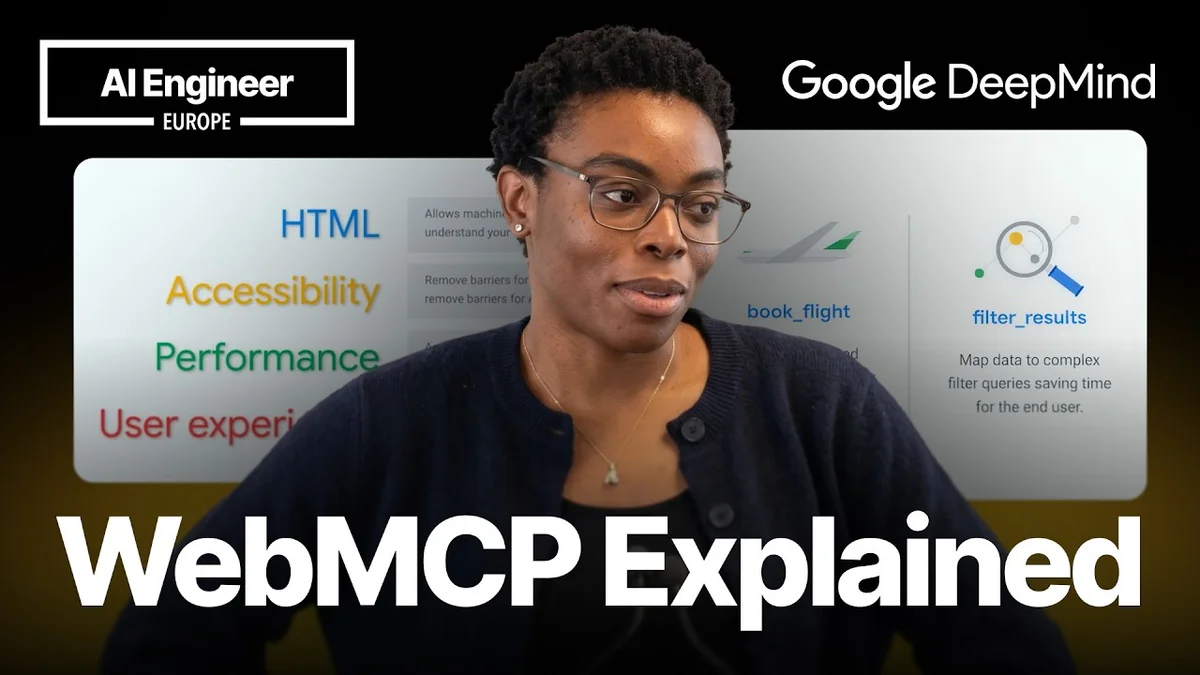
Tara Agyemang presenting on 'The agent-ready web: Simplify user actions with WebMCP' at a Google event.
Tara Agyemang from Google discusses the 'agent-ready web' and WebMCP.· AI Engineer

Tara Agyemang from Google recently presented on the concept of the 'agent-ready web,' focusing on how WebMCP can simplify user actions for AI agents. The core idea behind WebMCP, or Web Model Context Protocol, is to enable websites to expose their functionalities in a structured, machine-readable format, thereby facilitating smoother interactions for AI agents.

Google's WebMCP: Making the Web Agent-Ready - AI Engineer
Google's WebMCP: Making the Web Agent-Ready — from AI Engineer

Visual TL;DR. Web built for humans leads to AI agents struggle. AI agents struggle addressed by WebMCP protocol. WebMCP protocol uses Structured machine-readable. Structured machine-readable enables Agent-ready web. Agent-ready web enables Simplified AI actions. Simplified AI actions enables New user experiences.

  1. Web built for humans: current web design prioritizes human interaction over machine understanding
  2. AI agents struggle: AI agents face challenges understanding dynamic and unstructured web pages
  3. WebMCP protocol: Google's Web Model Context Protocol simplifies AI agent interactions
  4. Structured machine-readable: exposes website functionalities in a structured, machine-readable format
  5. Agent-ready web: enables websites to be easily understood and navigated by AI agents
  6. Simplified AI actions: AI agents can complete tasks more efficiently and reliably
  7. New user experiences: opens doors for innovative applications and enhanced user interactions
Visual TL;DR
Visual TL;DR — startuphub.ai Web built for humans leads to AI agents struggle. AI agents struggle addressed by WebMCP protocol. Agent-ready web enables Simplified AI actions leads to addressed by enables Web built for humans AI agents struggle WebMCP protocol Agent-ready web Simplified AI actions From startuphub.ai · The publishers behind this format
Visual TL;DR — startuphub.ai Web built for humans leads to AI agents struggle. AI agents struggle addressed by WebMCP protocol. Agent-ready web enables Simplified AI actions leads to addressed by enables Web built forhumans AI agentsstruggle WebMCP protocol Agent-ready web Simplified AIactions From startuphub.ai · The publishers behind this format
Visual TL;DR — startuphub.ai Web built for humans leads to AI agents struggle. AI agents struggle addressed by WebMCP protocol. Agent-ready web enables Simplified AI actions leads to addressed by enables Web built for humans current web design prioritizes humaninteraction over machine understanding AI agents struggle AI agents face challenges understandingdynamic and unstructured web pages WebMCP protocol Google's Web Model Context Protocolsimplifies AI agent interactions Agent-ready web enables websites to be easily understoodand navigated by AI agents Simplified AI actions AI agents can complete tasks moreefficiently and reliably From startuphub.ai · The publishers behind this format
Visual TL;DR — startuphub.ai Web built for humans leads to AI agents struggle. AI agents struggle addressed by WebMCP protocol. Agent-ready web enables Simplified AI actions leads to addressed by enables Web built forhumans current web designprioritizes humaninteraction over… AI agentsstruggle AI agents facechallengesunderstanding… WebMCP protocol Google's Web ModelContext Protocolsimplifies AI agent… Agent-ready web enables websites tobe easilyunderstood and… Simplified AIactions AI agents cancomplete tasks moreefficiently and… From startuphub.ai · The publishers behind this format
Visual TL;DR — startuphub.ai Web built for humans leads to AI agents struggle. AI agents struggle addressed by WebMCP protocol. WebMCP protocol uses Structured machine-readable. Structured machine-readable enables Agent-ready web. Agent-ready web enables Simplified AI actions. Simplified AI actions enables New user experiences leads to addressed by uses enables enables enables Web built for humans current web design prioritizes humaninteraction over machine understanding AI agents struggle AI agents face challenges understandingdynamic and unstructured web pages WebMCP protocol Google's Web Model Context Protocolsimplifies AI agent interactions Structured machine-readable exposes website functionalities in astructured, machine-readable format Agent-ready web enables websites to be easily understoodand navigated by AI agents Simplified AI actions AI agents can complete tasks moreefficiently and reliably New user experiences opens doors for innovative applicationsand enhanced user interactions From startuphub.ai · The publishers behind this format
Visual TL;DR — startuphub.ai Web built for humans leads to AI agents struggle. AI agents struggle addressed by WebMCP protocol. WebMCP protocol uses Structured machine-readable. Structured machine-readable enables Agent-ready web. Agent-ready web enables Simplified AI actions. Simplified AI actions enables New user experiences leads to addressed by uses enables enables enables Web built forhumans current web designprioritizes humaninteraction over… AI agentsstruggle AI agents facechallengesunderstanding… WebMCP protocol Google's Web ModelContext Protocolsimplifies AI agent… Structuredmachine-readable exposes websitefunctionalities ina structured,… Agent-ready web enables websites tobe easilyunderstood and… Simplified AIactions AI agents cancomplete tasks moreefficiently and… New userexperiences opens doors forinnovativeapplications and… From startuphub.ai · The publishers behind this format

The Need for an Agent-Ready Web

Agyemang highlighted that in the past two decades, the web has been built for human interaction. However, with the increasing prevalence of AI agents, there's a growing need to adapt web design and development to accommodate these agents. The challenge lies in the fact that AI agents often struggle to understand and interact with the dynamic and often unstructured nature of web pages. This leads to AI agents needing to perform extensive work, such as taking screenshots, analyzing HTML, and even guessing how data should be input, to complete simple tasks.

Related startups

To address this, WebMCP proposes a standardized way for websites to communicate their capabilities to AI agents. By making websites 'agent-ready,' developers can ensure that AI agents can more effectively and efficiently perform tasks on behalf of users.

Key Principles of WebMCP

The presentation emphasized several key principles for creating an agent-ready web:

  • Semantic HTML: Using HTML in a way that accurately describes the content and structure of the page allows machines to parse and understand the context more easily.
  • Accessibility: Adhering to accessibility standards not only benefits human users with disabilities but also removes barriers for AI agents. This ensures that AI can interpret the web as intended.
  • Performance: Optimizing web page performance is crucial, as AI agents can crawl, process, and retrieve data with maximum efficiency when pages load quickly.
  • User Experience: Clear navigation and predictable success logic are vital for autonomous agents to successfully complete tasks.
Declarative vs. Imperative APIs

WebMCP supports two primary approaches for defining tool capabilities: declarative and imperative APIs.

The declarative API approach involves defining the tool's capabilities using a structured format, such as JSON. This allows the AI agent to understand the tool's name, description, input schema, and how to execute it. Agyemang showed an example of a 'todo' tool, where the schema clearly outlines the expected input for adding a new item to a to-do list, including fields like 'text' and 'priority.' The browser can then use this schema to automatically generate user interfaces or provide necessary information to the AI agent.

The imperative API, on the other hand, involves writing JavaScript functions that define the tool's behavior. These functions can include validation, data fetching, and DOM manipulation. In the provided example, an `addToDoItem` function was demonstrated, which handles adding a new item to a to-do list by interacting with the DOM. This approach offers more flexibility for complex interactions but requires more explicit coding.

WebMCP in Action: A Demo

A live demonstration showcased how WebMCP works in practice. Using a 'Maze Escape' game as an example, Agyemang demonstrated how an AI agent could interact with the game by using available tools. The demo highlighted how the AI agent could 'look' to understand its surroundings, 'move' in specific directions, and 'pickup' items. The output of the AI agent's actions, including tool calls and results, was displayed, illustrating the process of AI-driven web interaction.

The demonstration also touched upon the 'Model Context Tool Inspector,' a Chrome extension that allows developers to inspect, monitor, and execute WebMCP tools. This tool provides a visual interface to see the available tools, their schemas, and the interaction history, making it easier to debug and develop AI-powered web experiences.

Status and Future

The presentation concluded by noting that WebMCP is currently in an 'early preview' stage. Google is actively seeking feedback from developers to improve the API and its capabilities. The resources provided, including a blog post and a GitHub repository, offer more detailed information for those interested in exploring or contributing to the development of the agent-ready web.

© 2026 StartupHub.ai. All rights reserved. Do not enter, scrape, copy, reproduce, or republish this article in whole or in part. Use as input to AI training, fine-tuning, retrieval-augmented generation, or any machine-learning system is prohibited without written license. Substantially-similar derivative works will be pursued to the fullest extent of applicable copyright, database, and computer-misuse laws. See our terms.