

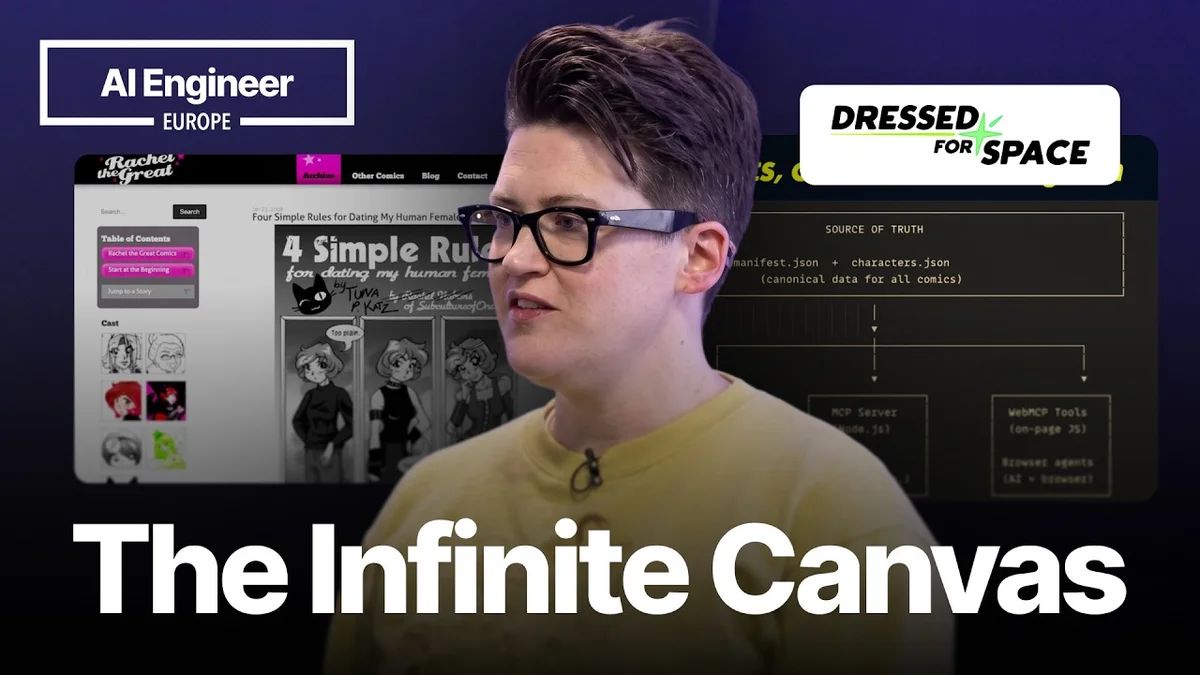
Rachel Nabors: The Infinite Canvas of the Web Agent

Rachel Nabors discusses how AI agents can leverage the web's 'infinite canvas' using MCP tools and WebMCP, transforming browser interactions.

5 min read
Rachel Nabors speaking on stage at AI Engineer Europe, with a slide showing 'Your Agent Is an Infinite Canvas'.
AI Engineer
Visual TL;DR
Webcomics to AIDriver
early career building interactive content for online communities
From the articleNabors began by recounting her early career creating webcomics, where she amassed a significant audience by engaging with online communities.
Browser as Infinite CanvasContext
browser evolving into a powerful platform for AI agents
From the articleHer journey has led her to explore the potential of making the browser an 'infinite canvas' for AI agents.
AI Agent InteractionContext
making AI agents more capable and interactive
From the article 9+ mentionsThis means moving beyond simple text-based interactions and enabling agents to engage with rich media, dynamic content, and interactive elements available on the web.
MCP ToolsCore
enabling AI agent interaction with the web
From the article 9+ mentionsA key element discussed was the Model Control Protocol (MCP), a framework that allows AI agents to communicate with external services and tools.
WebMCPCore
a specific tool for agent-web interaction
From the article 2 mentionsNabors introduced WebMCP as a new development that exposes website capabilities as structured tools for any AI agent.
Transforming Browser UseEffect
AI agents accessing and processing web information
Future DirectionsContext
addressing challenges and exploring new possibilities
Contents(4)

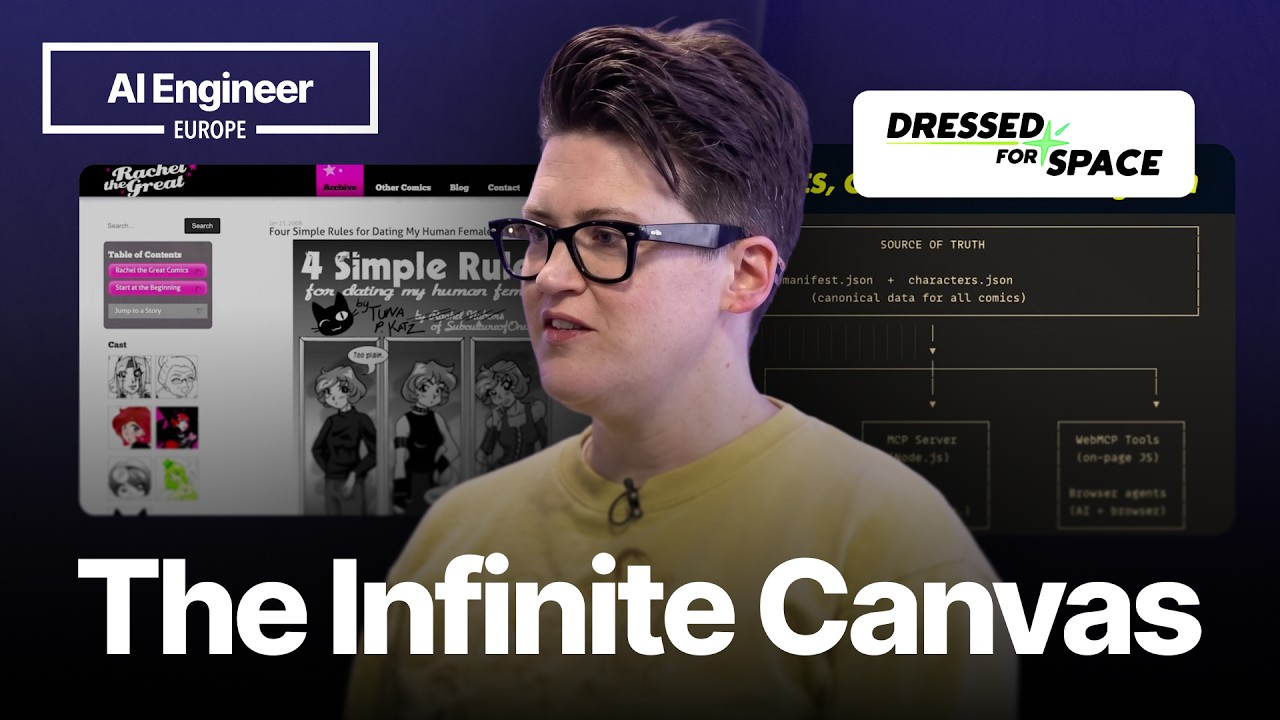
In a compelling presentation at AI Engineer Europe, Rachel Nabors, known for her work on the React team and her webcomic series, explored the concept of agents interacting with the web as an 'infinite canvas.' Nabors, who has spent three years consulting with AI startups and major tech companies, highlighted how the browser, far from being obsolete, is evolving into a powerful platform for AI agents to access and process information.

Rachel Nabors: The Infinite Canvas of the Web Agent - AI Engineer
Rachel Nabors: The Infinite Canvas of the Web Agent — from AI Engineer

From Webcomics to AI Agents

Nabors began by recounting her early career creating webcomics, where she amassed a significant audience by engaging with online communities. This experience, she noted, provided a foundational understanding of how to build and deploy interactive content on the web. She then transitioned to her current work as a principal developer experience engineer at Arize AI, where she focuses on making AI agents more capable and interactive.

Her journey has led her to explore the potential of making the browser an 'infinite canvas' for AI agents. This means moving beyond simple text-based interactions and enabling agents to engage with rich media, dynamic content, and interactive elements available on the web. Nabors emphasized that the browser's existing infrastructure, HTML, CSS, JavaScript, and HTTP, provides a robust foundation for this new paradigm.

MCP: Enabling AI Agent Interaction

A key element discussed was the Model Control Protocol (MCP), a framework that allows AI agents to communicate with external services and tools. Nabors explained that MCP defines how JSON-RPC messages flow between a server and a client, enabling agents to request specific actions and receive structured data in return. She highlighted two primary 'transports' for this communication: STDIO and HTTP.

The STDIO transport involves the server running as a local process, spawned by the client, communicating via standard input/output streams. This method is straightforward but can be limiting in terms of security and isolation. In contrast, the HTTP transport runs the server as a web service, listening at an HTTP endpoint, which is more scalable and aligns with modern web development practices. This approach also works well with serverless setups and offers better isolation for tools.

The 'Infinite Canvas' of WebMCP

Nabors introduced WebMCP as a new development that exposes website capabilities as structured tools for any AI agent. This allows agents to interact with websites more intelligently, whether they are operating 'headless' (without a visible interface) or with a viewport. The core idea is to represent website functionalities as discoverable tools that agents can call upon.

She demonstrated how to register custom tools within the agent framework. This involves defining the tool's name, a description of its function, and an input schema detailing the expected parameters. For example, a 'get_page' tool was showcased, which takes a comic ID, storyline ID, and page number to retrieve specific comic content. This data is then returned in a structured JSON format, allowing the agent to process it effectively.

Challenges and Future Directions

Nabors also touched upon some of the challenges in this domain, particularly regarding external resources and security. She noted that MCP apps are essentially 'islands' contained within a single HTML file, meaning all assets must be embedded or linked with a Cross-Origin Resource Sharing (CORS) policy. This isolation is crucial for security but also presents limitations.

Furthermore, she highlighted that UI-only tools need to be hidden from the agent to prevent models from trying to execute them directly and inappropriately. This is achieved by setting a 'visibility' attribute in the tool's metadata. Nabors concluded by emphasizing that WebMCP is still in active development, but its potential to unlock the web as an interactive canvas for AI agents is immense.

© 2026 StartupHub.ai. All rights reserved. Do not enter, scrape, copy, reproduce, or republish this article in whole or in part. Use as input to AI training, fine-tuning, retrieval-augmented generation, or any machine-learning system is prohibited without written license. Substantially-similar derivative works will be pursued to the fullest extent of applicable copyright, database, and computer-misuse laws. See our terms.