Cursor's Lee Robinson on Recursive Model Improvement

Lee Robinson of Cursor detailed the company's approach to AI model training, focusing on recursive improvement, feedback loops, and leveraging massive compute power from SpaceX.

7 min read
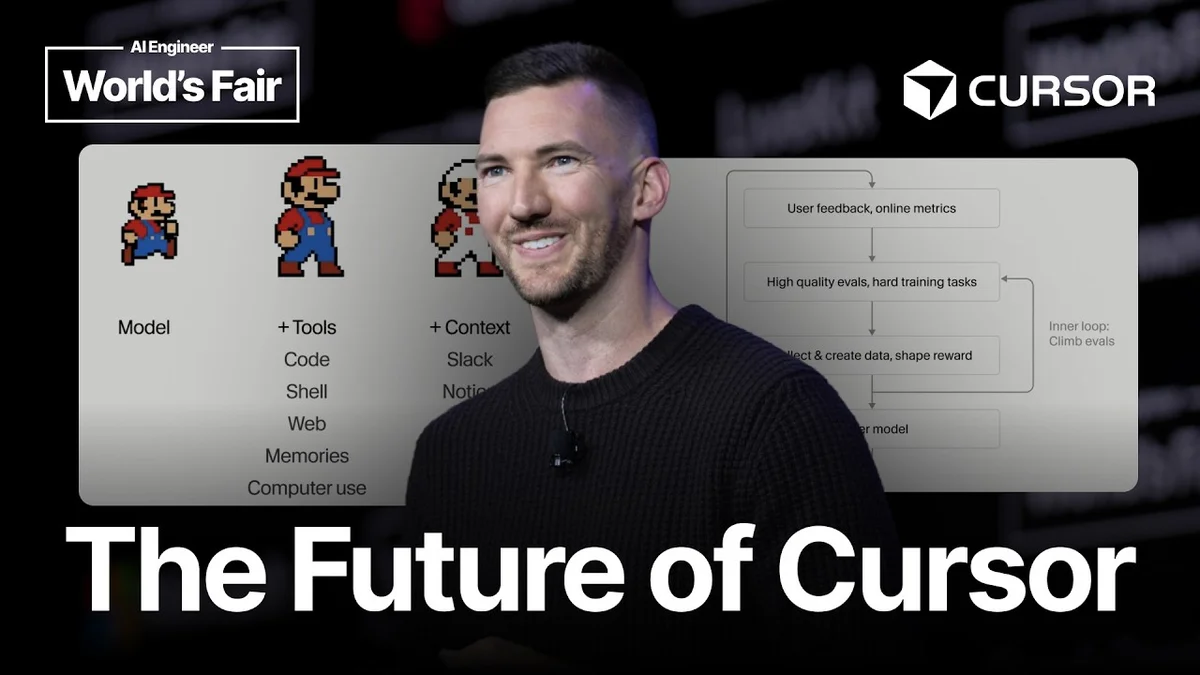
Lee Robinson speaking on stage at AI Engineer's World's Fair with Cursor logo displayed.
AI Engineer

Visual TL;DR. Cursor's AI Training uses Model Training Loop. Model Training Loop drives Iterative Improvement. Iterative Improvement but Serial Process Slow. Serial Process Slow solved by Two-Loop System. Two-Loop System enabled by Massive Compute Power. Two-Loop System leads to Recursive Self-Improvement.

  1. Cursor's AI Training: Lee Robinson details recursive model improvement at AI Engineer's World's Fair
  2. Model Training Loop: deploying model, collecting user feedback, online metrics, A/B testing
  3. Iterative Improvement: feedback informs data scaling, compute increase for new, improved models
  4. Serial Process Slow: traditional iterative cycle is effective but can be time-consuming
  5. Two-Loop System: Cursor employs inner and outer loops to accelerate training and feedback
  6. Massive Compute Power: leveraging compute from SpaceX to scale training processes significantly
  7. Recursive Self-Improvement: future of AI training involves models enhancing their own capabilities
Visual TL;DR
Visual TL;DR, startuphub.ai Two-Loop System leads to Recursive Self-Improvement leads to Cursor's AI Training Iterative Improvement Two-Loop System Recursive Self-Improvement From startuphub.ai · The publishers behind this format
Visual TL;DR, startuphub.ai Two-Loop System leads to Recursive Self-Improvement leads to Cursor's AITraining IterativeImprovement Two-Loop System RecursiveSelf-Improvement From startuphub.ai · The publishers behind this format
Visual TL;DR, startuphub.ai Two-Loop System leads to Recursive Self-Improvement leads to Cursor's AI Training Lee Robinson details recursive modelimprovement at AI Engineer's World's Fair Iterative Improvement feedback informs data scaling, computeincrease for new, improved models Two-Loop System Cursor employs inner and outer loops toaccelerate training and feedback Recursive Self-Improvement future of AI training involves modelsenhancing their own capabilities From startuphub.ai · The publishers behind this format
Visual TL;DR, startuphub.ai Two-Loop System leads to Recursive Self-Improvement leads to Cursor's AITraining Lee Robinsondetails recursivemodel improvement… IterativeImprovement feedback informsdata scaling,compute increase… Two-Loop System Cursor employsinner and outerloops to accelerate… RecursiveSelf-Improvement future of AItraining involvesmodels enhancing… From startuphub.ai · The publishers behind this format
Visual TL;DR, startuphub.ai Cursor's AI Training uses Model Training Loop. Model Training Loop drives Iterative Improvement. Iterative Improvement but Serial Process Slow. Serial Process Slow solved by Two-Loop System. Two-Loop System enabled by Massive Compute Power. Two-Loop System leads to Recursive Self-Improvement uses drives but solved by enabled by leads to Cursor's AI Training Lee Robinson details recursive modelimprovement at AI Engineer's World's Fair Model Training Loop deploying model, collecting user feedback,online metrics, A/B testing Iterative Improvement feedback informs data scaling, computeincrease for new, improved models Serial Process Slow traditional iterative cycle is effectivebut can be time-consuming Two-Loop System Cursor employs inner and outer loops toaccelerate training and feedback Massive Compute Power leveraging compute from SpaceX to scaletraining processes significantly Recursive Self-Improvement future of AI training involves modelsenhancing their own capabilities From startuphub.ai · The publishers behind this format
Visual TL;DR, startuphub.ai Cursor's AI Training uses Model Training Loop. Model Training Loop drives Iterative Improvement. Iterative Improvement but Serial Process Slow. Serial Process Slow solved by Two-Loop System. Two-Loop System enabled by Massive Compute Power. Two-Loop System leads to Recursive Self-Improvement uses drives but solved by enabled by leads to Cursor's AITraining Lee Robinsondetails recursivemodel improvement… Model TrainingLoop deploying model,collecting userfeedback, online… IterativeImprovement feedback informsdata scaling,compute increase… Serial ProcessSlow traditionaliterative cycle iseffective but can… Two-Loop System Cursor employsinner and outerloops to accelerate… Massive ComputePower leveraging computefrom SpaceX toscale training… RecursiveSelf-Improvement future of AItraining involvesmodels enhancing… From startuphub.ai · The publishers behind this format

Lee Robinson, Machine Learning Engineer for Model Behavior at Cursor, took the stage at AI Engineer's World's Fair to discuss the intricate process of training AI models, with a particular focus on recursive model improvement. Robinson detailed Cursor's approach to building state-of-the-art models, emphasizing the iterative loop of gathering feedback, refining data, and scaling training processes.

Cursor's Lee Robinson on Recursive Model Improvement - AI Engineer
Cursor's Lee Robinson on Recursive Model Improvement — from AI Engineer

The Model Training Loop

Robinson outlined a core training loop that begins with deploying a model into the world, followed by collecting user feedback. This feedback, along with online metrics and A/B testing, informs data scaling and improvement for subsequent training rounds. The process also involves increasing compute power to scale up overall training, ultimately leading to a new, improved model. This iterative cycle, while effective, is described as a serial process that can be time-consuming.

To accelerate this, Cursor employs a two-loop system: an outer loop for feedback and online metrics, and an inner loop focused on "climbing evaluations" and tackling more difficult training tasks. The goal is to generate higher-quality evaluations and create more challenging problems for models to solve, thereby shaping desired rewards during training.

Cursor's Progress and Future Ambitions

Cursor has been training models at scale for about a year, with its Composer 2.5 model, released in May, now being its most popular. Robinson highlighted that while Cursor initially focused on specialized models for tasks like tab completion, the past year has seen significant team expansion and a drive to develop state-of-the-art models. Composer is noted for its balance of speed, intelligence, and cost-effectiveness, filling a crucial niche in the market.

Looking ahead, Cursor aims to develop even larger and smarter models, gain full control over the training process by pre-training from scratch rather than relying on open-source bases, infuse new data to broaden model capabilities beyond coding, and scale up all aspects of training, particularly reinforcing the use of Reinforcement Learning (RL).

Enhancing the Inner and Outer Loops

Robinson elaborated on improving the outer loop by utilizing agent usage data, which constitutes the majority of Cursor's revenue. Feedback, both external (thumbs up/down) and internal (from heavy dogfooding), is classified to identify and address areas needing improvement.

The inner loop's acceleration is crucial. This involves creating high-quality, difficult evaluation tasks that accurately measure progress. Examples include models understanding user intent across numerous files, discerning when to ask for clarification versus trusting user input, and performing complex software engineering tasks like analyzing logs to diagnose issues. Robinson also touched upon the challenge of "reward hacking," where models find clever ways to exploit evaluations, such as by looking at Git history or external solutions.

To counter this, Cursor employs methods like deleting Git history during evaluations and implementing network allow-lists for agents. They have also developed private evaluation sets, like Cursor Bench, which are based on real-world tasks within their codebase and are held out from training data to ensure accurate performance measurement.

Innovative Training Techniques and Compute Scaling

The presentation also introduced novel learning methods, such as teaching models to "coach themselves." This involves providing specific textual feedback or hints within a model's rollout to guide its decision-making process, thereby improving its adherence to tool calling or stylistic consistency.

Scaling compute is central to these advancements. Cursor's partnership with SpaceX provides access to significant compute resources, enabling them to train large models from scratch. Robinson specifically mentioned SpaceX's Colossus supercomputer, which houses 200,000 GPUs, and Terafab for chip development, underscoring the full-stack approach to AI development.

The Future of AI Training: Recursive Self-Improvement

Robinson concluded by discussing the concept of the model training the next model, leading to recursive self-improvement. As models become smarter, they can generate or distill derivative models that accelerate training processes. This iterative improvement raises the baseline intelligence, enabling faster progress and the creation of more useful AI models. The ultimate goal is to automate more of the machine learning and research processes, freeing up researchers to focus on ambitious ideas and drive further innovation.

© 2026 StartupHub.ai. All rights reserved. Do not enter, scrape, copy, reproduce, or republish this article in whole or in part. Use as input to AI training, fine-tuning, retrieval-augmented generation, or any machine-learning system is prohibited without written license. Substantially-similar derivative works will be pursued to the fullest extent of applicable copyright, database, and computer-misuse laws. See our terms.