

Anthropic's Evolution of AI Agents

Anthropic's Gagan Bhat and Isabella Kai He detail the evolution of AI agents, from Messages API to Managed Agents, focusing on engineering principles, reliability, and security.

8 min read
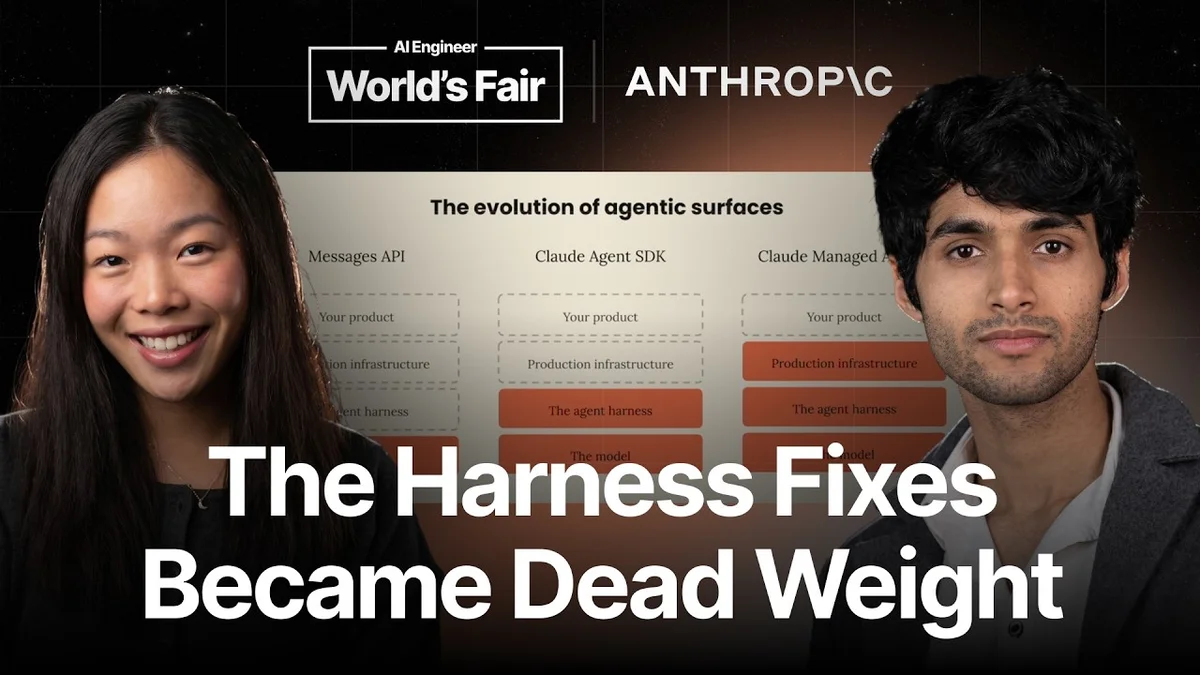
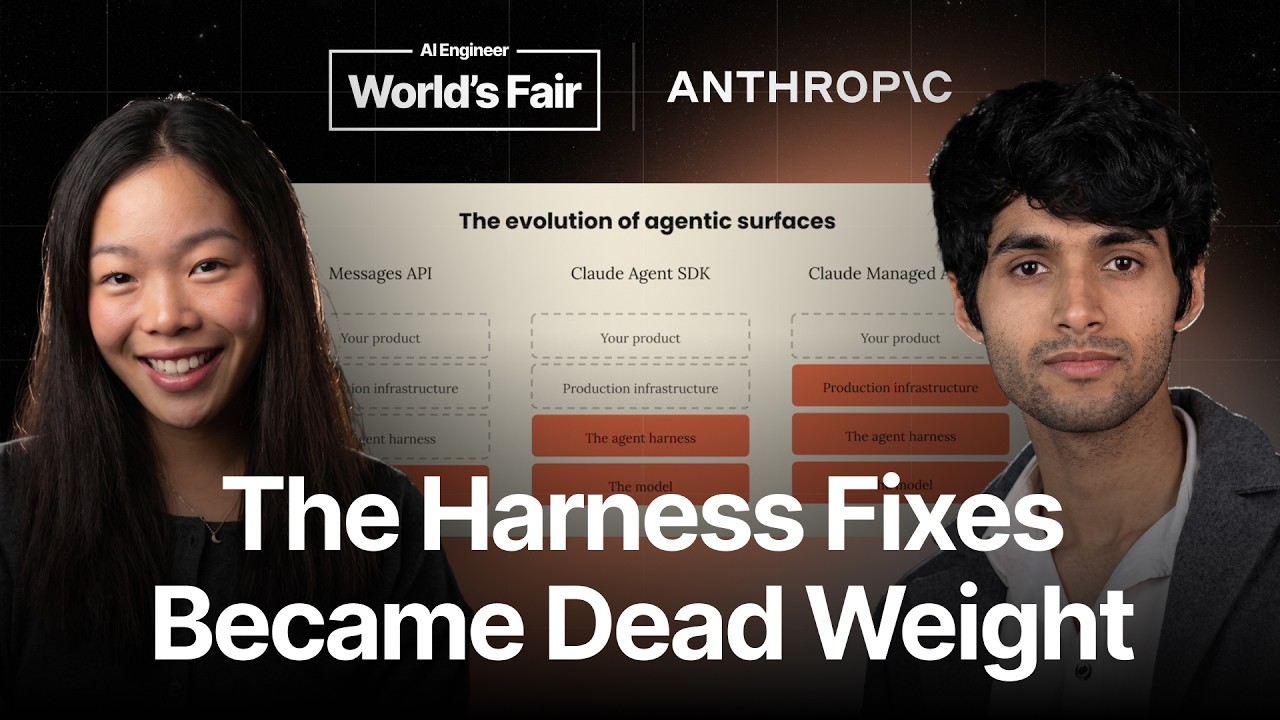
Gagan Bhat and Isabella Kai He from Anthropic presenting on the evolution of agentic surfaces.
Gagan Bhat and Isabella Kai He of Anthropic discuss the development of AI agents.· AI Engineer

Visual TL;DR. AI Progress Accelerates leads to Models Own Outcomes. Models Own Outcomes requires Evolving Agent Surfaces. Evolving Agent Surfaces started with Messages API. Messages API evolved to Agentic Loop. Agentic Loop then to Managed Agents. Managed Agents enables Production-Ready AI.

  1. AI Progress Accelerates: transformer architecture to current model capabilities dramatically increased task complexity
  2. Models Own Outcomes: AI models now capable of owning entire outcomes, not just simple Q&A
  3. Evolving Agent Surfaces: necessitates evolution in interfaces used to build these advanced AI agents
  4. Messages API: initial 'tokens in, tokens out' system for straightforward AI interactions
  5. Agentic Loop: models manage context and fetch information as task complexity grew
  6. Managed Agents: advanced Claude Managed Agents for production-ready, reliable, and secure AI
  7. Production-Ready AI: focus on engineering principles, reliability, and security for real-world deployment
Visual TL;DR
Visual TL;DR, startuphub.ai Managed Agents enables Production-Ready AI enables AI Progress Accelerates Evolving Agent Surfaces Managed Agents Production-Ready AI From startuphub.ai · The publishers behind this format
Visual TL;DR, startuphub.ai Managed Agents enables Production-Ready AI enables AI ProgressAccelerates Evolving AgentSurfaces Managed Agents Production-ReadyAI From startuphub.ai · The publishers behind this format
Visual TL;DR, startuphub.ai Managed Agents enables Production-Ready AI enables AI Progress Accelerates transformer architecture to current modelcapabilities dramatically increased taskcomplexity Evolving Agent Surfaces necessitates evolution in interfaces usedto build these advanced AI agents Managed Agents advanced Claude Managed Agents forproduction-ready, reliable, and secure AI Production-Ready AI focus on engineering principles,reliability, and security for real-worlddeployment From startuphub.ai · The publishers behind this format
Visual TL;DR, startuphub.ai Managed Agents enables Production-Ready AI enables AI ProgressAccelerates transformerarchitecture tocurrent model… Evolving AgentSurfaces necessitatesevolution ininterfaces used to… Managed Agents advanced ClaudeManaged Agents forproduction-ready,… Production-ReadyAI focus onengineeringprinciples,… From startuphub.ai · The publishers behind this format
Visual TL;DR, startuphub.ai AI Progress Accelerates leads to Models Own Outcomes. Models Own Outcomes requires Evolving Agent Surfaces. Evolving Agent Surfaces started with Messages API. Messages API evolved to Agentic Loop. Agentic Loop then to Managed Agents. Managed Agents enables Production-Ready AI leads to requires started with evolved to then to enables AI Progress Accelerates transformer architecture to current modelcapabilities dramatically increased taskcomplexity Models Own Outcomes AI models now capable of owning entireoutcomes, not just simple Q&A Evolving Agent Surfaces necessitates evolution in interfaces usedto build these advanced AI agents Messages API initial 'tokens in, tokens out' system forstraightforward AI interactions Agentic Loop models manage context and fetchinformation as task complexity grew Managed Agents advanced Claude Managed Agents forproduction-ready, reliable, and secure AI Production-Ready AI focus on engineering principles,reliability, and security for real-worlddeployment From startuphub.ai · The publishers behind this format
Visual TL;DR, startuphub.ai AI Progress Accelerates leads to Models Own Outcomes. Models Own Outcomes requires Evolving Agent Surfaces. Evolving Agent Surfaces started with Messages API. Messages API evolved to Agentic Loop. Agentic Loop then to Managed Agents. Managed Agents enables Production-Ready AI leads to requires started with evolved to then to enables AI ProgressAccelerates transformerarchitecture tocurrent model… Models OwnOutcomes AI models nowcapable of owningentire outcomes,… Evolving AgentSurfaces necessitatesevolution ininterfaces used to… Messages API initial 'tokens in,tokens out' systemfor straightforward… Agentic Loop models managecontext and fetchinformation as task… Managed Agents advanced ClaudeManaged Agents forproduction-ready,… Production-ReadyAI focus onengineeringprinciples,… From startuphub.ai · The publishers behind this format

Anthropic's Applied AI team members Gagan Bhat and Isabella Kai He recently discussed the evolution of agentic surfaces for building AI agents. They highlighted the journey from the initial Messages API to the more advanced Claude Managed Agents, emphasizing the challenges and lessons learned in creating production-ready AI agents.
Anthropic's Evolution of AI Agents - AI Engineer
Anthropic's Evolution of AI Agents — from AI Engineer

The Evolving Landscape of Agentic Surfaces

The rapid acceleration of AI progress, from the transformer architecture to current model capabilities, has dramatically increased the complexity of tasks assigned to AI models. Initially, models were used for simple Q&A, but now they are capable of owning entire outcomes. This progression necessitates an evolution in the interfaces, or 'surfaces,' used to build these agents.

Gagan Bhat outlined the progression: The initial Messages API was a straightforward 'tokens in, tokens out' system. As task complexity grew, the need for models to manage context and fetch information led to the 'agentic loop,' which customers initially had to build manually. This manual process was painstaking and often overlooked crucial production infrastructure challenges like session management, observability, credentials, hosting, and sandboxing. These hurdles prevented teams from focusing on their core products.

The second stage was the Claude Agent SDK, which packaged the agent loop with file system access, tools, and sandboxing. While it provided primitives for session management and observability, developers still had to handle aspects like credentials and hosting infrastructure.

The latest evolution, Claude Managed Agents, aims to provide a complete, production-grade infrastructure solution. Developers can focus on the product, task, and context, while Anthropic handles the underlying infrastructure, including the agentic loop, sandboxing, session management, observability, and more. This approach separates the 'brain' (the agent loop and Claude) from the 'hands' (the sandbox for tool execution), improving reliability and allowing for on-demand resource provisioning.

Engineering Principles for Model Evolution

Isabella Kai He elaborated on the engineering principles behind Claude Managed Agents, emphasizing the need to build for model evolution. She cited the example of 'context anxiety' observed in Sonnet 4.5, where the agent would prematurely end tasks as it neared its context window limit. The team implemented fixes like context resets in the harness. However, when Opus 4.5 was released, this behavior disappeared, rendering the previous fixes obsolete and even detrimental, adding latency and causing cache issues.

This experience highlighted the maintenance burden of static harnesses and the importance of designing for future model capabilities. Claude Managed Agents is built around a set of primitives with independent components, allowing for easy iteration and swapping as models advance. The design also prioritizes long-running agents, requiring robust context engineering, secure sandboxing, reliability over extended periods, and the ability to parallelize workflows.

A Demo of an SRE Investigator Agent

Gagan then demonstrated the practical application of Claude Managed Agents by building an SRE investigator agent. The process involved defining the agent with its system prompt and tools, specifying the environment (a secure sandbox with limited networking), and then initiating a session. The agent, when prompted with an incident, could leverage its tools (bash, grep, MCP tools) to investigate application logs and metrics, identify recent deploys, isolate the incident's start, find code diffs, and synthesize this information to determine the root cause.

Lessons Learned from the Field

Several key lessons emerged from taking this technology to enterprise customers:

  • Keep credentials away from your agent: The separation of the agent loop and tool execution, combined with 'vaults' for secure credential storage, ensures models never directly access sensitive tokens.
  • Don't block reasoning on container startup: Decoupling the brain from the hands significantly improves latency, particularly 'time to first token,' by allowing parallel processing.
  • Session logs for observability and self-improvement: These logs provide a play-by-play of agent execution, offering insights for both debugging and continuous improvement.
  • Security for tool execution: Features like self-hosted sandboxes and MCP tunnels allow customers to control execution environments and secure their internal systems.

Building at the Frontier with Future Features

Anthropic is continuously experimenting with new features to further enhance agent capabilities. Concepts like 'dreaming' (where agents refine their memory by processing past session transcripts periodically) and 'outcomes' (defining success criteria for agents and having a separate grader agent ensure task completion) are key to building self-improving and more intelligent agents. These advancements aim to close the gap between what current products can offer and the full potential of evolving AI models.

© 2026 StartupHub.ai. All rights reserved. Do not enter, scrape, copy, reproduce, or republish this article in whole or in part. Use as input to AI training, fine-tuning, retrieval-augmented generation, or any machine-learning system is prohibited without written license. Substantially-similar derivative works will be pursued to the fullest extent of applicable copyright, database, and computer-misuse laws. See our terms.