



In a recent discussion at the AI Ascent event, Andrej Karpathy, a prominent figure in the AI research community and former Director of AI at Tesla, offered a compelling perspective on the current state and future trajectory of artificial intelligence. Karpathy, known for his foundational work in deep learning and his ability to explain complex AI concepts with clarity, addressed the audience on the evolving relationship between humans and AI, particularly concerning the shift from traditional programming to prompt-based interactions.
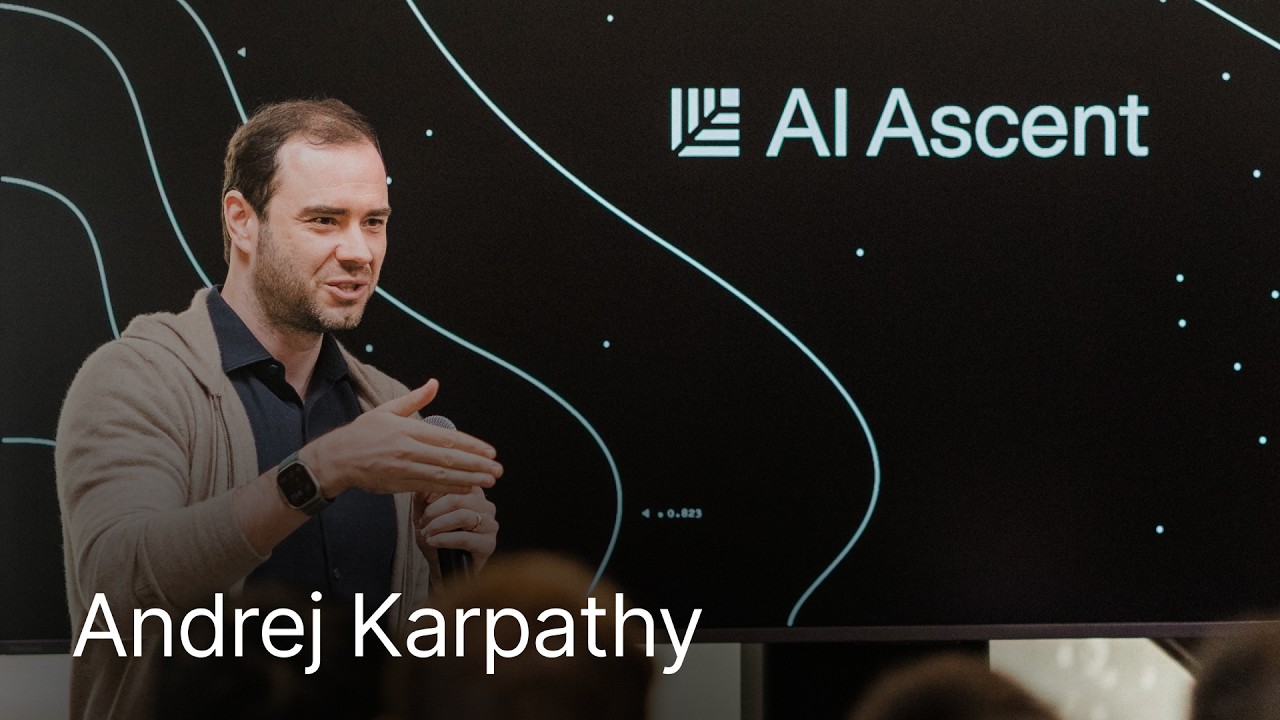
Andrej Karpathy's Background
Andrej Karpathy is a renowned researcher in the field of artificial intelligence, particularly in deep learning and computer vision. He played a pivotal role in the development of AI at Tesla, where he led the Autopilot team. Before his tenure at Tesla, Karpathy was a student of Fei-Fei Li at Stanford University, where he contributed significantly to computer vision research, including the influential ImageNet dataset. His work has been instrumental in pushing the boundaries of what AI can achieve in real-world applications.
The Shift from Programming to Prompting
Karpathy began by drawing a parallel between traditional software engineering and the emerging paradigm of interacting with large language models (LLMs) through prompts. He articulated that in the past, software development involved explicitly coding rules and logic. However, with the advent of models like GPT-3 and its successors, the approach has shifted towards crafting effective prompts to elicit desired behaviors from AI systems. This transition, he noted, represents a fundamental change in how we interact with and build intelligent systems.
The Need for Deeper Reasoning
A core theme of Karpathy's discussion was the current limitations of AI models, particularly in their ability to exhibit true understanding and reasoning. While LLMs can generate remarkably coherent text and perform various tasks, Karpathy argued that they often operate more like sophisticated pattern-matching machines than entities with genuine comprehension. He pointed out that these models can struggle with tasks requiring deep causal reasoning, common sense, or understanding nuanced context, which are fundamental aspects of human intelligence.
Karpathy elaborated on this by stating, "We're still very much in the realm of pattern matching, and we need to bridge the gap towards true reasoning." He emphasized that while current AI is impressive, it often lacks the underlying understanding that humans possess, leading to occasional nonsensical outputs or failures in critical reasoning tasks.