

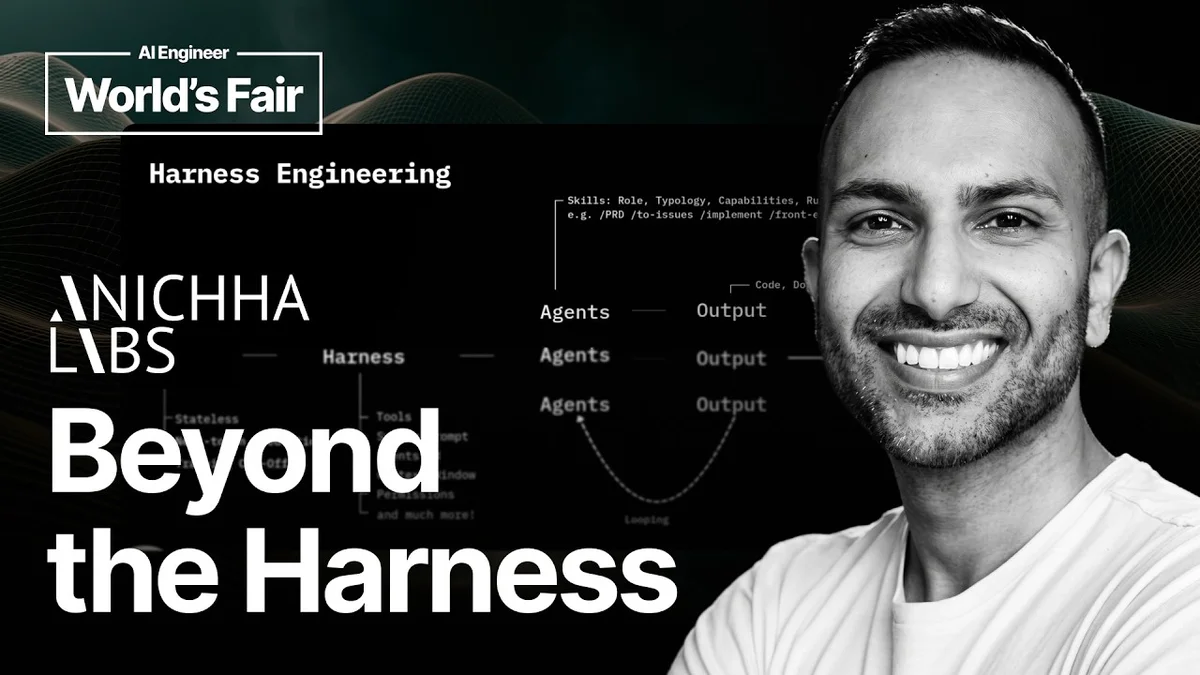
Slide showing the title 'Beyond the Harness: The journey towards Adaptive Engineering' with speaker Rajiv Chandegra and Annicha Labs logo.
Rajiv Chandegra introduces the concept of adaptive engineering.· AI Engineer

AI's Future: From Fixed to Adaptive Engineering

Rajiv Chandegra of Annicha Labs explores the transition from fixed to adaptive engineering in AI, emphasizing emergent, self-organizing systems.

9 min read

Rajiv Chandegra of Annicha Labs proposes a shift in AI engineering, moving beyond rigid, pre-defined systems towards a more dynamic and responsive approach. In his presentation, "Beyond the Harness: A Journey Towards adaptive engineering," Chandegra argues that the future of AI development lies in creating systems that can adapt and evolve in real-time, rather than relying on static, prescriptive frameworks.
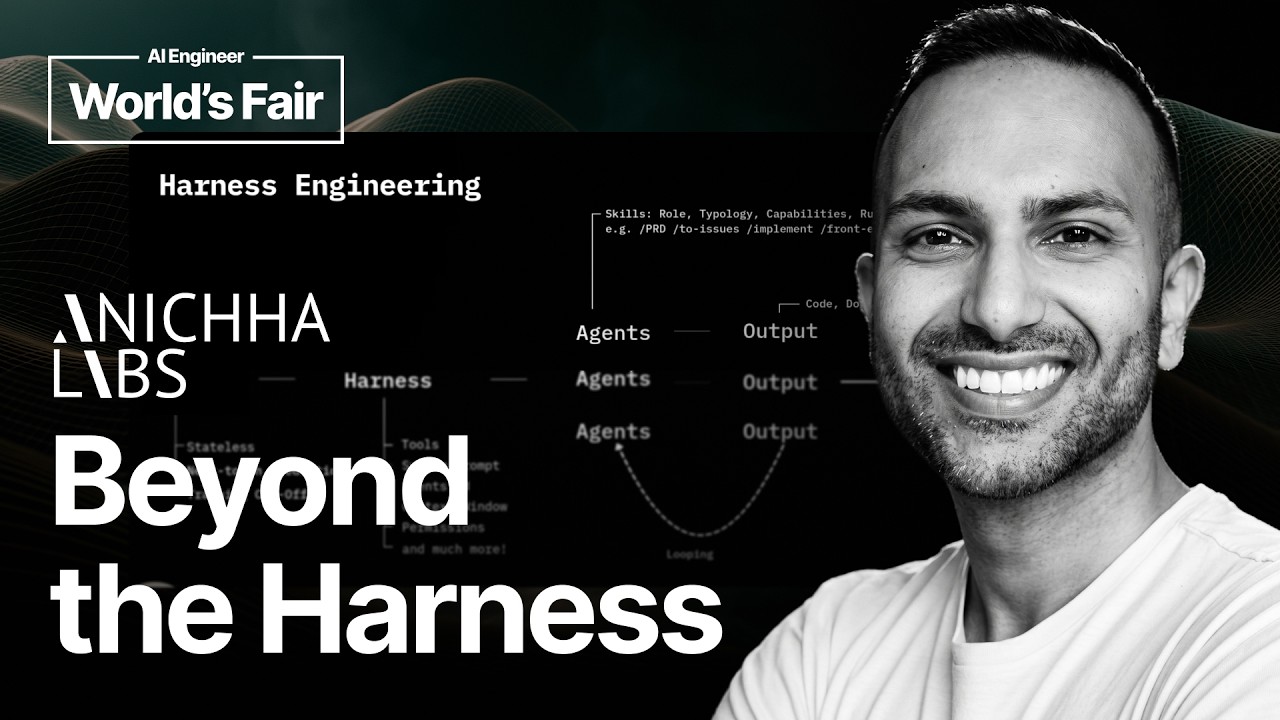
AI's Future: From Fixed to Adaptive Engineering - AI Engineer
AI's Future: From Fixed to Adaptive Engineering — from AI Engineer

Visual TL;DR. Fixed Harness Limitations leads to Introducing Adaptive Engineering. Introducing Adaptive Engineering enables Emergent, Self-Organizing Systems. Emergent, Self-Organizing Systems results in Future of AI Engineering. Rajiv Chandegra (Annicha Labs) identifies Fixed Harness Limitations. Rajiv Chandegra (Annicha Labs) proposes Introducing Adaptive Engineering.

  1. Fixed Harness Limitations: rigid, pre-defined frameworks struggle with dynamic environments
  2. Introducing Adaptive Engineering: moving beyond static, prescriptive frameworks for AI development
  3. The 'Harness' as Output: AI systems generate their own adaptive rules and structures
  4. Complicated vs. Complex: distinguishing between solvable and emergent problem spaces
  5. Emergent, Self-Organizing Systems: AI agents that can adapt and evolve in real-time
  6. Future of AI Engineering: dynamic, responsive AI development for evolving challenges
  7. Rajiv Chandegra (Annicha Labs): proposes shift from fixed to adaptive AI engineering
Visual TL;DR
Visual TL;DR, startuphub.ai Fixed Harness Limitations leads to Introducing Adaptive Engineering. Introducing Adaptive Engineering enables Emergent, Self-Organizing Systems. Emergent, Self-Organizing Systems results in Future of AI Engineering. Rajiv Chandegra (Annicha Labs) identifies Fixed Harness Limitations. Rajiv Chandegra (Annicha Labs) proposes Introducing Adaptive Engineering leads to enables results in identifies proposes Fixed Harness Limitations Introducing Adaptive Engineering Emergent, Self-Organizing Systems Future of AI Engineering Rajiv Chandegra (Annicha Labs) From startuphub.ai · The publishers behind this format
Visual TL;DR, startuphub.ai Fixed Harness Limitations leads to Introducing Adaptive Engineering. Introducing Adaptive Engineering enables Emergent, Self-Organizing Systems. Emergent, Self-Organizing Systems results in Future of AI Engineering. Rajiv Chandegra (Annicha Labs) identifies Fixed Harness Limitations. Rajiv Chandegra (Annicha Labs) proposes Introducing Adaptive Engineering leads to enables results in identifies proposes Fixed HarnessLimitations IntroducingAdaptive… Emergent,Self-Organizing… Future of AIEngineering Rajiv Chandegra(Annicha Labs) From startuphub.ai · The publishers behind this format
Visual TL;DR, startuphub.ai Fixed Harness Limitations leads to Introducing Adaptive Engineering. Introducing Adaptive Engineering enables Emergent, Self-Organizing Systems. Emergent, Self-Organizing Systems results in Future of AI Engineering. Rajiv Chandegra (Annicha Labs) identifies Fixed Harness Limitations. Rajiv Chandegra (Annicha Labs) proposes Introducing Adaptive Engineering leads to enables results in identifies proposes Fixed Harness Limitations rigid, pre-defined frameworks strugglewith dynamic environments Introducing Adaptive Engineering moving beyond static, prescriptiveframeworks for AI development Emergent, Self-Organizing Systems AI agents that can adapt and evolve inreal-time Future of AI Engineering dynamic, responsive AI development forevolving challenges Rajiv Chandegra (Annicha Labs) proposes shift from fixed to adaptive AIengineering From startuphub.ai · The publishers behind this format
Visual TL;DR, startuphub.ai Fixed Harness Limitations leads to Introducing Adaptive Engineering. Introducing Adaptive Engineering enables Emergent, Self-Organizing Systems. Emergent, Self-Organizing Systems results in Future of AI Engineering. Rajiv Chandegra (Annicha Labs) identifies Fixed Harness Limitations. Rajiv Chandegra (Annicha Labs) proposes Introducing Adaptive Engineering leads to enables results in identifies proposes Fixed HarnessLimitations rigid, pre-definedframeworks strugglewith dynamic… IntroducingAdaptive… moving beyondstatic,prescriptive… Emergent,Self-Organizing… AI agents that canadapt and evolve inreal-time Future of AIEngineering dynamic, responsiveAI development forevolving challenges Rajiv Chandegra(Annicha Labs) proposes shift fromfixed to adaptiveAI engineering From startuphub.ai · The publishers behind this format
Visual TL;DR, startuphub.ai Fixed Harness Limitations leads to Introducing Adaptive Engineering. Introducing Adaptive Engineering enables Emergent, Self-Organizing Systems. Emergent, Self-Organizing Systems results in Future of AI Engineering. Rajiv Chandegra (Annicha Labs) identifies Fixed Harness Limitations. Rajiv Chandegra (Annicha Labs) proposes Introducing Adaptive Engineering leads to enables results in identifies proposes Fixed Harness Limitations rigid, pre-defined frameworks strugglewith dynamic environments Introducing Adaptive Engineering moving beyond static, prescriptiveframeworks for AI development The 'Harness' as Output AI systems generate their own adaptiverules and structures Complicated vs. Complex distinguishing between solvable andemergent problem spaces Emergent, Self-Organizing Systems AI agents that can adapt and evolve inreal-time Future of AI Engineering dynamic, responsive AI development forevolving challenges Rajiv Chandegra (Annicha Labs) proposes shift from fixed to adaptive AIengineering From startuphub.ai · The publishers behind this format
Visual TL;DR, startuphub.ai Fixed Harness Limitations leads to Introducing Adaptive Engineering. Introducing Adaptive Engineering enables Emergent, Self-Organizing Systems. Emergent, Self-Organizing Systems results in Future of AI Engineering. Rajiv Chandegra (Annicha Labs) identifies Fixed Harness Limitations. Rajiv Chandegra (Annicha Labs) proposes Introducing Adaptive Engineering leads to enables results in identifies proposes Fixed HarnessLimitations rigid, pre-definedframeworks strugglewith dynamic… IntroducingAdaptive… moving beyondstatic,prescriptive… The 'Harness' asOutput AI systems generatetheir own adaptiverules and… Complicated vs.Complex distinguishingbetween solvableand emergent… Emergent,Self-Organizing… AI agents that canadapt and evolve inreal-time Future of AIEngineering dynamic, responsiveAI development forevolving challenges Rajiv Chandegra(Annicha Labs) proposes shift fromfixed to adaptiveAI engineering From startuphub.ai · The publishers behind this format
!-- /sh-diagram -->

The Limitations of Fixed Harnesses

Chandegra begins by outlining the current paradigm in AI engineering, which he characterizes as "fixed harnessing." This approach involves using a "harness", a scaffold of rules, roles, topology, and tool access, to steer AI agents. These fixed harnesses are reliable, replicable, and auditable, making them suitable for well-defined engineering problems. The engineer's role in this model is to build and manage these harnesses, essentially directing the agents' actions.

However, Chandegra posits that this fixed approach faces significant challenges as AI models become more powerful and the real world, with its inherent messiness and constant change, becomes increasingly intertwined with AI applications. He identifies two primary drivers for this shift: firstly, the sheer power of modern models, which can render pre-defined harnesses quickly outdated; and secondly, the dynamic and often unpredictable nature of real-world exposure, which makes fixed harnesses brittle and prone to failure.

Introducing Adaptive Engineering

To address these limitations, Chandegra introduces the concept of "adaptive engineering." In this model, the harness is not pre-defined but emerges dynamically from the interactions of agents. The engineer's role transforms from that of a director to a designer of constraints and selection pressures, guiding the agents to discover and adapt their own harnesses. This means setting the rules of interaction amongst agents and applying pressures that favor certain emergent behaviors.

Chandegra explains that adaptive engineering requires a fundamental shift in how we think about AI systems. Instead of imposing a rigid structure, the engineer sets the stage and allows the system to find its optimal structure and behavior. This is achieved by allowing the necessary "harness" to emerge and adapt mid-engineering, based on the agents' interactions with their environment.

The "Harness" as an Output

A key insight Chandegra shares is that in adaptive engineering, the "harness" itself becomes an output, rather than a static input. The agents, through their interactions and the environment's feedback, discover and refine the harness that is most suitable for their problem space. This process may involve mid-engineering adaptations, allowing the system to evolve its own operational framework.

The result is a self-organizing, constantly evolving, multi-agent system where the harness is not a fixed blueprint but a dynamic emergent property. This contrasts sharply with the current model, where the harness is a "single agent in the loop learning" system, dictating behavior from the outset.

The Duality of Problem Spaces: Complicated vs. Complex

Chandegra draws a distinction between "complicated" problems and "complex" problems. Complicated problems are characterized by passive parts in fixed linkage, akin to a clock. They are knowable, decomposable, predictable, and yield reliable, reproducible, and auditable outcomes with linear causality. Fixed harnesses are well-suited for these problems.

Complex problems, on the other hand, involve adaptive agents that respond to each other in a dynamic, interconnected way, like a cat, a flock of birds, or a market. Their behavior is emergent, with feedback loops shaping outcomes in ways that are not easily specified in advance. For these "messes," as Chandegra quotes Russell Ackoff, "Managers do not solve problems, they manage messes." Adaptive engineering is presented as the solution for these complex, messy, and constantly evolving scenarios.

The Future of AI Engineering

Chandegra's vision for adaptive engineering is one where the engineer's role shifts from prescriptive control to designing environments and constraints that foster emergent, adaptive behaviors. This approach aims to create AI systems that are not only more robust and capable of handling real-world complexities but also more efficient in their development, as the system itself contributes to finding optimal solutions.

Ultimately, adaptive engineering does not abolish the engineer; rather, it relocates the emphasis of engineering. The engineer becomes a facilitator, a designer of learning systems, and a curator of emergent behavior, rather than a direct controller of every aspect of the AI's operation. This paradigm shift promises a more powerful and flexible approach to building AI for the future.

© 2026 StartupHub.ai. All rights reserved. Do not enter, scrape, copy, reproduce, or republish this article in whole or in part. Use as input to AI training, fine-tuning, retrieval-augmented generation, or any machine-learning system is prohibited without written license. Substantially-similar derivative works will be pursued to the fullest extent of applicable copyright, database, and computer-misuse laws. See our terms.