

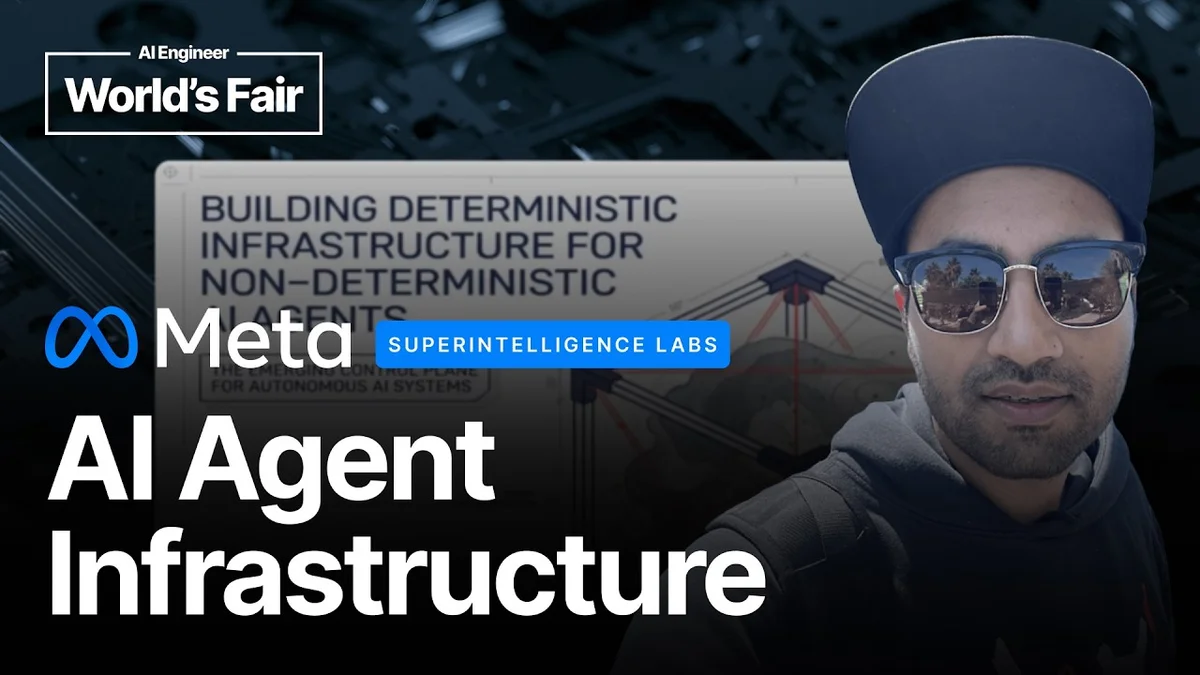
Meta's Nishant Gupta on Deterministic AI Infrastructure

Nishant Gupta from Meta discusses the critical need for deterministic infrastructure to reliably run non-deterministic AI agents, highlighting the shift from model-centric to systems-centric development.

9 min read
Diagram illustrating deterministic infrastructure for non-deterministic AI agents.
A conceptual diagram by Nishant Gupta of Meta illustrating the components of deterministic infrastructure for AI agents.· AI Engineer

Nishant Gupta, a Tech Lead at Meta, recently presented on the critical need for deterministic infrastructure to support non-deterministic AI agents. This presentation, titled "Deterministic Infra for Non-Deterministic AI Agents - The Emerging Control Plane for Autonomous AI Systems," highlights a fundamental shift in how AI systems are built and managed for production. Gupta argues that the current infrastructure, designed for predictable microservices, is ill-equipped to handle the complexities and probabilistic nature of advanced AI agents.

Meta's Nishant Gupta on Deterministic AI Infrastructure - AI Engineer
Meta's Nishant Gupta on Deterministic AI Infrastructure — from AI Engineer

Visual TL;DR. Traditional AI Infrastructure vs The Great Mismatch. Autonomous AI Agents vs The Great Mismatch. The Great Mismatch requires Deterministic AI Infrastructure. Deterministic AI Infrastructure is Agent Control Plane. Agent Control Plane uses Multidimensional Observability. Agent Control Plane enables Systems-Centric Development. Agent Control Plane leads to Reliable Autonomous AI.

Related startups

  1. Traditional AI Infrastructure: designed for predictable microservices, stateless, request-response based
  2. Autonomous AI Agents: stateful, probabilistic, multi-step work, non-deterministic operations
  3. The Great Mismatch: current infra ill-equipped for complex AI agent needs
  4. Deterministic AI Infrastructure: new infrastructure layer for reliable agent execution
  5. Agent Control Plane: emerging infrastructure layer for autonomous AI systems
  6. Multidimensional Observability: patterns for understanding and mitigating agent failures
  7. Systems-Centric Development: shift from model-centric to infrastructure-focused AI building
  8. Reliable Autonomous AI: enabling production-ready, dependable AI agent deployments
Visual TL;DR
Visual TL;DR, startuphub.ai Traditional AI Infrastructure vs The Great Mismatch. Autonomous AI Agents vs The Great Mismatch. The Great Mismatch requires Deterministic AI Infrastructure. Deterministic AI Infrastructure is Agent Control Plane. Agent Control Plane leads to Reliable Autonomous AI vs vs requires is leads to Traditional AI Infrastructure Autonomous AI Agents The Great Mismatch Deterministic AI Infrastructure Agent Control Plane Reliable Autonomous AI From startuphub.ai · The publishers behind this format
Visual TL;DR, startuphub.ai Traditional AI Infrastructure vs The Great Mismatch. Autonomous AI Agents vs The Great Mismatch. The Great Mismatch requires Deterministic AI Infrastructure. Deterministic AI Infrastructure is Agent Control Plane. Agent Control Plane leads to Reliable Autonomous AI vs vs requires is leads to Traditional AIInfrastructure Autonomous AIAgents The GreatMismatch Deterministic AIInfrastructure Agent ControlPlane ReliableAutonomous AI From startuphub.ai · The publishers behind this format
Visual TL;DR, startuphub.ai Traditional AI Infrastructure vs The Great Mismatch. Autonomous AI Agents vs The Great Mismatch. The Great Mismatch requires Deterministic AI Infrastructure. Deterministic AI Infrastructure is Agent Control Plane. Agent Control Plane leads to Reliable Autonomous AI vs vs requires is leads to Traditional AI Infrastructure designed for predictable microservices,stateless, request-response based Autonomous AI Agents stateful, probabilistic, multi-step work,non-deterministic operations The Great Mismatch current infra ill-equipped for complex AIagent needs Deterministic AI Infrastructure new infrastructure layer for reliableagent execution Agent Control Plane emerging infrastructure layer forautonomous AI systems Reliable Autonomous AI enabling production-ready, dependable AIagent deployments From startuphub.ai · The publishers behind this format
Visual TL;DR, startuphub.ai Traditional AI Infrastructure vs The Great Mismatch. Autonomous AI Agents vs The Great Mismatch. The Great Mismatch requires Deterministic AI Infrastructure. Deterministic AI Infrastructure is Agent Control Plane. Agent Control Plane leads to Reliable Autonomous AI vs vs requires is leads to Traditional AIInfrastructure designed forpredictablemicroservices,… Autonomous AIAgents stateful,probabilistic,multi-step work,… The GreatMismatch current infraill-equipped forcomplex AI agent… Deterministic AIInfrastructure new infrastructurelayer for reliableagent execution Agent ControlPlane emerginginfrastructurelayer for… ReliableAutonomous AI enablingproduction-ready,dependable AI agent… From startuphub.ai · The publishers behind this format
Visual TL;DR, startuphub.ai Traditional AI Infrastructure vs The Great Mismatch. Autonomous AI Agents vs The Great Mismatch. The Great Mismatch requires Deterministic AI Infrastructure. Deterministic AI Infrastructure is Agent Control Plane. Agent Control Plane uses Multidimensional Observability. Agent Control Plane enables Systems-Centric Development. Agent Control Plane leads to Reliable Autonomous AI vs vs requires is uses enables leads to Traditional AI Infrastructure designed for predictable microservices,stateless, request-response based Autonomous AI Agents stateful, probabilistic, multi-step work,non-deterministic operations The Great Mismatch current infra ill-equipped for complex AIagent needs Deterministic AI Infrastructure new infrastructure layer for reliableagent execution Agent Control Plane emerging infrastructure layer forautonomous AI systems Multidimensional Observability patterns for understanding and mitigatingagent failures Systems-Centric Development shift from model-centric toinfrastructure-focused AI building Reliable Autonomous AI enabling production-ready, dependable AIagent deployments From startuphub.ai · The publishers behind this format
Visual TL;DR, startuphub.ai Traditional AI Infrastructure vs The Great Mismatch. Autonomous AI Agents vs The Great Mismatch. The Great Mismatch requires Deterministic AI Infrastructure. Deterministic AI Infrastructure is Agent Control Plane. Agent Control Plane uses Multidimensional Observability. Agent Control Plane enables Systems-Centric Development. Agent Control Plane leads to Reliable Autonomous AI vs vs requires is uses enables leads to Traditional AIInfrastructure designed forpredictablemicroservices,… Autonomous AIAgents stateful,probabilistic,multi-step work,… The GreatMismatch current infraill-equipped forcomplex AI agent… Deterministic AIInfrastructure new infrastructurelayer for reliableagent execution Agent ControlPlane emerginginfrastructurelayer for… MultidimensionalObservability patterns forunderstanding andmitigating agent… Systems-CentricDevelopment shift frommodel-centric toinfrastructure-focus ReliableAutonomous AI enablingproduction-ready,dependable AI agent… From startuphub.ai · The publishers behind this format

The Great Mismatch: Traditional vs. Autonomous AI Agents

Gupta begins by outlining the core differences between traditional microservices and autonomous AI agents, illustrating a significant mismatch in their operational characteristics. Traditional microservices are typically stateless, deterministic, request-response based, and execute within milliseconds. In contrast, autonomous AI agents are stateful, probabilistic, operate on multi-step workflows, and can have long-running execution times measured in minutes or hours. This fundamental difference means that infrastructure built for the former is inherently unsuitable for the latter.

He emphasizes that while current AI development often focuses on model capabilities, the real challenge in production lies in reliability. "Demos optimize for capability. Production demands reliability," Gupta states. He points out that many failures in production AI systems originate not from the models themselves, but from the underlying infrastructure that cannot adequately manage the agents' stochastic nature.

Understanding and Mitigating Agent Failures

The presentation delves into the common failure modes of AI agents, categorizing them into issues stemming from logic, action, and state. Failures can manifest as recursive reasoning loops, tool hallucinations, context drift, and more. Gupta presents a "Diagnostic Failure Tree" showing how a stochastic model output can cascade into complex issues like workflow deadlocks, cost explosions, and memory poisoning. He notes that these failures are often amplified by infrastructure that cannot handle the retry storms or context corruption inherent in agent execution.

Gupta highlights that uncontrolled retries are a significant risk, leading to exponential resource consumption and cost overruns when agents encounter minor errors. He illustrates this with a "retry storm" scenario where a simple API parameter error can lead to a feedback loop of failed attempts and escalating resource demands.

The Agent Control Plane: A New Infrastructure Layer

To address these challenges, Gupta proposes the concept of an "Agent Control Plane" as a new, essential infrastructure layer. This layer acts as an operating system for AI agents, analogous to how Kubernetes became the control plane for orchestrating containers. The Agent Control Plane would manage scheduling, memory coordination, orchestration, compute scheduling, and policy enforcement.

Gupta envisions this control plane acting as a deterministic wrapper around the stochastic core of the AI agent. This wrapper would enforce layered containment boundaries, including validation, tool permissions, policy checks, human approval, and audit layers. The principle is clear: "The platform decides. The model merely proposes." This separation ensures that the platform's deterministic controls govern the agent's execution, ensuring safety and reliability even when the underlying model is probabilistic.

Multidimensional Observability and Reliability Patterns

The presentation underscores the inadequacy of traditional logging for understanding AI agent behavior. "Logs are dead. Autonomous workflows require multidimensional observability," Gupta asserts. He showcases an "Agent Trace Timeline" that visualizes agent activity across multiple tracks, including LLM decisions, orchestration plans, tool calls, memory access, and state transitions. This detailed, multi-dimensional view is essential for debugging complex, non-linear agent workflows.

Gupta also draws parallels between established distributed systems reliability patterns and their equivalents for AI agents. He presents a "Reliability Rosetta Stone" mapping concepts like circuit breakers to tool isolation, rate limiting to agent limits, retries to controlled recovery, quotas to cost governance, and observability to agent tracing. By adapting these battle-tested patterns, developers can build more robust and reliable AI systems.
The Paradigm Shift: From Prompts to Infrastructure

Finally, Gupta discusses a significant paradigm shift in competitive advantage within the AI field. He presents a "Paradigm Shift" graph illustrating the evolution from a focus on prompts, to models, and now to infrastructure. As models and prompts become commoditized, the key differentiator for success will be the underlying infrastructure and systems engineering. "Competitive advantage has shifted from prompt engineering to systems engineering," Gupta declares.

He concludes by reiterating the core message: "AI agents are distributed systems. Treat them accordingly." The future of AI will be determined not by better prompts or even just better models, but by superior, reliable, and deterministic infrastructure that can effectively manage the inherent stochasticity of advanced AI agents.

© 2026 StartupHub.ai. All rights reserved. Do not enter, scrape, copy, reproduce, or republish this article in whole or in part. Use as input to AI training, fine-tuning, retrieval-augmented generation, or any machine-learning system is prohibited without written license. Substantially-similar derivative works will be pursued to the fullest extent of applicable copyright, database, and computer-misuse laws. See our terms.