Artificial Intelligence

Abed Matini on Hybrid RAG, SQL, and UI Telemetry

Abed Matini from Ogilvy discusses hybrid RAG, SQL, and UI telemetry for efficient document chatbots, highlighting challenges and solutions.

StartupHub.ai Staff

By StartupHub.ai Staff, reviewed by Daniel Singer, Editor

4 min read

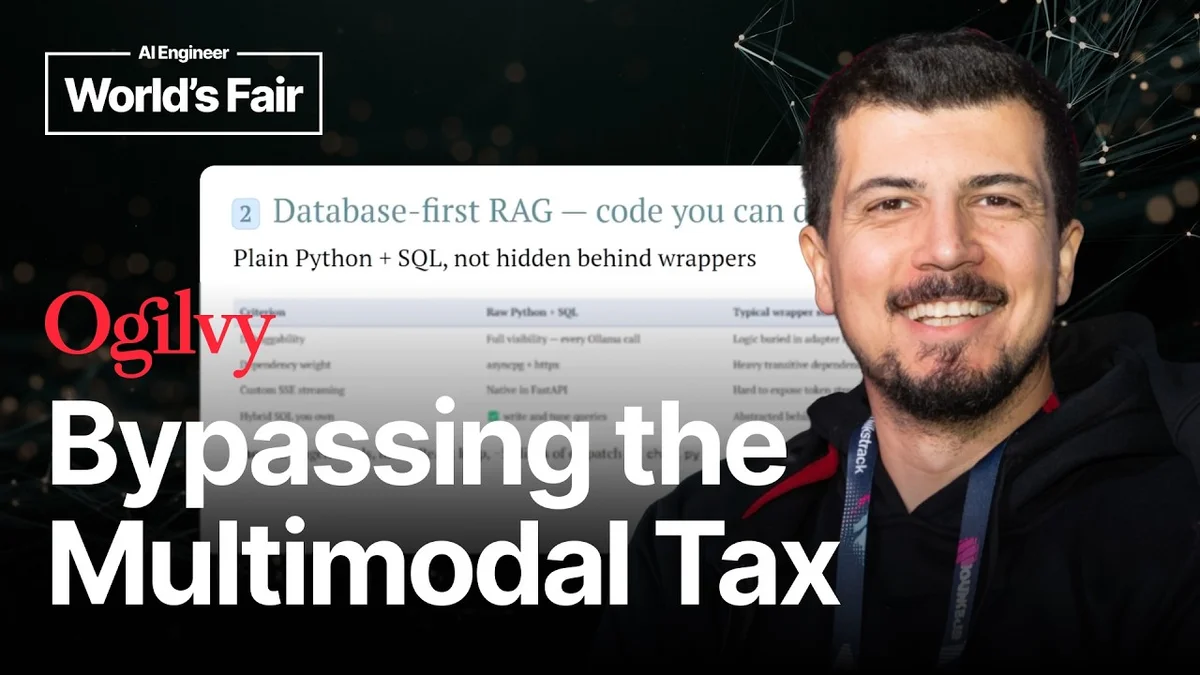
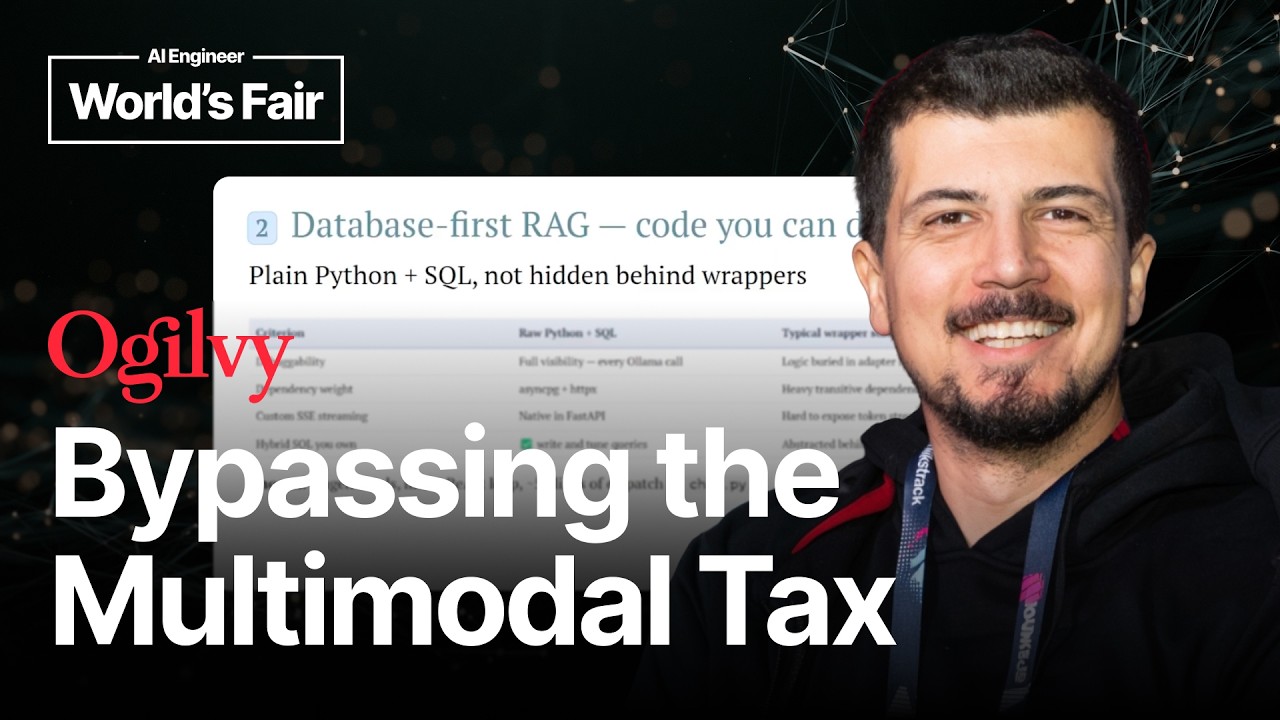
Presentation slide titled "Bypassing the Multimodal Tax: Framework-Free Hybrid RAG, Raw SQL RRF, and Live UI Telemetry" with speaker Abed Matini.
Abed Matini presenting on advanced RAG techniques.Credit: AI Engineer
Visual TL;DR
Multimodal TaxDriver
cost and complexity of integrating diverse data formats
From the article 3 mentionsAbed Matini, Senior Backend Developer at Ogilvy, recently presented on "Bypassing the Multimodal Tax: Hybrid RAG, SQL RRF & UI Telemetry" at AI Engineer World's Fair 2026.
Ogilvy StackCore
framework for building advanced RAG systems
From the article 3 mentionsThe presentation showcased the tools used in their stack, including Python, Docker, Fast API, React, PostgreSQL, Ollama, and LangChain.
Document Chatbot ProblemsDriver
high cost of reading docs, scattered search capabilities
From the articleHe highlighted two primary problems that document chatbots face: the cost of reading documents multiple times and the scattering of search capabilities across too many tools.
Hybrid RAG SolutionsCore
combining RAG with SQL for efficient retrieval
From the article 3 mentionsMatini's talk explored the challenges and solutions for building robust and efficient Retrieval-Augmented Generation (RAG) systems, particularly those dealing with multimodal data and complex user queries.
Parse First, Prompt LaterContext
optimizing data ingest for better performance
From the articleMatini discussed optimizing the data ingest pipeline with a "parse first, prompt later" strategy.
UI TelemetryContext
monitoring user interactions for system improvement
From the articleAbed Matini, Senior Backend Developer at Ogilvy, recently presented on "Bypassing the Multimodal Tax: Hybrid RAG, SQL RRF & UI Telemetry" at AI Engineer World's Fair 2026.
Efficient ChatbotsEffect
robust and performant document chatbots
From the article 4 mentionsMatini emphasized that when dealing with large documents, especially those with complex layouts or tables, a structural-first approach is generally more efficient and reliable.
Database Schema StrategiesContext
structuring data for effective search
From the articleHe then presented a schema for a PostgreSQL database designed to handle both vectors and text.
Contents(5)

Abed Matini, Senior Backend Developer at Ogilvy, recently presented on "Bypassing the Multimodal Tax: Hybrid RAG, SQL RRF & UI Telemetry" at AI Engineer World's Fair 2026. Matini's talk explored the challenges and solutions for building robust and efficient Retrieval-Augmented Generation (RAG) systems, particularly those dealing with multimodal data and complex user queries.

Abed Matini on Hybrid RAG, SQL, and UI Telemetry - AI Engineer
Abed Matini on Hybrid RAG, SQL, and UI Telemetry, AI Engineer

Understanding the Multimodal Tax

Matini began by defining the "multimodal tax" as the inherent cost and complexity associated with processing and integrating various data formats, such as text, images, and structured data, within a single RAG system. He highlighted two primary problems that document chatbots face: the cost of reading documents multiple times and the scattering of search capabilities across too many tools.

He elaborated on the cost factor, explaining that cloud vision APIs can charge between 500 to 1000 tokens per page just to convert a PDF into text. Before a user even asks a question, this process alone can incur significant costs, especially with large documents. For instance, a 200-page manual could cost up to 100,000 tokens, with tables often proving to be particularly challenging and costly to process accurately.

The "Search Split" Problem and Hybrid RAG Solutions

The second major challenge Matini addressed was the "search split across too many tools." He noted that good answers often require a combination of semantic understanding (via embeddings) and exact keyword matching. This often leads to teams implementing a vector database for semantic search and a traditional keyword search engine separately, requiring complex wrapper code to combine the results. This separation can lead to suboptimal outcomes when results are wrong, necessitating extensive configuration file adjustments not directly related to the core query.

To combat these issues, Matini proposed a framework-free hybrid RAG approach. He detailed his talk's focus on parsing documents locally, utilizing a single Postgres database, and employing hybrid search in plain Python. This approach aims to parse documents efficiently, extract meaningful chunks, and then leverage both keyword and semantic search capabilities within a unified system.

Optimizing Data Ingest: Parse First, Prompt Later

Matini discussed optimizing the data ingest pipeline with a "parse first, prompt later" strategy. He presented a comparison of "vision-first" versus "structural-first" approaches to data processing.

  • Vision-first: This approach involves using cloud vision APIs to process documents, often incurring high token costs per page. The quality risk here includes layout hallucinations and potential table breakage, leading to less accurate data extraction.
  • Structural-first: This method focuses on parsing the document's inherent structure, such as headings, paragraphs, and sentences, to create cleaner chunks and more cost-effective prompts. This approach also reduces the risk of hallucinations and improves the overall accuracy of the extracted information.

Matini emphasized that when dealing with large documents, especially those with complex layouts or tables, a structural-first approach is generally more efficient and reliable.

Database Schema and Search Strategies

He then presented a schema for a PostgreSQL database designed to handle both vectors and text. This schema includes tables for storing document chunks, their metadata, and embeddings. He specifically highlighted the use of PostgreSQL's `pgvector` extension for efficient vector similarity search, enabling both dense (semantic) and sparse (keyword) search capabilities.

Matini demonstrated how to create indices for both dense and sparse searches, explaining the importance of these indices for retrieving relevant information quickly. He also touched upon the use of `RRF` (Reciprocal Rank Fusion) for merging ranked lists from different search strategies, a technique that can significantly improve the relevance of the final results.

The Ogilvy Stack and Live Demos

The presentation showcased the tools used in their stack, including Python, Docker, Fast API, React, PostgreSQL, Ollama, and LangChain. Matini stressed the "deliberately boring on purpose" nature of their stack, highlighting a preference for mature, reliable technologies over cutting-edge, unproven ones. He also mentioned the absence of cloud vision for data ingestion, reinforcing the cost-efficiency of their local processing approach.

Matini concluded by demonstrating a live pipeline, showing how documents are parsed, chunked, embedded, and then queried. He walked through the process of uploading a document, extracting its text, and then using the RAG system to retrieve relevant information based on user queries. The live demo illustrated how the system can handle various document types and provide accurate, context-aware answers, showcasing the practical application of the discussed concepts.

TopicsAbed MatiniOgilvyRAGSQLPostgreSQLPythonLangChainLLM

StartupHub.ai StaffDaniel SingerWritten by StartupHub.ai Staff, Editorial teamReviewed by Daniel Singer, EditorAbout

StartupHub.ai Staff, Editorial team

The staff writers of StartupHub.ai, ranging from investment analysts to avid AI tool users, early adopters and critical enthusiasts. Backgrounds span engineering, business and the arts. We hold every piece to rigorous standards of research and review.

Daniel Singer, Editor

Daniel Singer is an AI expert who has been writing about, covering and building AI technology since 2018.

More from Daniel Singer

Get the free daily brief every morning

Every morning the day's AI news, new AI startups and new funding rounds. Free and takes a few minutes to read, unsubscribe at any time.

Join 64,000 other subscribers.

Test your Agent Readiness now

Paste your website. How well ChatGPT, Claude and the other agents can read and use a site, in about a minute.

The videos behind the news, one flip at a time

The feed mixes the videos from our articles with startup demos and you flip through them like TV channels for free with no signup.