
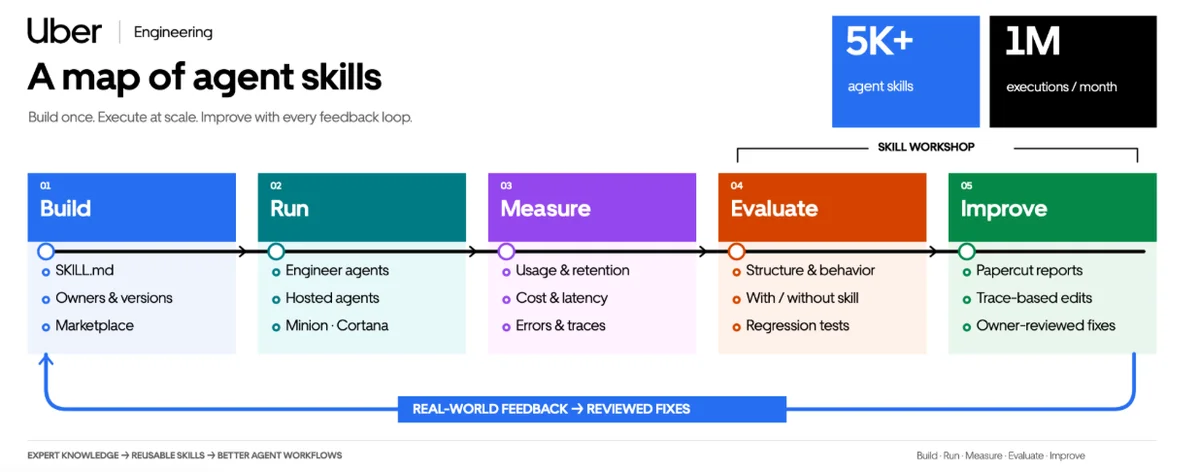
Uber has stopped treating agent skills as prompts and started treating them as production software. Uber grew from 1 skill in October 2025 to more than 5,000 a year later, the company said. Uber Engineering says agents invoked skills more than 1 million times in a single month.
I think Uber's million matters more than its 5,000.
Uber splits the marketplace into Domain, Core and Always-on tiers, Uber said. Any team can publish to Domain after one peer approval and a CI check. Core skills get platform review and dedicated maintenance. About 100 Always-on skills ship by default for pull requests, code review and data analysis, Uber said. A CLI called aifx installs the same plugin across Claude Code, Codex, OpenCode and an internal agent, so switching tools does not strand skills. Skill Workshop adds specs, a linter and evals built from about 5% golden cases, 80% real prompts graded on trajectory and 15% author checks, Uber said.
The proof is ablation, not vibes. Sessions without a warehouse query skill made 13% more tool calls, suffered six times as many tool errors and took 31% longer, Uber said. Sessions with that skill won 87% of blind comparisons, Uber said. A tracing skill cut cost per invocation 46% by dispatching work to a cheaper worker model, Uber said. That cost focus echoes recent reporting on 50x token burn driving interest in cheaper execution.
NVIDIA takes the opposite route with public skills for CUDA, robotics, simulation, Physical AI and RAG workflows that install into Claude Code and Codex, per GitHub. The open Agent Skills specification defines the shared format with progressive disclosure, per the specification linked by Innovation Insight. Uber adds what both lack: Git versioning, OpenTelemetry usage events, 12 measures per skill and retirement. The fair counter is overhead. A five person startup does not need three tiers and 12 measures per skill. I think Uber still wins the argument past a few hundred skills, because discovery and cost collapse without evals.
If you sell agents to the enterprise, copy Uber's harness before you copy its skills.




