

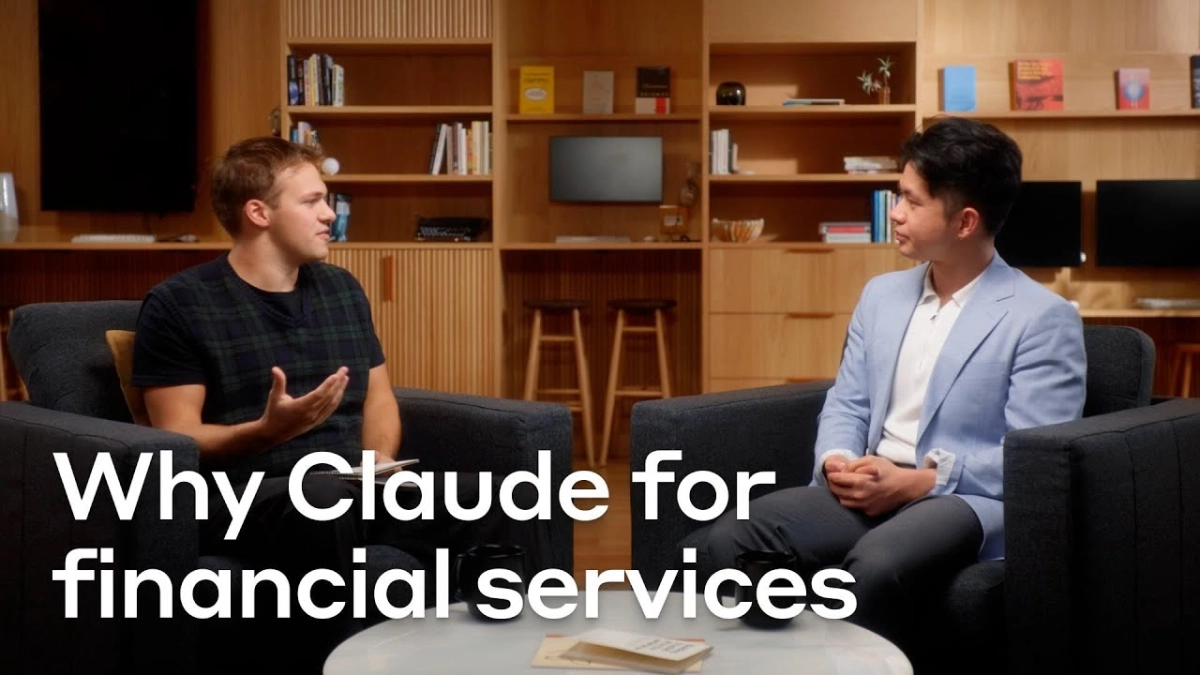
The landscape of enterprise AI in financial services is undergoing a profound transformation, moving decisively from exploratory curiosity to tangible, production-ready deployment. This pivotal shift was the central theme of a recent discussion between Anthropic's Alexander Bricken, Applied AI Product Engineer for Financial Services, and Nick Lin, Product Lead for Claude for Financial Services. Lin, a self-described "recovering investment banker and private equity investor," offered sharp insights into how Claude is not merely accelerating existing financial workflows but fundamentally reshaping them.

Lin highlighted a critical observation: the financial sector, having previously approached AI with caution, is now actively building and deploying solutions. This transition is powered by advancements in AI's ability to handle complex, logic-driven tasks, particularly in coding and tool utilization. He noted that while software engineers represent a minuscule fraction of the global population, their capacity to create and manage digital systems is foundational to every company's operation. Claude, with its exceptional proficiency in code, effectively extends this crucial skill across the financial ecosystem.
A core insight into Claude's power lies in its "artifact" feature, exemplified by customer successes at NBIM (the Norwegian Sovereign Wealth Fund) and BCI. These institutions, managing thousands of portfolio companies, historically relied on manual, weekly or quarterly refreshes of static Excel sheets for comparative analysis. Instead, BCI now leverages Claude's artifact feature to connect directly to live data sets from S&P and FactSet. This creates dynamic, "live dashboards" that provide real-time metrics and comparisons, updated with a single prompt. The result is not just accelerated work, but a complete transformation, allowing managing directors direct interface with these platforms.
This efficiency gain frees financial analysts from "mundane, manual, tedious parts of the work," enabling them to focus on high-value activities like building relationships, meeting customers, and deeply understanding business models. Bricken resonated with this, noting that previous client engagements often started with building a simple AI chat feature, but the evolution of tools like Anthropic's Model Context Protocol (MCP) has made these interactions "so much more powerful." Claude can now interact with the systems analysts care about, providing an exciting leap for a sector traditionally burdened by numerous, disparate product surfaces.
Safety, accuracy, and auditability are paramount in the heavily regulated financial domain. Alexander Bricken underscored Anthropic's founding principles around AI safety, which prioritize building models that are helpful, harmless, and honest. This translates into securely deploying solutions within enterprise environments, ensuring models accurately answer questions with the right level of fidelity, and providing users with the trust, verification, and auditability needed to confidently understand results. Financial analysts, who spend considerable time on "pixel-perfect" presentations and Excel models, cannot afford errors. Claude’s ability to write structured logic and expose its thinking processes directly addresses this critical need.