

The era of stateless AI interactions is rapidly drawing to a close, marked by Anthropic's latest stride with Claude: the introduction of persistent memory. This fundamental upgrade shifts the paradigm from a transactional tool to a truly adaptive, context-aware digital partner, promising to redefine how professionals engage with artificial intelligence.
Anthropic, a leading AI research and safety company, recently unveiled a significant enhancement to its Claude AI model, allowing it to retain and recall information across multiple conversations and sessions. This feature, simply termed "memory," addresses a critical pain point in current large language model (LLM) usage: the constant need to re-establish context. As outlined in the video accompanying the announcement, Claude can now remember how users work across web, desktop, and mobile applications, eliminating the inefficiency of repeating explanations or sifting through past interactions.
The implementation of memory is designed with user control at its core. The video demonstrates clear toggles for "Search and reference chats" and "Generate memory from chat history," empowering users to dictate the extent of Claude's recall. Once enabled, Claude actively synthesizes a "Memory summary" from past interactions, categorizing information into practical domains such as "Role & Work," "Current Projects," and even "Personal Content." This proactive synthesis creates a living profile of the user's ongoing tasks, preferences, and professional identity. For instance, a user's memory might include details like "Works as a healthcare transformation consultant leading digital strategy for Mountain View Healthcare's 12-hospital network" or "Planning spring 2026 trip to Japan."
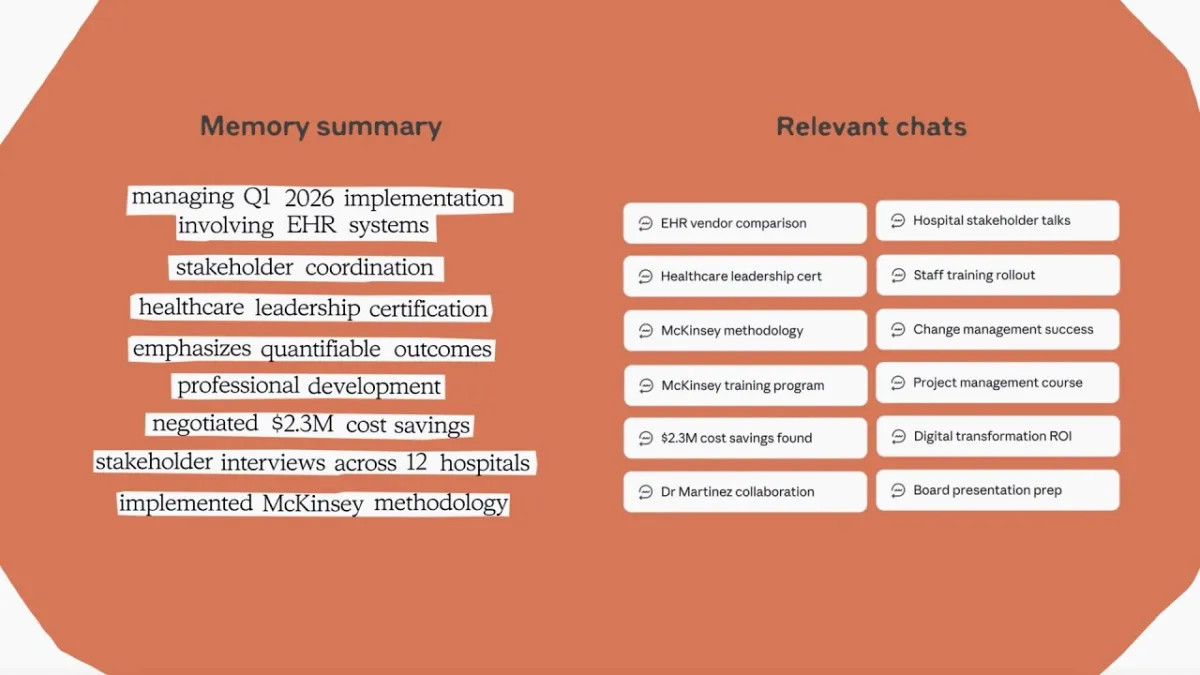
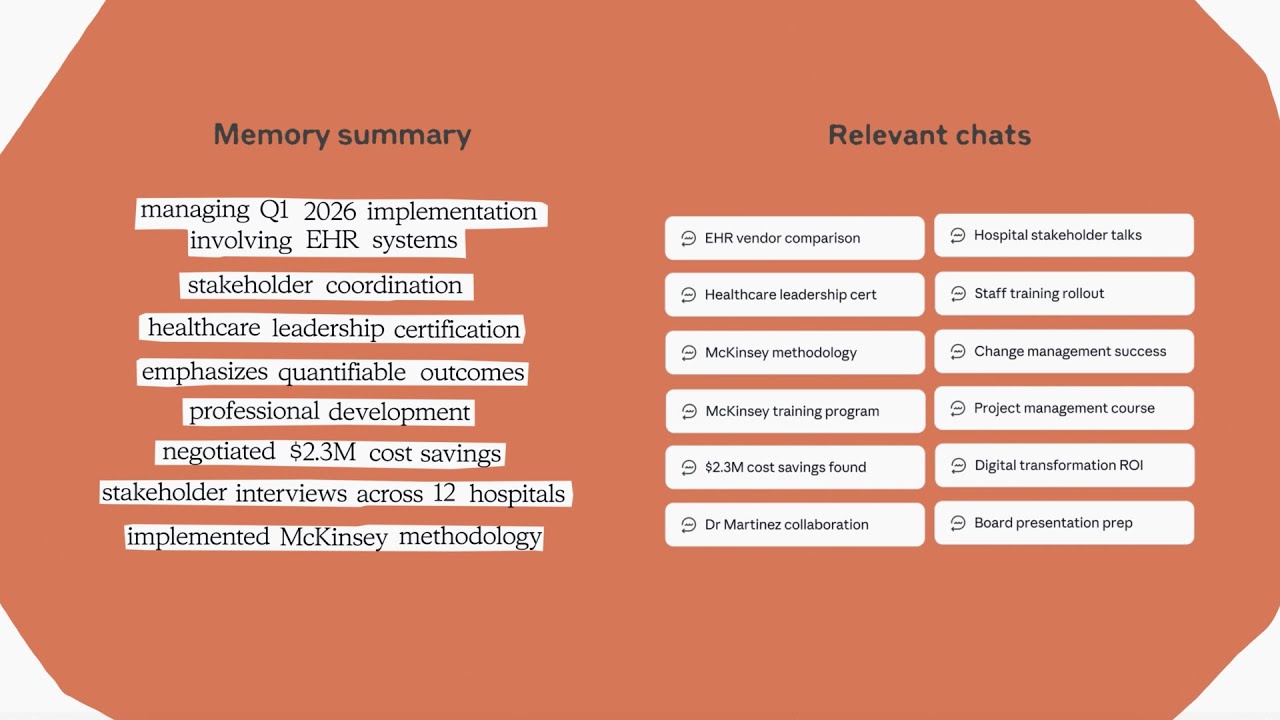
This persistent understanding profoundly streamlines workflows. Imagine needing to compile a quarterly performance review. Instead of manually collating achievements or feeding the AI piecemeal data, a user can simply prompt, "Can you remind me of everything I've accomplished this quarter? Have to write a very overdue self review..." Claude then searches relevant chats, drawing upon its generated memory and specific past conversations to produce a comprehensive summary. "Perfect! I found our work discussions from this quarter. Here's everything you've accomplished," Claude responds, presenting a detailed breakdown of project leadership, financial impact, professional development, and team collaboration. The ability to then ask Claude to "structure by impact areas" for a compelling review demonstrates the immediate, practical utility of this deep contextual understanding.
This memory feature marks a pivotal step towards truly personalized AI. Previous LLMs, while powerful, operated largely as blank slates with each new interaction, requiring users to constantly re-educate them. Claude's memory changes this fundamental dynamic. It fosters a cumulative intelligence, allowing the AI to build a nuanced understanding of an individual's professional role, personal interests, communication style, and ongoing objectives. This isn't just about recalling facts; it's about forming a persistent, evolving model of the user, enabling more relevant, proactive, and anticipatory assistance. The integration of "Personal Content" into the memory summary highlights Anthropic's vision for a holistic AI companion, capable of assisting across both professional and personal spheres, reflecting the integrated nature of modern life.