

UC Berkeley PhD Student Challenges AI Evaluation Methods

Parth Asawa, a PhD student at UC Berkeley, argues that current AI evaluation methods are insufficient for measuring continual learning and calls for a new benchmark approach.

8 min read
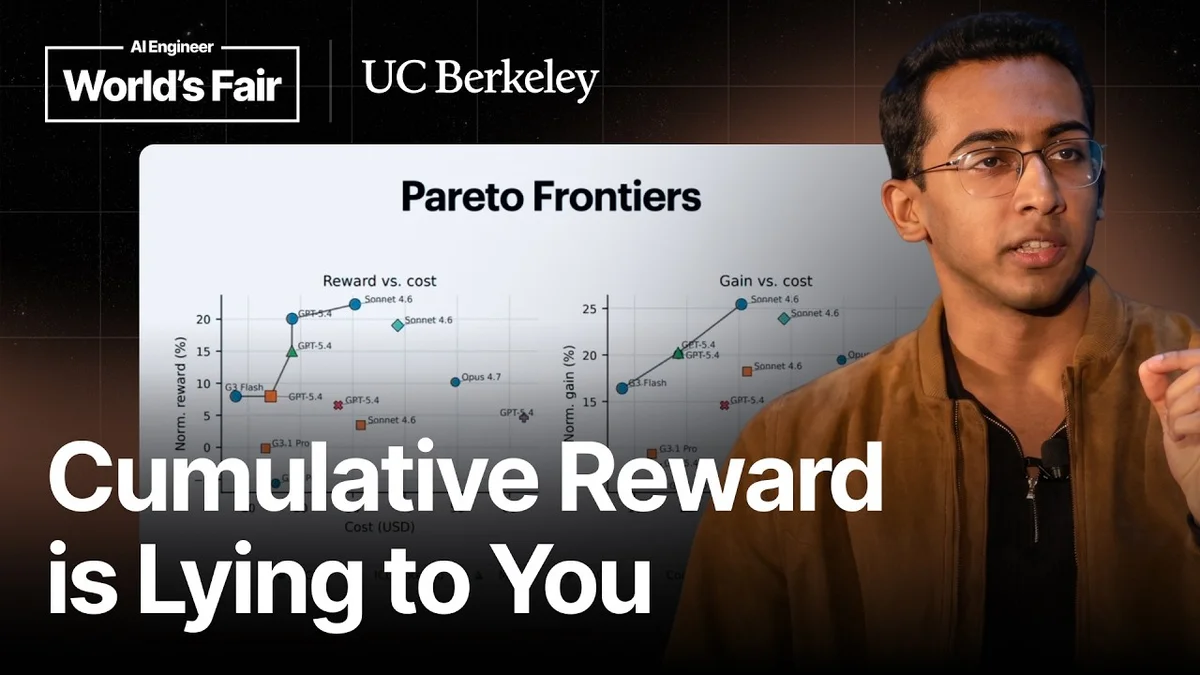
Parth Asawa speaking at a podium during the AI Engineer World's Fair
AI Engineer

Visual TL;DR. Parth Asawa (UCB PhD) presents at Rethink Evaluation. Rethink Evaluation critiques Current AI Benchmarks. Current AI Benchmarks leads to Fails Continual Learning. Fails Continual Learning requires Need New Benchmark. Need New Benchmark defines True Learning Measure. Parth Asawa (UCB PhD) at AI Engineer Fair.

  1. Parth Asawa (UCB PhD): UC Berkeley PhD student challenges current AI evaluation methods for LLMs
  2. Current AI Benchmarks: evaluate LLMs on isolated tasks, ignoring past experiences and learning
  3. Fails Continual Learning: this method cannot measure how models learn and adapt over time
  4. Need New Benchmark: calls for a new approach to truly assess models' learning ability
  5. True Learning Measure: performance should improve as a function of prior experience, not restart
  6. Rethink Evaluation: critical look at how large language models are currently evaluated
  7. AI Engineer Fair: presented his critical findings at the AI Engineer World's Fair
Visual TL;DR
Visual TL;DR, startuphub.ai Current AI Benchmarks leads to Fails Continual Learning. Fails Continual Learning requires Need New Benchmark leads to requires Parth Asawa (UCB PhD) Current AI Benchmarks Fails Continual Learning Need New Benchmark From startuphub.ai · The publishers behind this format
Visual TL;DR, startuphub.ai Current AI Benchmarks leads to Fails Continual Learning. Fails Continual Learning requires Need New Benchmark leads to requires Parth Asawa (UCBPhD) Current AIBenchmarks Fails ContinualLearning Need NewBenchmark From startuphub.ai · The publishers behind this format
Visual TL;DR, startuphub.ai Current AI Benchmarks leads to Fails Continual Learning. Fails Continual Learning requires Need New Benchmark leads to requires Parth Asawa (UCB PhD) UC Berkeley PhD student challenges currentAI evaluation methods for LLMs Current AI Benchmarks evaluate LLMs on isolated tasks, ignoringpast experiences and learning Fails Continual Learning this method cannot measure how modelslearn and adapt over time Need New Benchmark calls for a new approach to truly assessmodels' learning ability From startuphub.ai · The publishers behind this format
Visual TL;DR, startuphub.ai Current AI Benchmarks leads to Fails Continual Learning. Fails Continual Learning requires Need New Benchmark leads to requires Parth Asawa (UCBPhD) UC Berkeley PhDstudent challengescurrent AI… Current AIBenchmarks evaluate LLMs onisolated tasks,ignoring past… Fails ContinualLearning this method cannotmeasure how modelslearn and adapt… Need NewBenchmark calls for a newapproach to trulyassess models'… From startuphub.ai · The publishers behind this format
Visual TL;DR, startuphub.ai Parth Asawa (UCB PhD) presents at Rethink Evaluation. Rethink Evaluation critiques Current AI Benchmarks. Current AI Benchmarks leads to Fails Continual Learning. Fails Continual Learning requires Need New Benchmark. Need New Benchmark defines True Learning Measure. Parth Asawa (UCB PhD) at AI Engineer Fair presents at critiques leads to requires defines at Parth Asawa (UCB PhD) UC Berkeley PhD student challenges currentAI evaluation methods for LLMs Current AI Benchmarks evaluate LLMs on isolated tasks, ignoringpast experiences and learning Fails Continual Learning this method cannot measure how modelslearn and adapt over time Need New Benchmark calls for a new approach to truly assessmodels' learning ability True Learning Measure performance should improve as a functionof prior experience, not restart Rethink Evaluation critical look at how large language modelsare currently evaluated AI Engineer Fair presented his critical findings at the AIEngineer World's Fair From startuphub.ai · The publishers behind this format
Visual TL;DR, startuphub.ai Parth Asawa (UCB PhD) presents at Rethink Evaluation. Rethink Evaluation critiques Current AI Benchmarks. Current AI Benchmarks leads to Fails Continual Learning. Fails Continual Learning requires Need New Benchmark. Need New Benchmark defines True Learning Measure. Parth Asawa (UCB PhD) at AI Engineer Fair presents at critiques leads to requires defines at Parth Asawa (UCBPhD) UC Berkeley PhDstudent challengescurrent AI… Current AIBenchmarks evaluate LLMs onisolated tasks,ignoring past… Fails ContinualLearning this method cannotmeasure how modelslearn and adapt… Need NewBenchmark calls for a newapproach to trulyassess models'… True LearningMeasure performance shouldimprove as afunction of prior… RethinkEvaluation critical look athow large languagemodels are… AI Engineer Fair presented hiscritical findingsat the AI Engineer… From startuphub.ai · The publishers behind this format

At the AI Engineer World's Fair, Parth Asawa, a PhD student at UC Berkeley, presented a critical look at how artificial intelligence, particularly large language models (LLMs), are evaluated. Asawa argued that the current approach, which often treats each task in isolation, fails to measure a crucial aspect of intelligence: the ability to learn and adapt over time, a concept known as continual learning.

UC Berkeley PhD Student Challenges AI Evaluation Methods - AI Engineer
UC Berkeley PhD Student Challenges AI Evaluation Methods — from AI Engineer

The Limitations of Current AI Benchmarks

Asawa highlighted how the typical evaluation of LLMs involves presenting them with a series of independent tasks. This method, he explained, is akin to asking a model to restart from scratch every single time, fundamentally ignoring its past experiences and learning capabilities. This approach is insufficient for assessing how well models can truly learn and improve from prior interactions.

He contrasted this with what a true measure of learning ability should look like: performance that improves as a function of prior experience, rather than a scattered, inconsistent performance. Asawa defined continual learning as "sample efficient, online learning that is stable over long horizons." This involves retaining information without forgetting while simultaneously adapting to new data.
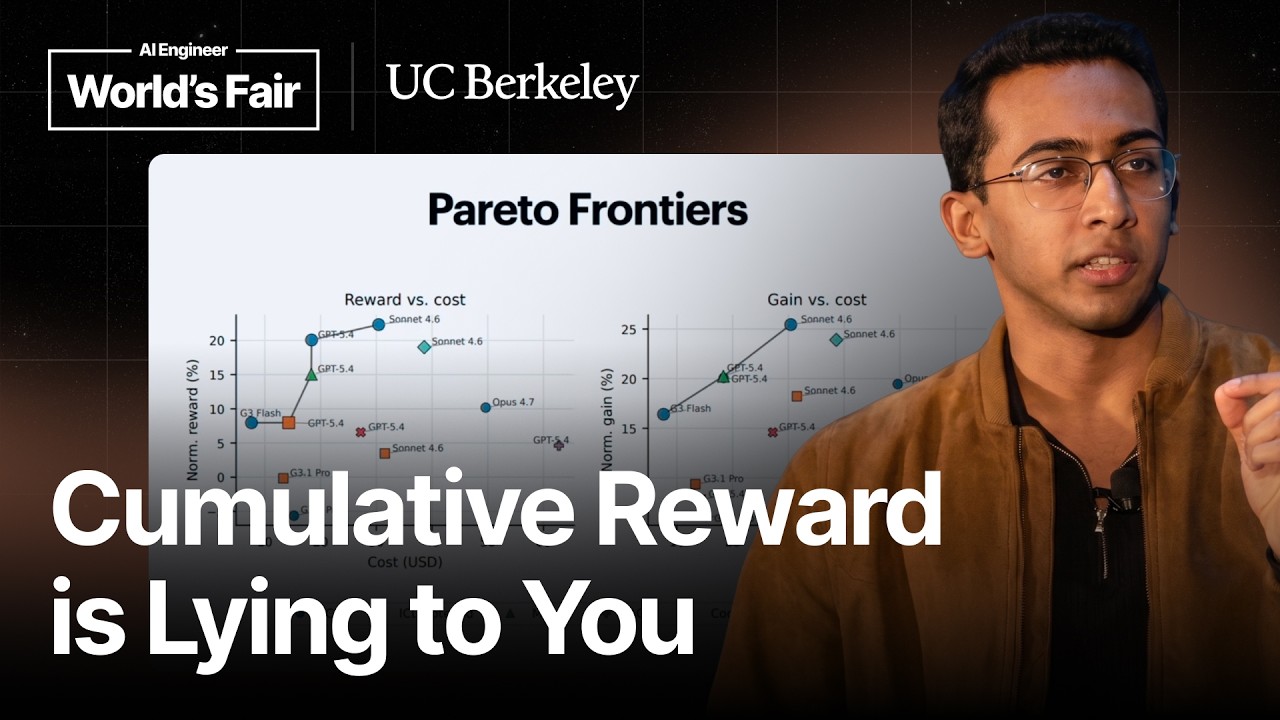
Rethinking Continual Learning Evaluation

The current paradigm in LLM training involves offline processes where models are trained on vast datasets and then deployed as frozen checkpoints. Continual learning aims to change this by enabling models to learn and update their parameters over time. Asawa discussed various approaches being explored, including in-context learning, external memory stores, and updating model weights directly.

However, his core argument was that the field is not adequately evaluating these capabilities. He stressed that if continual learning is not about "point capabilities," then the evaluation methods must change to reflect this. Asawa proposed three key criteria for designing effective continual learning benchmarks:

  • Headroom: Tasks must require online adaptation or learning, meaning models shouldn't be able to perform well by simply relying on offline training on that specific data.
  • Shared Structure: To enable improvement from prior experience, tasks need to have underlying shared latent structures that models can exploit.
  • Learning Mechanism: There must be a signal within the environment, such as rewards, error messages, or textual feedback, that guides the model's learning process.

Asawa also elaborated on the metrics used for evaluation, emphasizing the importance of the 'gain' metric. Gain is calculated as the difference between stateful reward (where the model can maintain state) and stateless reward (where the model is reset between tasks). This metric helps to isolate the actual benefit derived from accumulated experience, rather than just reflecting the base model's initial capability.

The Continual Learning Bench 1.0 and Failure Modes

Asawa introduced the Continual Learning Bench 1.0, a benchmark suite featuring tasks from six different domains, including signal processing, software engineering, epidemiology, game playing, database exploration, and sales prediction. Each task is designed with specific reward metrics and validated by domain experts to ensure realism and learnability.

He then discussed observed failure modes in continual learning, categorizing them into stability and plasticity issues. Stability failures occur when models fail to retain new information, while plasticity failures happen when models cannot adapt to new information. He provided examples from the sales prediction task (demonstrating a stability failure) and the epidemiology task (illustrating a plasticity failure) to highlight these concepts.

Challenging the Status Quo in AI Research

Reflecting on broader implications, Asawa suggested that the current LLM training stack, which has evolved over years, might not be optimally designed for continual learning. He posed the question of whether the field is falling into a sunk cost fallacy by trying to adapt existing methods rather than redesigning models from the ground up with continual learning as a primary objective.

Furthermore, Asawa called for a re-evaluation of how AI research is conducted as a whole, touching upon issues of open science, power consolidation, and safety. He encouraged greater involvement in reimagining the future of AI research institutions and open science practices.

The presentation concluded with a summary of the key takeaway: "Continual learning doesn't look like point capabilities. We need to measure it the right way to optimize for the right objective as a field." This sentiment underscores the need for a fundamental shift in how AI’s learning abilities are assessed and developed.

© 2026 StartupHub.ai. All rights reserved. Do not enter, scrape, copy, reproduce, or republish this article in whole or in part. Use as input to AI training, fine-tuning, retrieval-augmented generation, or any machine-learning system is prohibited without written license. Substantially-similar derivative works will be pursued to the fullest extent of applicable copyright, database, and computer-misuse laws. See our terms.