Business questions fail when the definition lives outside the table. Databricks says its answer, built with Turing, hit a 91% pass rate on live workspace tasks, against 45% and 58% for two frontier agents.
Tables alone do not know the rule.
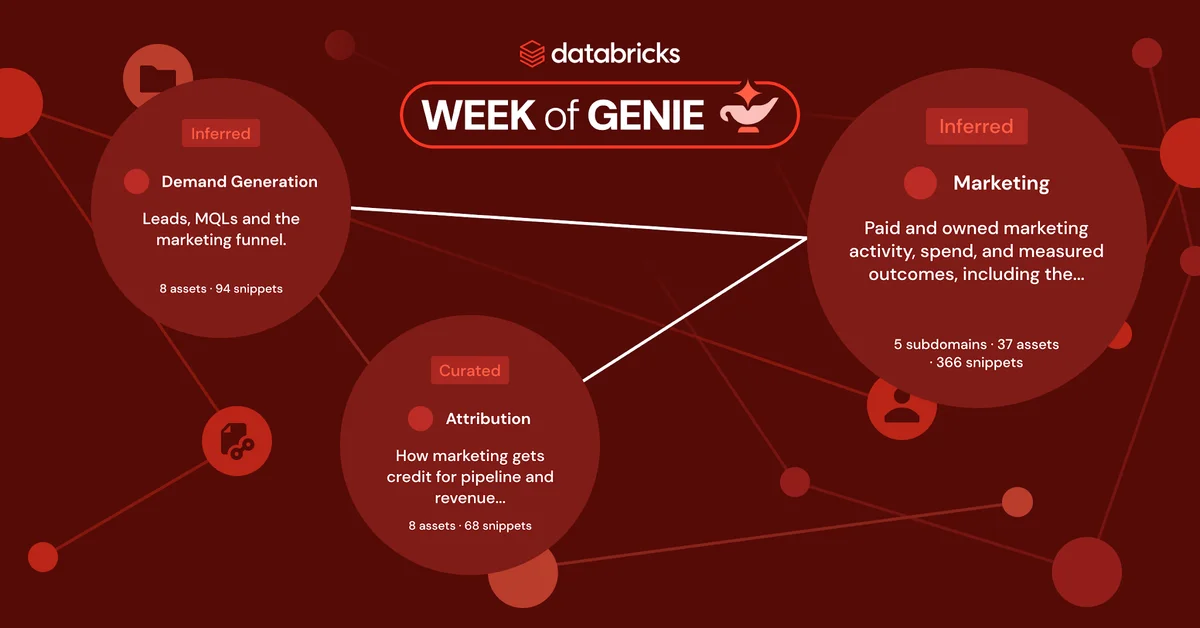
Genie Ontology is the enterprise context layer that extracts business definitions from work teams already did. It scans notebooks, dashboards, saved SQL queries and documents, then surfaces the relevant snippet when Genie answers. That retrieval is why Databricks credits the system with 431,829 tokens per run and 100.3 seconds wall time, according to the company, against 889,019 and 434.6 seconds for Agent A and 1,051,070 and 306.5 seconds for Agent B. Each task ran five times in the same live Databricks workspace.
The test company is Calderwick Energy, a fictional UK supplier with hundreds of tables and the usual mess. The largest table holds around 120 million rows of half-hourly meter data, plus copied notebooks, frozen reporting tables and old docs, according to Databricks. One task asks for the Commercial planning rate for FY24/25. The bill cost stack table shows 0.31 pence per kWh, which reflects FY25/26 assumptions. The notebook that builds the mart, 45_mart_bill_cost_stack, records the history as 0.52 for FY24/25, 0.31 for FY25/26 and 0.45 draft for FY26/27. Genie retrieved that snippet and returned 0.52 in all five runs, while the other agents returned 0.31 or said no year-specific rate was documented, according to Databricks.
The frontier agents ran through a Databricks toolbelt, not natively. The toolbelt excluded Genie MCP, the Model Context Protocol interface that lets outside agents call Genie tools, to keep the comparison on retrieval and reasoning. Unity Catalog is the Databricks governance layer that controls who can see what data, and all agents worked under it. The same setup explains the limit Databricks states directly. In new deployments with little workspace knowledge, or where tables and schemas are enough, the gap between agents narrows.
That context layer is now showing up outside Databricks itself. The company launched native Genie plugins for ChatGPT, Claude, Microsoft Copilot Cowork and Grok Bot, giving those assistants governed access to the same business context, as reported by Unite.AI. Watch whether teams use Genie in the UI, through Genie MCP or inside those hosts, and whether their own notebooks hold the definitions that decide the answer.