


Prime Intellect Unveils Open-Source AI Training Stack

Will Brown of Primed and Loaded details the 'open superintelligence stack' for AI research, covering Verifiers, Prime RL, and the future of model post-training.

10 min read
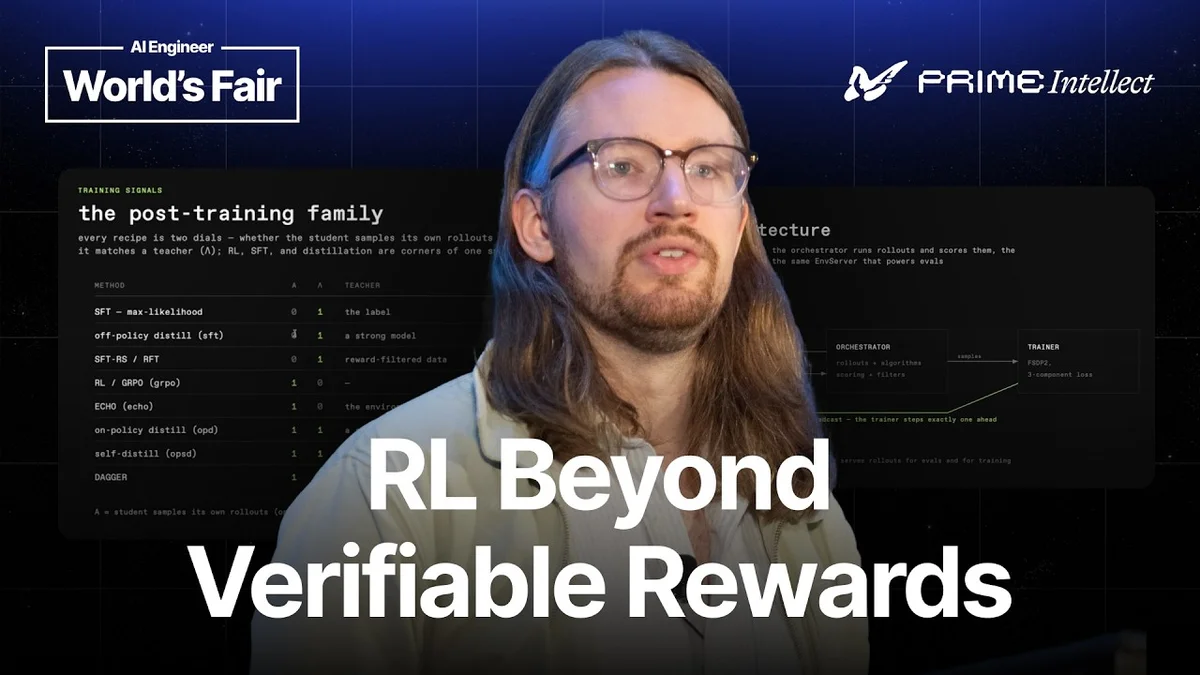
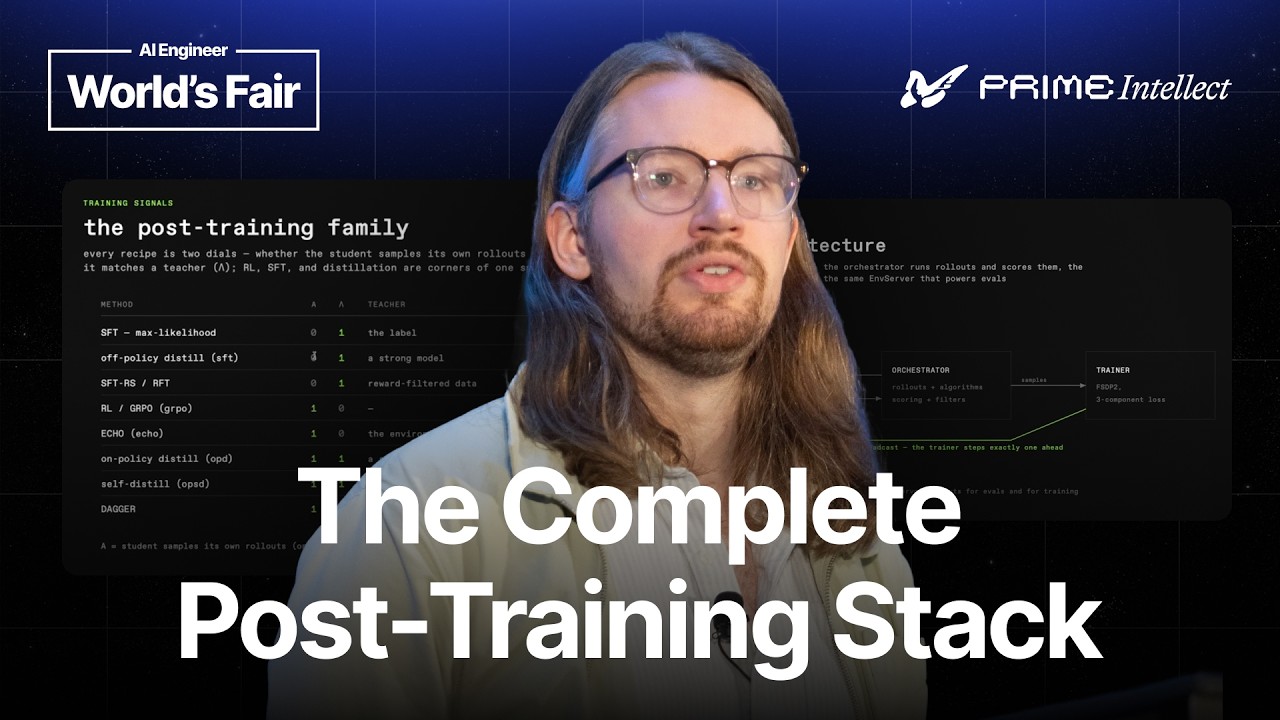
Will Brown presenting 'The Prime Intellect Stack' at AI Engineer World's Fair
AI Engineer

Visual TL;DR. Primed & Loaded aims to Simplify AI Research. Simplify AI Research via Open Superintelligence Stack. Open Superintelligence Stack includes Prime RL. Open Superintelligence Stack includes Verifiers Library. Verifiers Library powers Environments Hub. Open Superintelligence Stack provides Global GPU Marketplace. Prime RL enables Enhance Open-Source Models. Verifiers Library enables Enhance Open-Source Models.

  1. Primed & Loaded: Will Brown details open superintelligence stack at AI Engineer World's Fair
  2. Simplify AI Research: mission to simplify large-scale open-source AI research for companies
  3. Open Superintelligence Stack: comprehensive infrastructure stack for training and deploying AI models
  4. Prime RL: open-source, full-stack training framework for asynchronous reinforcement learning
  5. Verifiers Library: used to build environments and evaluate model performance with tasksets
  6. Environments Hub: platform for creating and managing environments built with the Verifiers library
  7. Enhance Open-Source Models: toolkit allows users to enhance open-source models for specific use cases
  8. Global GPU Marketplace: over 10,000 GPUs available for compute resources in data centers
Visual TL;DR
Visual TL;DR, startuphub.ai Primed & Loaded aims to Simplify AI Research. Simplify AI Research via Open Superintelligence Stack. Open Superintelligence Stack includes Prime RL. Prime RL enables Enhance Open-Source Models aims to via includes enables Primed & Loaded Simplify AI Research Open Superintelligence Stack Prime RL Enhance Open-Source Models From startuphub.ai · The publishers behind this format
Visual TL;DR, startuphub.ai Primed & Loaded aims to Simplify AI Research. Simplify AI Research via Open Superintelligence Stack. Open Superintelligence Stack includes Prime RL. Prime RL enables Enhance Open-Source Models aims to via includes enables Primed & Loaded Simplify AIResearch OpenSuperintelligence… Prime RL EnhanceOpen-Source… From startuphub.ai · The publishers behind this format
Visual TL;DR, startuphub.ai Primed & Loaded aims to Simplify AI Research. Simplify AI Research via Open Superintelligence Stack. Open Superintelligence Stack includes Prime RL. Prime RL enables Enhance Open-Source Models aims to via includes enables Primed & Loaded Will Brown details open superintelligencestack at AI Engineer World's Fair Simplify AI Research mission to simplify large-scaleopen-source AI research for companies Open Superintelligence Stack comprehensive infrastructure stack fortraining and deploying AI models Prime RL open-source, full-stack training frameworkfor asynchronous reinforcement learning Enhance Open-Source Models toolkit allows users to enhanceopen-source models for specific use cases From startuphub.ai · The publishers behind this format
Visual TL;DR, startuphub.ai Primed & Loaded aims to Simplify AI Research. Simplify AI Research via Open Superintelligence Stack. Open Superintelligence Stack includes Prime RL. Prime RL enables Enhance Open-Source Models aims to via includes enables Primed & Loaded Will Brown detailsopensuperintelligence… Simplify AIResearch mission to simplifylarge-scaleopen-source AI… OpenSuperintelligence… comprehensiveinfrastructurestack for training… Prime RL open-source,full-stack trainingframework for… EnhanceOpen-Source… toolkit allowsusers to enhanceopen-source models… From startuphub.ai · The publishers behind this format
Visual TL;DR, startuphub.ai Primed & Loaded aims to Simplify AI Research. Simplify AI Research via Open Superintelligence Stack. Open Superintelligence Stack includes Prime RL. Open Superintelligence Stack includes Verifiers Library. Verifiers Library powers Environments Hub. Open Superintelligence Stack provides Global GPU Marketplace. Prime RL enables Enhance Open-Source Models. Verifiers Library enables Enhance Open-Source Models aims to via includes includes powers provides enables enables Primed & Loaded Will Brown details open superintelligencestack at AI Engineer World's Fair Simplify AI Research mission to simplify large-scaleopen-source AI research for companies Open Superintelligence Stack comprehensive infrastructure stack fortraining and deploying AI models Prime RL open-source, full-stack training frameworkfor asynchronous reinforcement learning Verifiers Library used to build environments and evaluatemodel performance with tasksets Environments Hub platform for creating and managingenvironments built with the Verifierslibrary Enhance Open-Source Models toolkit allows users to enhanceopen-source models for specific use cases Global GPU Marketplace over 10,000 GPUs available for computeresources in data centers From startuphub.ai · The publishers behind this format
Visual TL;DR, startuphub.ai Primed & Loaded aims to Simplify AI Research. Simplify AI Research via Open Superintelligence Stack. Open Superintelligence Stack includes Prime RL. Open Superintelligence Stack includes Verifiers Library. Verifiers Library powers Environments Hub. Open Superintelligence Stack provides Global GPU Marketplace. Prime RL enables Enhance Open-Source Models. Verifiers Library enables Enhance Open-Source Models aims to via includes includes powers provides enables enables Primed & Loaded Will Brown detailsopensuperintelligence… Simplify AIResearch mission to simplifylarge-scaleopen-source AI… OpenSuperintelligence… comprehensiveinfrastructurestack for training… Prime RL open-source,full-stack trainingframework for… Verifiers Library used to buildenvironments andevaluate model… Environments Hub platform forcreating andmanaging… EnhanceOpen-Source… toolkit allowsusers to enhanceopen-source models… Global GPUMarketplace over 10,000 GPUsavailable forcompute resources… From startuphub.ai · The publishers behind this format

Will Brown, Head of Applied Research at Primed and Loaded, recently presented the company's comprehensive AI research infrastructure stack, dubbed the 'open superintelligence stack.' This detailed dive, delivered at the AI Engineer World's Fair, focused on the post-training tools and libraries Primed and Loaded has developed, including Verifiers and Prime RL.

Prime Intellect Unveils Open-Source AI Training Stack - AI Engineer
Prime Intellect Unveils Open-Source AI Training Stack — from AI Engineer

The Open Superintelligence Stack

Brown outlined Primed and Loaded's mission to simplify large-scale open-source AI research and empower companies to train and deploy their own models. The company aims to provide a toolkit that allows users to enhance open-source models for their specific use cases. The 'open superintelligence stack' encompasses several key components:

  • Compute: A global marketplace of data centers operating over 10,000 GPUs.
  • Prime RL: An open-source, full-stack training framework for asynchronous reinforcement learning.
  • Environments: Built with the Verifiers library and the Environments Hub platform.
  • Lab: A platform for research workflows, integrating environments, hosted training, evaluations, inference, and sandboxes.

Brown noted that while the term 'open superintelligence stack' might have sounded like marketing a year ago, it now reflects the reality of increasingly capable AI models that can surpass human performance in many areas. The goal is to provide an open toolkit that grants users the control needed for customization and deployment.

Modern Post-Training: Verifiers and Prime RL

The core of the presentation focused on post-training, a phase where Brown spends much of his time. He highlighted the evolution of their tools, particularly the Verifiers library, which has undergone a complete overhaul. The new V1 version aims to be more powerful and intuitive for users.

Prime RL, described as a full-stack open-source training framework, supports asynchronous reinforcement learning and has been enhanced with new features for scale and custom algorithms. Brown emphasized the need for efficient and affordable training, especially as models grow larger, to make post-training accessible to a wider audience.

Environments as Evaluations

Brown elaborated on the concept of 'environments' in post-training, explaining that they are more than just Reinforcement Learning environments. Environments, in this context, serve as a language for specifying a model's desired behavior, encapsulating data, scenarios, interaction methods, and scoring mechanisms. He stressed that environments are crucial for both offline evaluation and for driving RL training and data generation for Supervised Fine-Tuning (SFT).

He also touched upon the common practice of prompt optimization and how evaluations are the gateway to post-training, noting that building robust evaluations is beneficial for product hygiene regardless of whether one is using API models or custom-trained ones.

The Post-Training Loop: From Build to Deploy

The post-training process was broken down into a loop: Build (creating an environment with tasks and rewards), Evaluate (scoring a model and reading rollouts), Train (using RL, SFT, or other methods), and Deploy (serving the trained model). Brown reiterated that the goal is not a one-time post-training event, but rather an iterative process of model refinement that leverages real-world signals.

Verifiers V1: Tasksets, Harnesses, and Runtimes

The overhauled Verifiers library, referred to as Verifiers V1, is built around a composable structure of three key pieces: tasksets, harnesses, and runtimes.

  • Tasksets: These are agent-agnostic data and rules that define what needs to be done, integrating with existing ecosystems like Hugging Face Datasets and Harbor.
  • Harnesses: These are the driver programs that can support various execution patterns, from simple loops to complex CLI agents.
  • Runtimes: This is where the harness code executes, supporting options like subprocesses, Docker, or specialized sandbox environments.

Brown also highlighted the decoupling of harnesses and tasksets, allowing for greater flexibility. The default harness pattern supports standard system prompts and tools, while the harness pattern itself is extensible to more complex scenarios.

Rewards, Metrics, and Group Rewards

The discussion then moved to rewards and metrics, explaining that these are functions that process rollout data to produce numerical outputs. Rewards drive progress in RL, while metrics provide insights into tool usage and errors. Brown emphasized the importance of first-class support for group rewards, which are often overlooked in existing frameworks. These allow for pairwise judging, ranking, and rewarding conciseness, which can be crucial for controlling model output length and efficiency.

Tools, User Simulators, and the Trace Graph

Tools and user simulators are becoming increasingly important in complex AI applications. Brown explained how user simulators, acting as MCP servers, can mimic user interaction within a rollout. He also introduced the concept of the 'trace graph,' a system designed to manage sub-agents and parallel branching trees, while preserving sequential dependencies and enabling careful token control. This structure is vital for handling the nuances of tokenization and avoiding numerical issues in large-scale training.

Renderers and Tokenization

The Renderers library was presented as a standalone toolkit for managing tokenizers and chat templates. Brown noted the difficulties users often face when debugging chat templates, citing issues with newline stripping and logical mismatches. Renderers abstract these complexities, turning chat templates into programmable artifacts that can leverage trace history for accurate tokenization, even when dealing with re-tokenization.

Prime RL: Architecture and Performance

Finally, Brown detailed the Prime RL architecture, which is built around an orchestrator that manages separate inference and trainer processes. This client-server model allows for decoupled scaling and efficient resource utilization. He shared performance benchmarks, stating that a GLM-5 step on 28 nodes for long-horizon coding tasks with a 131K context can be completed in under 5 minutes, enabling a 1,000-step run in approximately 3 days at a cost of around $50,000. This, he argued, makes large-scale post-training feasible for many enterprises.

Brown also touched upon the benefits of asynchronous RL, particularly in handling the long tail of rollout durations inherent in agentic tasks. The system's ability to go reasonably off-policy allows for greater flexibility in managing rollout completion times without sacrificing GPU utilization.

The discussion concluded by highlighting the ongoing work on optimizing the stack with techniques like FP8, wide expert parallelism, and disintegrated prefill, all built upon a Torch-Titan base for maximum hackability and modularity.

© 2026 StartupHub.ai. All rights reserved. Do not enter, scrape, copy, reproduce, or republish this article in whole or in part. Use as input to AI training, fine-tuning, retrieval-augmented generation, or any machine-learning system is prohibited without written license. Substantially-similar derivative works will be pursued to the fullest extent of applicable copyright, database, and computer-misuse laws. See our terms.