

MiniMax M3: Open Source AI Model Deep Dive

Dan from Together AI and Olive from MiniMax discuss the open-sourcing of the M3 multimodal AI model, its capabilities, and the infrastructure behind scaling AI.

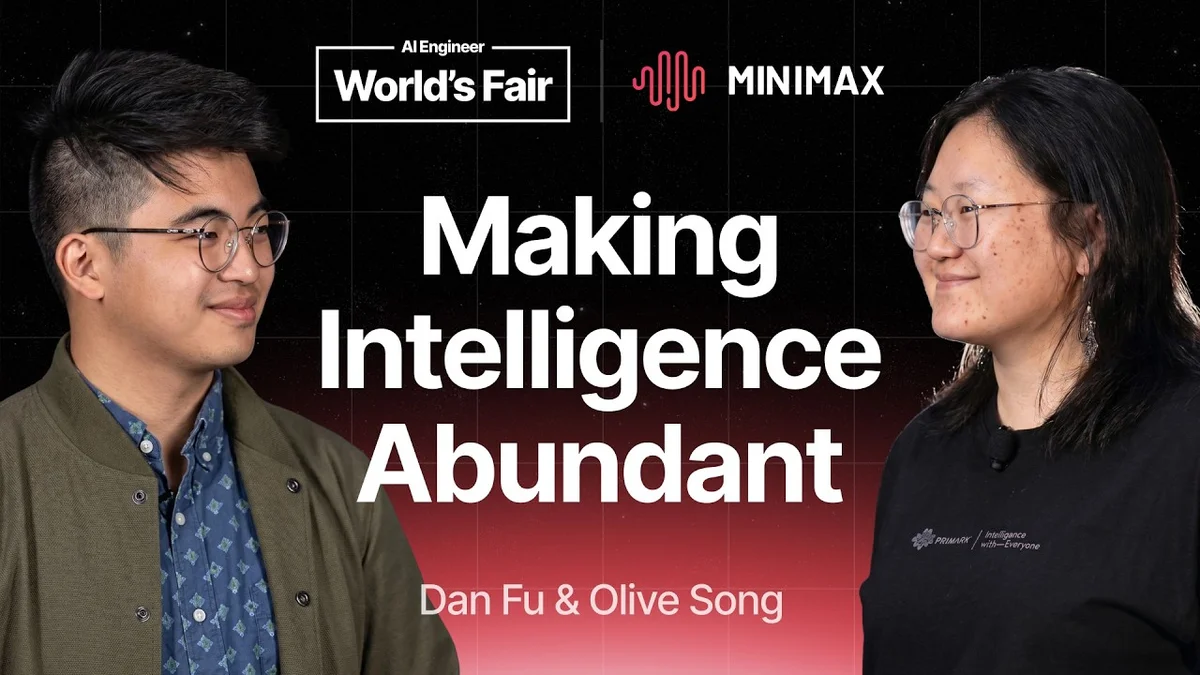
Dan from Together AI and Olive from MiniMax on stage discussing AI models.
AI Engineer
Visual TL;DR
MiniMax M3 Open-SourceCore
MiniMax open-sources M3, its most advanced multimodal AI model yet
From the article 9+ mentionsA recent discussion featuring Dan from Together AI and Olive from MiniMax offered a deep dive into these critical areas, focusing on MiniMax's latest open-source model, M3.
Open-Source VisionContext
aligns with MiniMax's mission to bring intelligence to everyone
From the article 5 mentionsThe conversation highlighted the strategic decision to open-source M3, its unique multimodal capabilities, and the intricate infrastructure required to serve such advanced AI models at scale.
Multimodal CapabilitiesCore
M3 possesses unique multimodal capabilities, discussed by Olive
From the article 4 mentionsThe conversation highlighted the strategic decision to open-source M3, its unique multimodal capabilities, and the intricate infrastructure required to serve such advanced AI models at scale.
Community CollaborationEffect
fosters developer feedback and improvements, strengthening the model
From the article 3 mentions"We do believe that the open-source community as a whole is very strong and powerful," Olive stated.
Together AI's RoleCore
Dan from Together AI discusses infrastructure for scaling M3
From the article 4 mentionsDan, VP of Kernels at Together AI, elaborated on the partnership between the two companies.
Scaling AI InfrastructureDriver
From the articleThe conversation highlighted the strategic decision to open-source M3, its unique multimodal capabilities, and the intricate infrastructure required to serve such advanced AI models at scale.
Efficient AI DeploymentOutcome
optimizing AI for performance and scale is crucial for widespread adoption
From the article 2 mentionsIn a rapidly evolving AI landscape, understanding the nuances of model development and deployment is crucial.
Future of AIOutcome
open source and efficiency are key drivers for AI's evolution
Contents(5)

In a rapidly evolving AI landscape, understanding the nuances of model development and deployment is crucial. A recent discussion featuring Dan from Together AI and Olive from MiniMax offered a deep dive into these critical areas, focusing on MiniMax's latest open-source model, M3. The conversation highlighted the strategic decision to open-source M3, its unique multimodal capabilities, and the intricate infrastructure required to serve such advanced AI models at scale.

MiniMax's Open-Source Vision

Olive, Research Lead of RL at MiniMax, explained the company's rationale behind open-sourcing their most advanced model yet, M3. "We do believe that the open-source community as a whole is very strong and powerful," Olive stated. By making the model accessible to everyone, MiniMax aligns with its mission to bring intelligence to everyone. This approach also fosters collaboration, allowing developers to contribute feedback and improvements, ultimately strengthening the model.

Together AI's Role in Scaling Intelligence

Dan, VP of Kernels at Together AI, elaborated on the partnership between the two companies. Together AI focuses on making intelligence abundant and accessible. Their collaboration with MiniMax began with earlier models and culminated in supporting the M3 launch. "We are seeing the usage and what people are doing with it was it was really quite exciting," Dan remarked, highlighting the significant token usage of M3 on their platform. Together AI's expertise in GPU optimization and serving AI models at scale was instrumental in making M3 widely available.

M3's Multimodal Capabilities and Hidden Gems

A key differentiator for MiniMax M3, as explained by Olive, is its multimodal nature. Unlike previous M2 series models, M3 was trained from scratch to understand not only text and code but also images and videos. This allows for applications in areas like generative technology and multimodal agents. Olive pointed out that while many developers are exploring gen tech and multimodal agents, a particularly exciting and perhaps overlooked capability is M3's potential in game development. "The model can help you develop real cool games," she noted.

Optimizing AI for Performance and Scale

The conversation then shifted to the technical challenges of post-training and serving AI models. Both Olive and Dan emphasized the importance of data and problem formulation. Dan detailed the process of optimizing the inference stack, which involves writing and benchmarking kernels, modifying existing ones, or creating new ones from scratch. This continuous optimization ensures that models like M3 become faster and more efficient over time.

The shift towards agentic workloads, characterized by hundreds of multi-turn tool calls, presents new challenges for the inference stack. Dan explained how these workflows influence decisions regarding KV cache, prompting, and kernel optimization. Unlike traditional chat applications, agentic workflows require handling much larger contexts, such as entire codebases, posing different optimization and routing challenges.

The Future of AI: Open Source and Efficiency

Looking ahead, Dan expressed optimism about the pace of AI development, predicting that in three years, the industry will look back and realize how early the current stage is. He specifically hopes for better GPU utilization, stating, "I hope in three years, well, they should already be embarrassed about it, but I hope in three years they're extra embarrassed by it." He also anticipates that the open-source frontier will continue to close the gap with leading proprietary models, citing M3 and others as examples of this trend.

Olive echoed this sentiment, emphasizing that the acceleration in AI development, partly driven by open-weight models, is enabling open-source initiatives to catch up with frontier labs. This progress aligns with MiniMax's mission to make their models accessible to everyone.

© 2026 StartupHub.ai. All rights reserved. You may not republish this article in full without a license. Search engines and AI research tools may crawl and summarize for reference. Bulk reproduction or model training requires a license. See our terms.
Daniel Singer

Written by

Daniel Singer

Editor, StartupHub.ai

Daniel Singer is the editor of StartupHub.ai, a technology expert and thought leader on AI and its applications across sectors, from fintech and healthcare to developer tooling and consumer software. He writes and tests the tools covered here thoroughly and regularly, and built StartupHub.ai to give founders, operators and buyers a clearer read on what they are actually being sold.