

Google's Gemma 4 12B: AI on Your Laptop

Google's Gemma 4 12B model brings efficient, multimodal AI directly to laptops with a novel unified architecture.

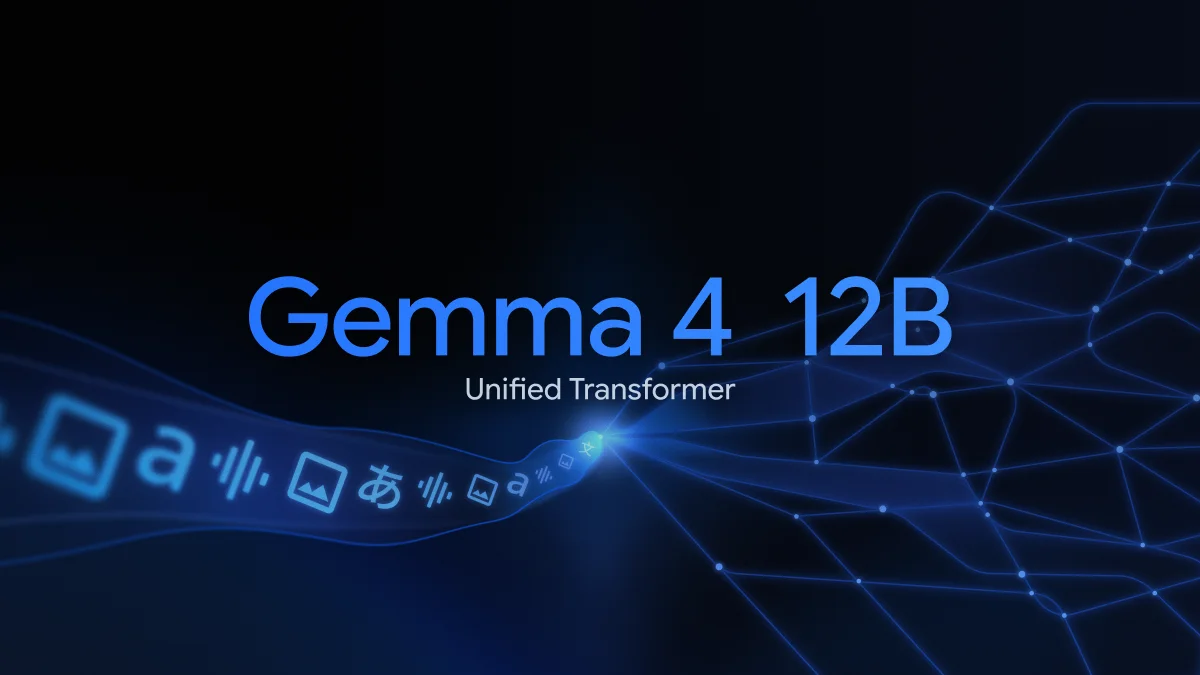
Illustration representing Google's Gemma 4 12B AI model processing multimodal data.
Google's Gemma 4 12B aims to bring advanced AI capabilities directly to consumer laptops.· Deepmind
Visual TL;DR
Advanced AI on LaptopsDriver
bringing multimodal intelligence directly to consumer hardware
From the article 4 mentionsGoogle DeepMind is pushing advanced AI capabilities directly to consumer hardware with the launch of its Gemma 4 12B model.
Gemma 4 12B ModelCore
Google DeepMind's new 12 billion parameter multimodal model
From the article 6 mentionsDespite its compact design, Gemma 4 12B delivers performance competitive with larger models on standard benchmarks.
Unified ArchitectureCore
eliminates separate encoding layers for different data types
From the article 2 mentionsIts key innovation lies in a unified, encoder-free architecture.
Lightweight Embedding ModuleContext
From the articleVision inputs are handled by a lightweight embedding module, with the main LLM backbone taking over the processing.
Simplified Audio InputContext
From the articleAudio inputs are simplified further by projecting the raw signal directly into the same dimensional space as text tokens.
Laptop-Ready PerformanceEffect
enables multimodal AI without relying on cloud processing
From the articleDespite its compact design, Gemma 4 12B delivers performance competitive with larger models on standard benchmarks.
Open and AccessibleOutcome
positions model as bridge between smaller and larger models
From the articleIt requires as little as 16GB of VRAM or unified memory, making it accessible for local execution on many modern laptops.
Contents(3)

Google DeepMind is pushing advanced AI capabilities directly to consumer hardware with the launch of its Gemma 4 12B model. This new offering aims to bring multimodal intelligence, capable of understanding images and audio alongside text, to laptops without relying on cloud processing.

The 12 billion parameter model positions itself as a bridge between Google's smaller, edge-focused E4B and its larger 26B Mixture of Experts model. Its key innovation lies in a unified, encoder-free architecture.

No More Encoding Layers

Traditional multimodal AI systems typically use separate encoder modules to process different data types like images or audio before feeding them into a core language model. Gemma 4 12B eliminates these intermediate steps.

Vision inputs are handled by a lightweight embedding module, with the main LLM backbone taking over the processing. Audio inputs are simplified further by projecting the raw signal directly into the same dimensional space as text tokens.

This streamlined approach reduces latency and memory usage, making the model more efficient.

Laptop-Ready Performance

Despite its compact design, Gemma 4 12B delivers performance competitive with larger models on standard benchmarks. It requires as little as 16GB of VRAM or unified memory, making it accessible for local execution on many modern laptops.

This enables powerful agentic workflows and multi-step reasoning directly on user devices, a significant step for on-device AI. The model also includes Multi-Token Prediction (MTP) drafters to further reduce latency.

Open and Accessible

Google is releasing Gemma 4 12B under an Apache 2.0 license, fostering broad developer adoption. The company highlights over 150 million downloads for previous Gemma models, demonstrating strong community engagement.

Developers can access Gemma 4 12B through various platforms including LM Studio, Ollama, Hugging Face, and Kaggle. Google is also providing a Skills Repository to aid in the development of AI agents using the new model. For enterprise deployment, options include Google Cloud's Gemini Enterprise Agent Platform Model Garden, Cloud Run, and GKE.

This release signifies Google DeepMind's commitment to democratizing advanced AI, bringing sophisticated multimodal capabilities to everyday hardware. For further insights into Google's approach to AI development, consider reading about Google DeepMind's multimodal model strategy.

© 2026 StartupHub.ai. All rights reserved. You may not republish this article in full without a license. Search engines and AI research tools may crawl and summarize for reference. Bulk reproduction or model training requires a license. See our terms.
Daniel Singer

Written by

Daniel Singer

Editor, StartupHub.ai

Daniel Singer is the editor of StartupHub.ai, a technology expert and thought leader on AI and its applications across sectors, from fintech and healthcare to developer tooling and consumer software. He writes and tests the tools covered here thoroughly and regularly, and built StartupHub.ai to give founders, operators and buyers a clearer read on what they are actually being sold.