

Google DeepMind Discusses Open Models & AI Ownership

Google DeepMind's Gus Martins and Ian Ballantyne discuss the benefits of open AI models like Gemma for ownership, control, and custom applications.

9 min read
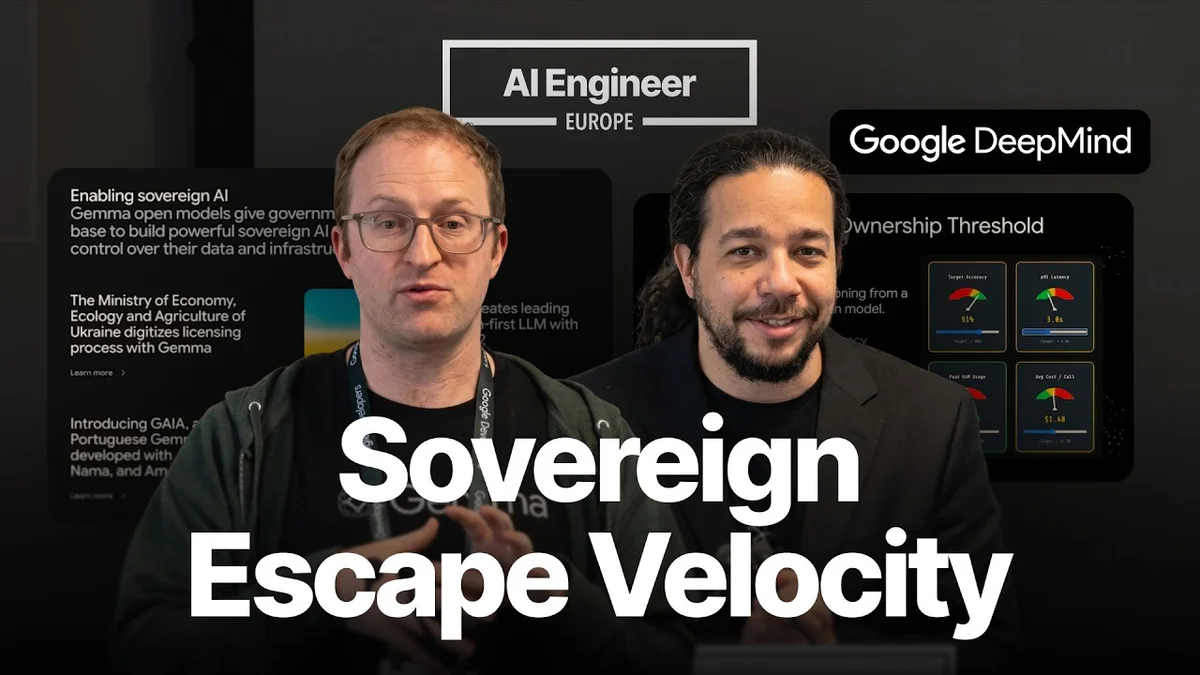
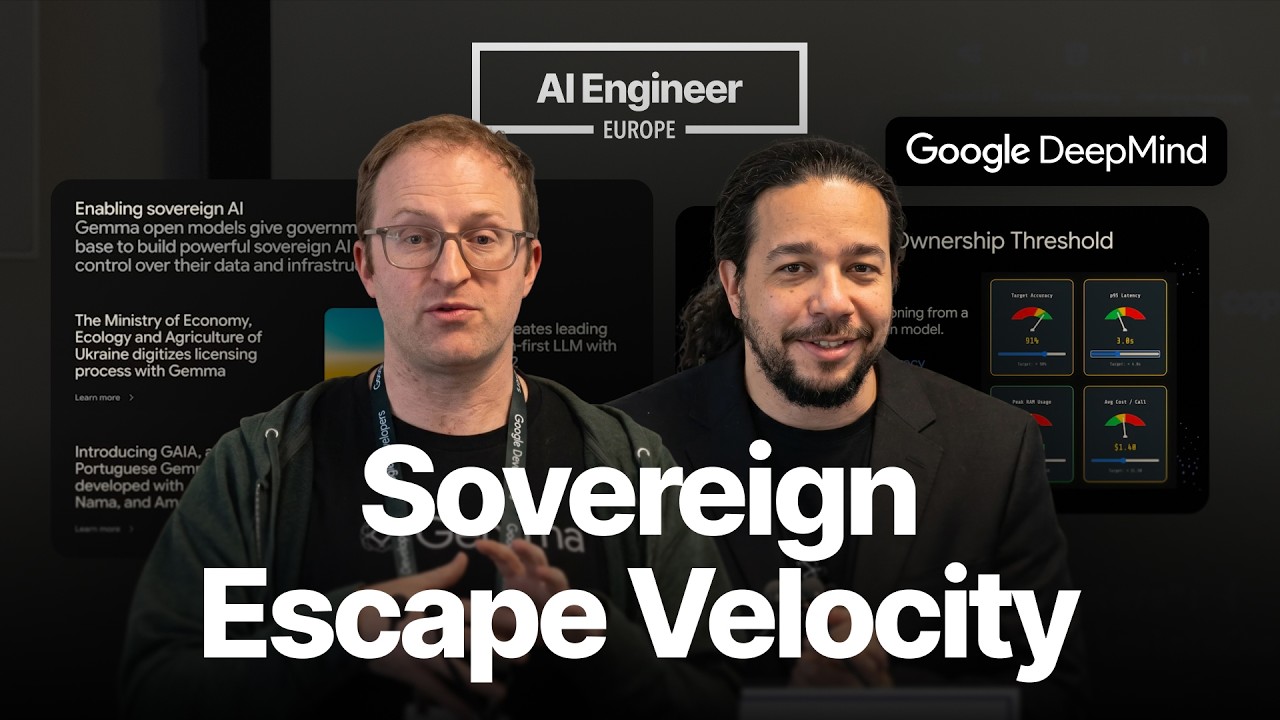
Gus Martins and Ian Ballantyne of Google DeepMind presenting on open models and AI ownership.
AI Engineer

Google DeepMind researchers Gus Martins and Ian Ballantyne recently explored the critical topic of AI ownership and the role of open models in achieving it. In their presentation, titled "Sovereign Escape Velocity: Ownership w Open Models," they detailed Google DeepMind's latest advancements with the Gemma family of models, emphasizing how these open-source solutions empower developers and enterprises to maintain greater control over their AI deployments.

Google DeepMind Discusses Open Models & AI Ownership - AI Engineer
Google DeepMind Discusses Open Models & AI Ownership — from AI Engineer

Visual TL;DR. Drive for AI Ownership enables Open Models (Gemma). Open Models (Gemma) addresses Feasibility & Cost Realities. Open Models (Gemma) enables Personal & Edge AI. Open Models (Gemma) enables Enterprise Consolidation. Feasibility & Cost Realities leads to Personal & Edge AI. Feasibility & Cost Realities leads to Enterprise Consolidation. Personal & Edge AI leads to Empowered Developers. Enterprise Consolidation leads to Empowered Developers. Effective Parameter Efficiency feature of Open Models (Gemma). Empowered Developers informs Best Practices.

  1. Drive for AI Ownership: desire for control and custom applications
  2. Open Models (Gemma): Google DeepMind's Gemma family of models, varying sizes
  3. Feasibility & Cost Realities: balancing performance and efficiency for deployments
  4. Personal & Edge AI: smaller Gemma models for personal devices and mobile hardware
  5. Enterprise Consolidation: larger Gemma models for desktop or single-GPU setups
  6. Effective Parameter Efficiency: models delivering strong performance per parameter used
  7. Empowered Developers: greater control over AI deployments and custom applications
  8. Best Practices: guidance on next steps for AI ownership
Visual TL;DR
Visual TL;DR — startuphub.ai Drive for AI Ownership enables Open Models (Gemma). Open Models (Gemma) enables Personal & Edge AI. Open Models (Gemma) enables Enterprise Consolidation. Personal & Edge AI leads to Empowered Developers. Enterprise Consolidation leads to Empowered Developers enables enables enables leads to leads to Drive for AI Ownership Open Models (Gemma) Personal & Edge AI Enterprise Consolidation Empowered Developers From startuphub.ai · The publishers behind this format
Visual TL;DR — startuphub.ai Drive for AI Ownership enables Open Models (Gemma). Open Models (Gemma) enables Personal & Edge AI. Open Models (Gemma) enables Enterprise Consolidation. Personal & Edge AI leads to Empowered Developers. Enterprise Consolidation leads to Empowered Developers enables enables enables leads to leads to Drive for AIOwnership Open Models(Gemma) Personal & EdgeAI EnterpriseConsolidation EmpoweredDevelopers From startuphub.ai · The publishers behind this format
Visual TL;DR — startuphub.ai Drive for AI Ownership enables Open Models (Gemma). Open Models (Gemma) enables Personal & Edge AI. Open Models (Gemma) enables Enterprise Consolidation. Personal & Edge AI leads to Empowered Developers. Enterprise Consolidation leads to Empowered Developers enables enables enables leads to leads to Drive for AI Ownership desire for control and custom applications Open Models (Gemma) Google DeepMind's Gemma family of models,varying sizes Personal & Edge AI smaller Gemma models for personal devicesand mobile hardware Enterprise Consolidation larger Gemma models for desktop orsingle-GPU setups Empowered Developers greater control over AI deployments andcustom applications From startuphub.ai · The publishers behind this format
Visual TL;DR — startuphub.ai Drive for AI Ownership enables Open Models (Gemma). Open Models (Gemma) enables Personal & Edge AI. Open Models (Gemma) enables Enterprise Consolidation. Personal & Edge AI leads to Empowered Developers. Enterprise Consolidation leads to Empowered Developers enables enables enables leads to leads to Drive for AIOwnership desire for controland customapplications Open Models(Gemma) Google DeepMind'sGemma family ofmodels, varying… Personal & EdgeAI smaller Gemmamodels for personaldevices and mobile… EnterpriseConsolidation larger Gemma modelsfor desktop orsingle-GPU setups EmpoweredDevelopers greater controlover AI deploymentsand custom… From startuphub.ai · The publishers behind this format
Visual TL;DR — startuphub.ai Drive for AI Ownership enables Open Models (Gemma). Open Models (Gemma) addresses Feasibility & Cost Realities. Open Models (Gemma) enables Personal & Edge AI. Open Models (Gemma) enables Enterprise Consolidation. Feasibility & Cost Realities leads to Personal & Edge AI. Feasibility & Cost Realities leads to Enterprise Consolidation. Personal & Edge AI leads to Empowered Developers. Enterprise Consolidation leads to Empowered Developers. Effective Parameter Efficiency feature of Open Models (Gemma). Empowered Developers informs Best Practices enables addresses enables enables leads to leads to feature of informs Drive for AI Ownership desire for control and custom applications Open Models (Gemma) Google DeepMind's Gemma family of models,varying sizes Feasibility & Cost Realities balancing performance and efficiency fordeployments Personal & Edge AI smaller Gemma models for personal devicesand mobile hardware Enterprise Consolidation larger Gemma models for desktop orsingle-GPU setups Effective Parameter Efficiency models delivering strong performance perparameter used Empowered Developers greater control over AI deployments andcustom applications Best Practices guidance on next steps for AI ownership From startuphub.ai · The publishers behind this format
Visual TL;DR — startuphub.ai Drive for AI Ownership enables Open Models (Gemma). Open Models (Gemma) addresses Feasibility & Cost Realities. Open Models (Gemma) enables Personal & Edge AI. Open Models (Gemma) enables Enterprise Consolidation. Feasibility & Cost Realities leads to Personal & Edge AI. Feasibility & Cost Realities leads to Enterprise Consolidation. Personal & Edge AI leads to Empowered Developers. Enterprise Consolidation leads to Empowered Developers. Effective Parameter Efficiency feature of Open Models (Gemma). Empowered Developers informs Best Practices enables addresses enables enables leads to leads to feature of informs Drive for AIOwnership desire for controland customapplications Open Models(Gemma) Google DeepMind'sGemma family ofmodels, varying… Feasibility &Cost Realities balancingperformance andefficiency for… Personal & EdgeAI smaller Gemmamodels for personaldevices and mobile… EnterpriseConsolidation larger Gemma modelsfor desktop orsingle-GPU setups EffectiveParameter… models deliveringstrong performanceper parameter used EmpoweredDevelopers greater controlover AI deploymentsand custom… Best Practices guidance on nextsteps for AIownership From startuphub.ai · The publishers behind this format

Understanding Gemma models

Martins and Ballantyne introduced the Gemma family, which comprises models of varying sizes, including the 2B, 4B, 26B A4B, and 31B Dense variants. They explained that these models are designed to offer a balance of performance and efficiency, with the smaller versions being suitable for personal devices and NPU/mobile hardware, while larger models can be deployed on desktop or single-GPU setups. The concept of "effective parameter efficiency" was highlighted, suggesting that these models deliver strong performance relative to their size, often outperforming larger proprietary models on targeted tasks.

Related startups

The Drive for AI Ownership

A central theme of the discussion was the burgeoning need for AI ownership, especially among governments and enterprises. Ballantyne elaborated on how relying solely on proprietary cloud APIs for AI services can create significant operational liabilities, particularly concerning data privacy and the potential for service disruptions or changes in terms of use. Open models, conversely, offer a path to greater control, allowing users to deploy, customize, and fine-tune models on their own infrastructure. This "sovereign escape velocity" refers to the ability of organizations to achieve a degree of autonomy in their AI capabilities, independent of external service providers.

Feasibility and Cost Realities

The presenters touched upon the practical considerations for adopting open models, outlining feasibility criteria such as task accuracy, hardware feasibility, and acceptable performance. They acknowledged the cost realities involved, which include upfront hardware investment and ongoing running costs, but emphasized that these can be balanced against the long-term benefits of ownership and the avoidance of pay-per-token models. The ability to run models on local hardware also addresses concerns about data security and latency, crucial for many sensitive applications.

Personal and Edge AI Deployments

The discussion then shifted to the practical applications of these models, particularly in personal and edge computing scenarios. Martins demonstrated how models like Gemma can be run on mobile devices and desktops, enabling local data processing and reducing reliance on cloud connectivity. The concept of "battery priority" was raised, noting that for mobile devices, power utilization is a critical cost factor, often more so than raw token generation costs. The ability to deploy efficient models on these constrained devices is therefore paramount.

Enterprise Consolidation and Fine-Tuning

For enterprise use cases, the trend is moving towards consolidating AI workloads from large cluster-scale setups to more manageable, consolidated nodes. This approach, typically involving 1-2 GPUs, not only reduces serving costs but also simplifies the physical network overhead. Furthermore, specialized tasks can benefit from targeted fine-tuning, such as the development of domain-specific variants like MedGemma for medical applications. The availability of open models under permissive licenses, like Apache 2.0, is key to enabling this enterprise adoption and customization.

Best Practices and Next Steps

Martins and Ballantyne concluded by outlining best practices for leveraging open models. These include:
  • Drop-in Evaluation: Using local engines or lightweight serving with standard API interfaces to quickly assess model capabilities.
  • Custom Evaluation: Building robust, cross-platform evaluation suites tailored to specific domain tasks.
  • Serving Management: Factoring in the operational realities of serving, including downtime, and managing the underlying hardware (GPUs, NPUs).
  • Enterprise Scaling: Scaling from local prototypes to production-grade serving, often utilizing managed platforms.

The overall message conveyed was that open models like Gemma are democratizing access to powerful AI capabilities, offering a flexible and controllable path for innovation across a wide range of applications and industries.

© 2026 StartupHub.ai. All rights reserved. Do not enter, scrape, copy, reproduce, or republish this article in whole or in part. Use as input to AI training, fine-tuning, retrieval-augmented generation, or any machine-learning system is prohibited without written license. Substantially-similar derivative works will be pursued to the fullest extent of applicable copyright, database, and computer-misuse laws. See our terms.