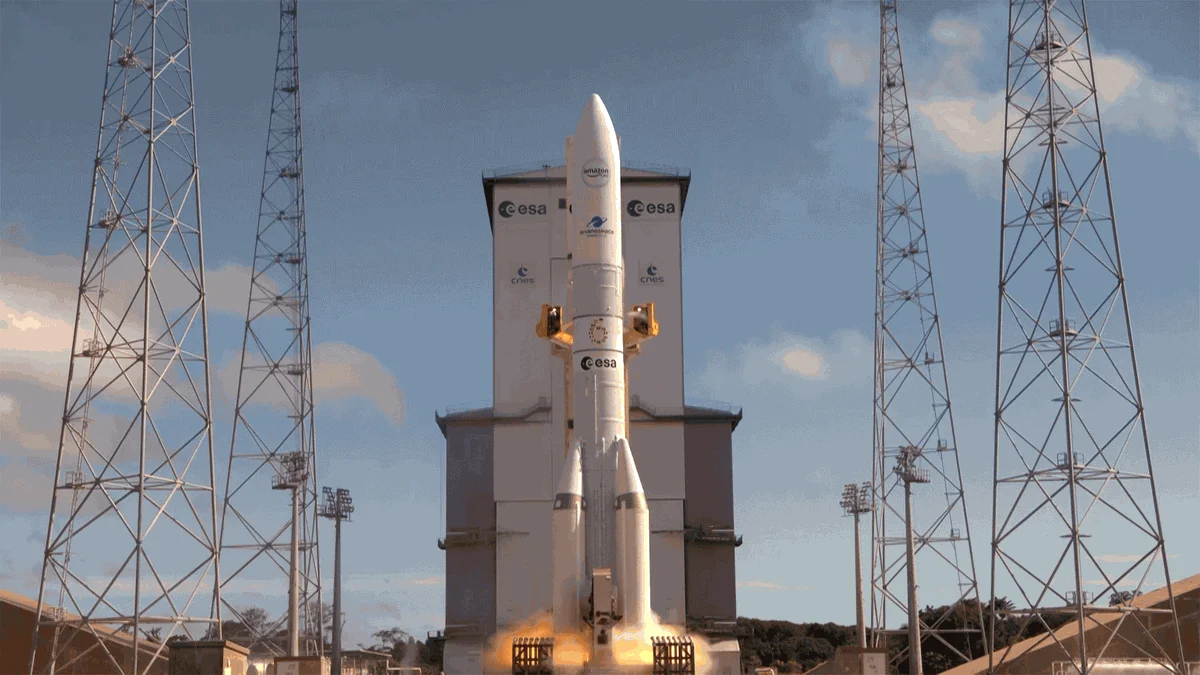
Amazon Leo is no longer an experiment. It is infrastructure under construction.
Amazon says its constellation of more than 3,200 satellites will deliver internet from under 400 miles up. Nearly 400 spacecraft are already in orbit, the company said, with initial service starting in some regions later this year. I read this as Amazon doing what it always does: owning the stack to control cost and experience.
The scale is the point.
Leo started in 2018 under Rajeev Badyal with more than $10 billion in upfront capital, Amazon said. The team built its own satellites, factory, test labs and payload facility at Cape Canaveral, plus a mission operations center. Claus Schulze, who leads integration and testing of the end-to-end system after almost 20 years at Qualcomm and OneWeb, said building in-house lets Amazon control its destiny on technology and schedules. Satellites will fly at 367 to 392 miles on Ka-band spectrum, a zone Amazon claims gives faster speeds with fewer spacecraft.
The hard part is software, not rockets. Each satellite moves at 17,500 miles per hour and holds a customer for one to three minutes before handoff, Amazon said. Data can hop between satellites on laser links until it hits a gateway near AWS infrastructure, then travel by fiber to the internet. The system recalculates the fastest path every 4.5 seconds based on position, weather and load. Nick Matthews, a solutions architect who talks to prospective customers, said it will feel like normal internet with 4K streaming and file downloads running at once.
The fair pushback is that Starlink got there first and tells you the price. Amazon has published no monthly price and no price for terminals, per OrbitalRadar, while Starlink costs from $55 a month in the US with the kit now included in the plan. A separate November check found only an updates list, not a priced US home-internet checkout. That gap matters because coverage without pricing is not yet a product.
It does not break my claim. Distribution and cloud give Amazon a second way to win on enterprise, ships, planes and remote sites. If you build for those places, test Leo now but do not put its pricing in your plan yet.