Zach Lloyd demoed Warp Factories as infrastructure to move coding agents off laptops and into sandboxed cloud loops in a talk for AI Engineer. Lloyd said local agents run with the permissions of the signed-in user, so a compromise can take over that laptop and no central team can audit private MCP and skill configs.
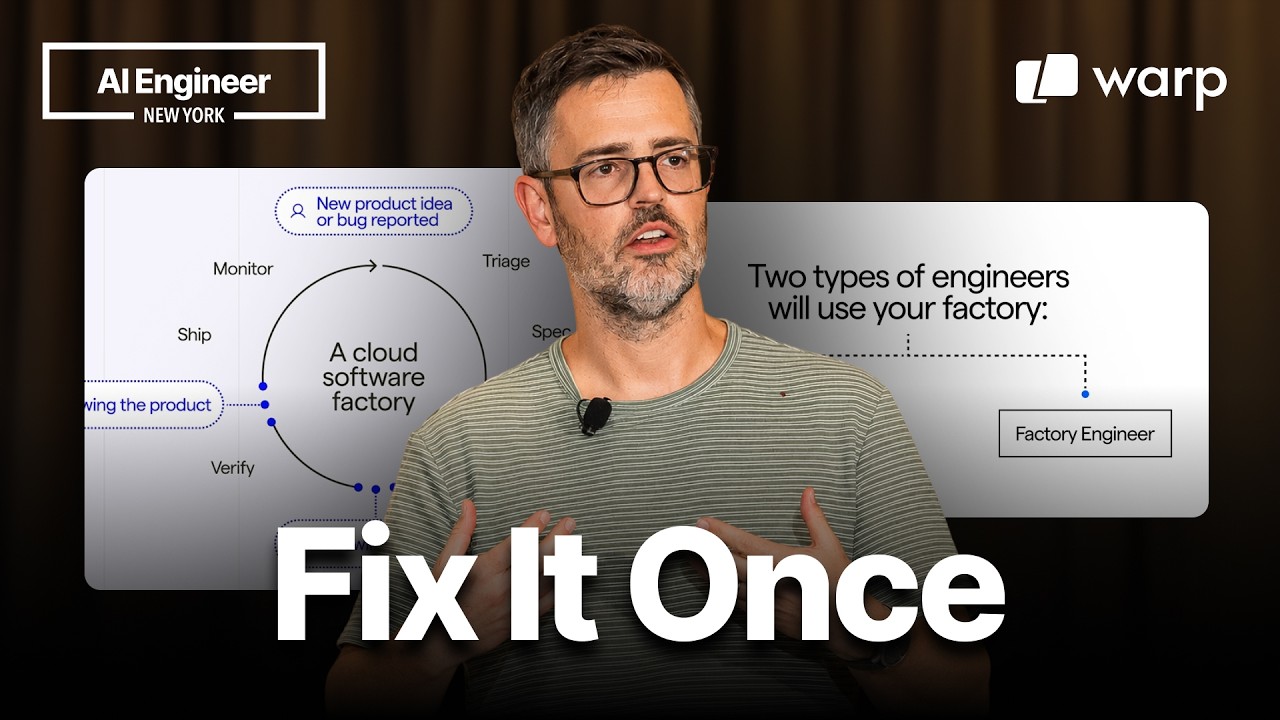
Why would a team rebuild how it ships code? Because interactive prompting has hit a ceiling on cost, control and security. A cloud software factory, which Lloyd defines as a governed loop in the cloud where humans submit work and agents triage, spec, build and verify it, is his answer.
Lloyd was a principal engineer on the Google Docs suite and now leads Warp, known for Warp Terminal with about 65,000 GitHub stars and almost a million active developers, he said. Factories have to be open, adaptable and defined in code. Open means any frontier or open weight model and any harness, adaptable means it runs on your stack and compute with data and inference under your control, and defined in code means workflows, prompts, secrets, MCPs, skills, benchmarks and run targets live in a versioned repo.
The payoff is measurement.
Product engineers still file in Slack, Linear, Jira or a GitHub comment, Lloyd showed. Every run then lands in one store with productivity, cycle time and spend attached. Online scorers grade each run with LLM as judge, including one that flags redundant tests, and failures feed a self improvement loop that aggregates patterns and opens a pull request against the factory repo, like one fix that cited 37 failures to read matching skills before implementing.
Can you trust that loop to pick models? Lloyd said no public chart can. His fix is to replay your own past tasks as a benchmark and score correctness with the same judges. One Warp view had GLM 53 flash at 93% correct for $2 against GPT 56 saw at 95% for three times the price, data a team can use to route front end work by cost and quality.
That changes who does what. Product engineers keep shipping features through the factory while platform or factory engineers tune context, skills and model mix. They contain PR pileup with spec driven development and computer use verification that produces user level evidence, and they track cost per PR including scoring and benchmarking before scaling budgets, Lloyd said in answering audience questions. Warp documents the same flow as issues, tickets and Slack messages becoming reviewed pull requests with people approving specs and merges, and Lloyd said the setup fits teams of around 10 or more rather than solo developers.
Watch your own evals before your model contracts. If you cannot score redundant tests, routing cost and spec adherence on your code, you do not have a factory yet.