

Waymo CEO on AI's Real-World Challenges

Waymo Co-CEO Dmitri Dolgov shares 7 lessons learned from building and scaling autonomous driving technology, emphasizing the difference between demos and products.

9 min read
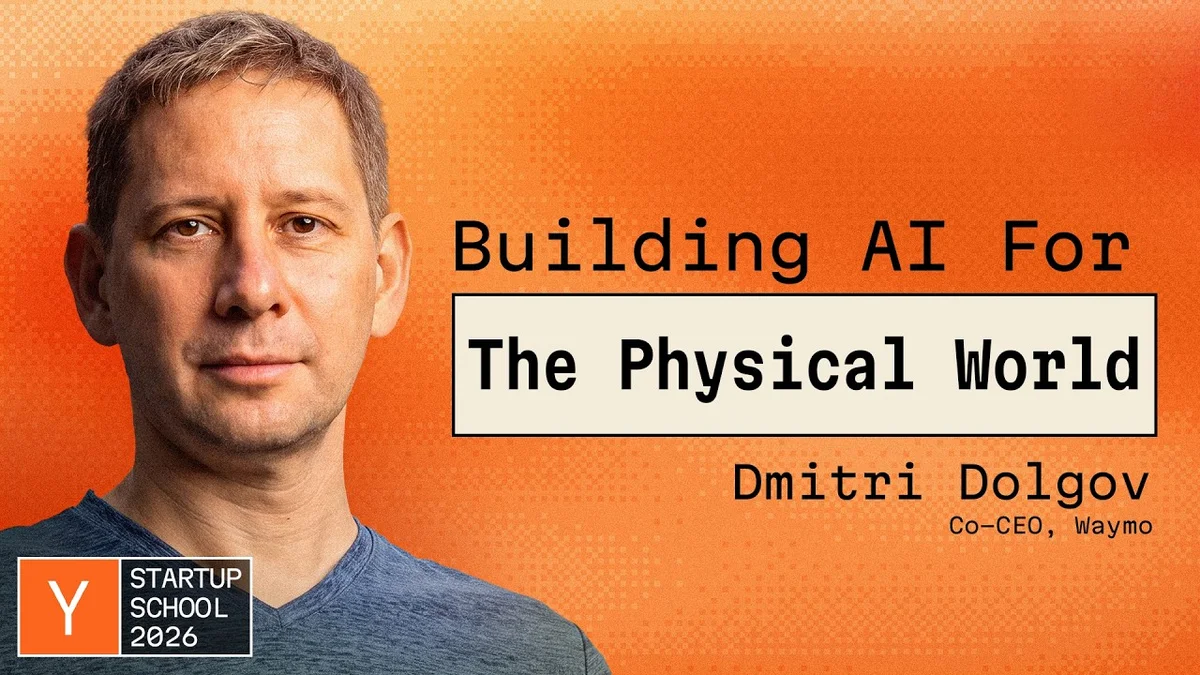
Dmitri Dolgov, Co-CEO of Waymo, speaking on stage about AI development.
Waymo Co-CEO Dmitri Dolgov discusses the challenges and lessons learned in building AI for the physical world.· YC

Visual TL;DR. AI Demos vs. Product highlights Four Physical AI Gaps. Four Physical AI Gaps addressed by Waymo Driver. Waymo Driver uses Architecture & Iteration. Architecture & Iteration enables Scale & Safety. Waymo Driver achieves Scale & Safety. Scale & Safety leads to Real-World AI Challenges. Waymo Foundation Model informs Real-World AI Challenges.

  1. AI Demos vs. Product: demos are the first 1%, achieving many nines of performance is the product
  2. Four Physical AI Gaps: bridging the gap between digital AI and real-world physical deployment challenges
  3. Waymo Driver: nearly two decades of experience building and scaling autonomous driving technology
  4. Architecture & Iteration: importance of robust system architecture and continuous iteration for reliability
  5. Scale & Safety: achieving public deployment requires many nines of performance and reliability
  6. Waymo Foundation Model: leveraging a foundation model for the future of physical AI applications
  7. Real-World AI Challenges: lessons learned from building and deploying AI in the physical world
Visual TL;DR
Visual TL;DR, startuphub.ai Waymo Driver achieves Scale & Safety. Scale & Safety leads to Real-World AI Challenges achieves leads to AI Demos vs. Product Waymo Driver Scale & Safety Real-World AI Challenges From startuphub.ai · The publishers behind this format
Visual TL;DR, startuphub.ai Waymo Driver achieves Scale & Safety. Scale & Safety leads to Real-World AI Challenges achieves leads to AI Demos vs.Product Waymo Driver Scale & Safety Real-World AIChallenges From startuphub.ai · The publishers behind this format
Visual TL;DR, startuphub.ai Waymo Driver achieves Scale & Safety. Scale & Safety leads to Real-World AI Challenges achieves leads to AI Demos vs. Product demos are the first 1%, achieving manynines of performance is the product Waymo Driver nearly two decades of experience buildingand scaling autonomous driving technology Scale & Safety achieving public deployment requires manynines of performance and reliability Real-World AI Challenges lessons learned from building anddeploying AI in the physical world From startuphub.ai · The publishers behind this format
Visual TL;DR, startuphub.ai Waymo Driver achieves Scale & Safety. Scale & Safety leads to Real-World AI Challenges achieves leads to AI Demos vs.Product demos are the first1%, achieving manynines of… Waymo Driver nearly two decadesof experiencebuilding and… Scale & Safety achieving publicdeployment requiresmany nines of… Real-World AIChallenges lessons learnedfrom building anddeploying AI in the… From startuphub.ai · The publishers behind this format
Visual TL;DR, startuphub.ai AI Demos vs. Product highlights Four Physical AI Gaps. Four Physical AI Gaps addressed by Waymo Driver. Waymo Driver uses Architecture & Iteration. Architecture & Iteration enables Scale & Safety. Waymo Driver achieves Scale & Safety. Scale & Safety leads to Real-World AI Challenges. Waymo Foundation Model informs Real-World AI Challenges highlights addressed by uses enables achieves leads to informs AI Demos vs. Product demos are the first 1%, achieving manynines of performance is the product Four Physical AI Gaps bridging the gap between digital AI andreal-world physical deployment challenges Waymo Driver nearly two decades of experience buildingand scaling autonomous driving technology Architecture & Iteration importance of robust system architectureand continuous iteration for reliability Scale & Safety achieving public deployment requires manynines of performance and reliability Waymo Foundation Model leveraging a foundation model for thefuture of physical AI applications Real-World AI Challenges lessons learned from building anddeploying AI in the physical world From startuphub.ai · The publishers behind this format
Visual TL;DR, startuphub.ai AI Demos vs. Product highlights Four Physical AI Gaps. Four Physical AI Gaps addressed by Waymo Driver. Waymo Driver uses Architecture & Iteration. Architecture & Iteration enables Scale & Safety. Waymo Driver achieves Scale & Safety. Scale & Safety leads to Real-World AI Challenges. Waymo Foundation Model informs Real-World AI Challenges highlights addressed by uses enables achieves leads to informs AI Demos vs.Product demos are the first1%, achieving manynines of… Four Physical AIGaps bridging the gapbetween digital AIand real-world… Waymo Driver nearly two decadesof experiencebuilding and… Architecture &Iteration importance ofrobust systemarchitecture and… Scale & Safety achieving publicdeployment requiresmany nines of… Waymo FoundationModel leveraging afoundation modelfor the future of… Real-World AIChallenges lessons learnedfrom building anddeploying AI in the… From startuphub.ai · The publishers behind this format

Waymo Co-CEO Dmitri Dolgov recently shared valuable insights into the complexities of building and deploying AI in the physical world, drawing from Waymo's nearly two decades of experience with its autonomous driving technology. Speaking at a Startup School event, Dolgov outlined seven key lessons learned, emphasizing the stark differences between digital and physical AI applications.

The 1% Demo vs. the 99% Product

Dolgov began by highlighting the vast gap between a working AI demo and a truly shippable product. He stressed that "the demo is the first 1%, the nines are the product." He illustrated this point with Waymo's own journey, noting that achieving a capability-complete autonomous driving system in 2010 took about 18 months, but scaling it to a reliable public service took another 15 years. This extended period was necessary to achieve the "many nines of performance and reliability" required for public deployment.

The full discussion can be found on YC's YouTube channel.

Waymo Co-CEO Dmitri Dolgov: The Demo Is Only 1% Of The Work - YC
Waymo Co-CEO Dmitri Dolgov: The Demo Is Only 1% Of The Work, from YC

He explained that each additional "nine" of reliability demands exponentially more effort, necessitating fundamentally different approaches like fully redundant systems and tiered fallback architectures. Dolgov cautioned against overspending on spectacular demos, advising founders to "count your nines before you count your demo views."

The Four Gaps of Physical AI

A core theme of Dolgov's presentation was the identification of four key gaps that differentiate building AI for the physical world compared to the digital realm:

  • Cost of Error Gap: Mistakes in digital AI might cost a retry, but in the physical world, they can be measured in human lives. There's no "undo" button.
  • Latency Gap: Milliseconds matter for physical agents like cars traveling at high speeds, demanding on-board compute that makes split-second decisions.
  • Data Gap: Unlike digital AI, which benefits from the internet's vast cache of human knowledge, the physical world lacks a readily digitized, pre-labeled equivalent.
  • Validation Gap: Physical AI requires a very high level of safety and confidence from day one, before any units are deployed, unlike digital AI where iteration can happen post-launch.

Navigating the Hype Cycles

Dolgov also touched upon the cyclical nature of AI hype, noting that each technological breakthrough, from deep learning to transformers, makes initial demos easier but doesn't necessarily solve the hard problems inherent in scaling to a real product. He advised founders to remain honest about their product's demands and avoid cutting corners, as this can lead to a "pretty rude awakening later."

The Waymo Driver's Scale and Safety

He shared Waymo's current operational scale: approximately 500,000 trips per week, driving over 4 million fully autonomous miles weekly across 15 cities in the United States. This translates to over 300 years of an average American driver's annual mileage each week. Crucially, the Waymo Driver achieves this with a "superhuman safety record," preventing a serious injury every eight days by preventing potential crashes.

The Importance of Architecture and Iteration

Dolgov emphasized that the required "number of nines" dictates the architecture and technical approach. He used the example of sensing for autonomous driving, explaining that while cameras alone might suffice for assistance products, full autonomy demands multiple sensing modalities like lidar and radar to overcome limitations in various conditions. He also highlighted the importance of hardware evolution, noting that companies should design for future upgrades rather than anchoring to current component costs.

Furthermore, Dolgov stressed the need to "ride those tech waves and do that repeatedly," rebuilding the Waymo driver around AI breakthroughs while focusing on unification and simplification. The company has successfully integrated technologies like convolutional neural networks (CNNs) and transformers, and is now leveraging the latest in vision-language models (VLMs) and frontier world models. He noted that driving, with its social and sequential aspects, shares similarities with language modeling.

The Waymo Foundation Model and the Future of Physical AI

The presentation culminated in a discussion of Waymo's foundational model, a multimodal world action language model. This model processes camera, lidar, and radar data, understands world physics and social dynamics, and can predict the effects of its own actions. Dolgov stated that this approach allows for a more agile development process by moving complexity upstream to a large, shared foundation.

Ultimately, Dolgov's message was one of pragmatic optimism: while the magic of early-stage development is crucial, the real challenge and reward lie in building reliable, safe, and scalable AI solutions for the physical world. He concluded by stating that physical AI is where digital AI was years ago, and the next decade will likely see its major advancements in the physical realm.
© 2026 StartupHub.ai. All rights reserved. Do not enter, scrape, copy, reproduce, or republish this article in whole or in part. Use as input to AI training, fine-tuning, retrieval-augmented generation, or any machine-learning system is prohibited without written license. Substantially-similar derivative works will be pursued to the fullest extent of applicable copyright, database, and computer-misuse laws. See our terms.