

Alloy Robotics Raises $8M to Debug Robot Fleets With AI

Alloy Robotics has raised $8 million at an $80 million valuation for AI agents that read a robot fleet's logs, telemetry and video to explain why a machine failed. Square Peg led the round.

6 min read
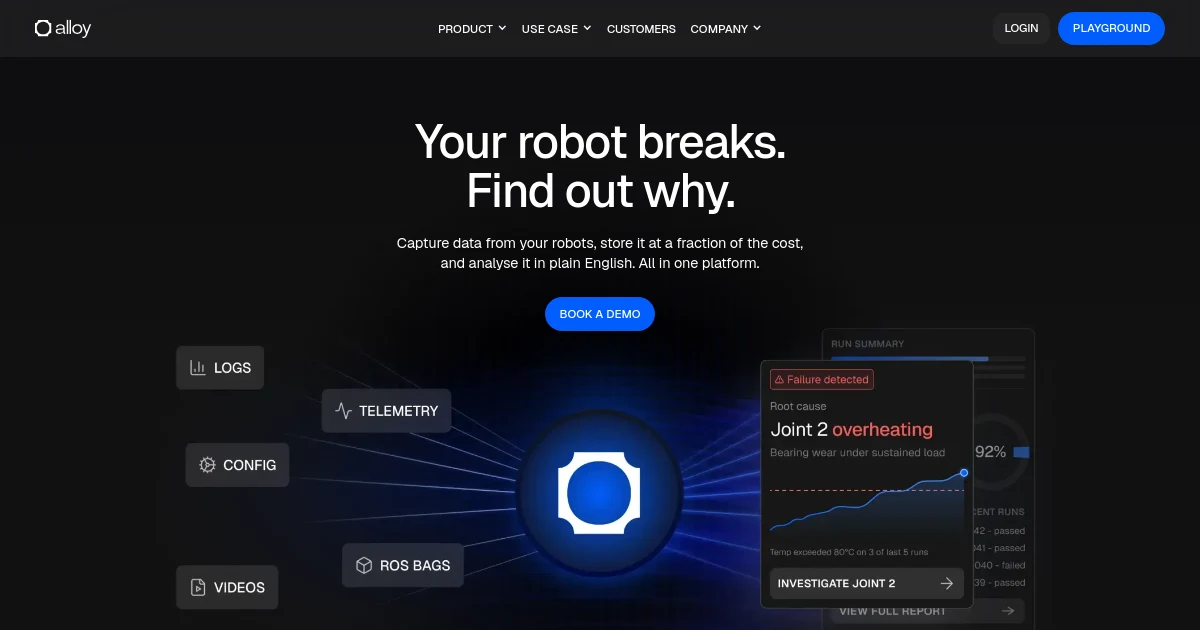
Alloy homepage showing an AI agent identifying a robot joint overheating as the root cause of a failure
Alloy's platform surfaces the root cause behind a robot failure. Source: usealloy.ai
Key Takeaways
  • 1
    Alloy Robotics raised $8 million at an $80 million valuation, just over a year after it was founded.

  • 2
    Its AI agents pull together fleet logs, telemetry, video and sensor data, then add engineering context from Slack and Jira, so engineers can ask why a robot failed in plain language.

  • 3
    Square Peg led the round, with pre-seed backers Blackbird, Airtree and Skip Capital returning.

  • 4
    At Advanced Navigation, field-test analysis that took a full day now takes under ten minutes.

  • 5
    The bet is that fleet-data infrastructure, which Tesla and Waymo built in house, becomes shared infrastructure for everyone else.

Alloy Robotics has raised $8 million at an $80 million valuation for AI agents that work out why a robot broke. The round comes just over a year after the company was founded, and it targets a problem every robotics team hits the moment its fleet outgrows a handful of machines: the answer to a failure is somewhere in the data, but finding it can take days.

"When a robot fails, an engineer can spend days, sometimes weeks, working out why. Often the same issue has come up before," said Joe Harris, founder and CEO of Alloy Robotics, who previously helped scale Eucalyptus as chief commercial officer before its $1 billion acquisition. "The answer's in the data, just buried. And the more robots you run, the more often that happens. Alloy finds the relevant evidence and surfaces the pattern."

What Alloy actually does

Alloy brings a fleet's logs, telemetry, video and sensor data into one place, then layers on the engineering context that already lives in Slack, Jira and similar systems. Its agents run continuously, scanning for anomalies, regressions and recurring patterns. Engineers can interrogate a known problem in natural language, and the agents surface issues nobody thought to look for.

The part that matters for trust is the audit trail. Every finding links back to the underlying missions, timestamps and signals, so an engineer can open the evidence and judge it rather than taking a model's word for it.

Alloy also ships a native Model Context Protocol server, which gives coding agents such as Codex and Claude Code access to the context behind each mission. That removes the step where an engineer manually assembles disconnected raw files before they can ask a useful question.

Why fleet debugging breaks at scale

Most robotics teams still investigate incidents one mission at a time, using visualization tools, dashboards and custom scripts. That workflow holds up for a pilot deployment and falls apart as the fleet grows, because the number of things that can go wrong grows faster than the team looking at them.

Companies with the deepest pockets solved this privately. Tesla and Waymo built extensive fleet-data infrastructure internally. Alloy is betting that the same capability becomes shared infrastructure for the rest of the industry, in the way that observability tooling stopped being something each software company built for itself.

Two customer examples give a sense of the delta. At Advanced Navigation, field-test analysis that once consumed a full day now takes less than ten minutes. "The conversation has completely shifted," said Jai Castle, the company's product validation manager. "Instead of 'Can we get this done in time?', it's 'What else can we go after?'"

At the US autonomous-drone startup DroneForge, engineer David Crabtree suspected the wrong component was failing. Alloy showed that both state estimators were working normally and pointed at the actual fault. "Every time you misdiagnose, it can just compound," Crabtree said. That compounding is the real cost: a wrong diagnosis sends a team down a multi-week path fixing something that was never broken.

Where this sits in the robotics market

StartupHub.ai tracks 1,257 robotics companies, and the picture in that data explains why a tool like this arrives now. The median score across the robotics companies we have scored is 38.5 out of 100, and only about one percent clear 70. That spread is what an industry looks like when most participants are still pre-product or pre-fleet, while a small group has crossed into running real machines at real scale. The second group is the one that suddenly needs fleet-wide root cause analysis, and it is growing.

Alloy is now used by teams across navigation, defense, drones, agriculture, maritime, humanoids, construction and medical robotics. Some push entire fleets through it. Others are designing their next robot around it from the start, which is the more telling signal: it suggests the tool is shaping hardware decisions rather than just reporting on them.

The investors

Square Peg Capital led the round. Pre-seed backers Blackbird Ventures, Airtree Ventures and Skip Capital all returned, having first backed the company in a pre-seed round announced in September 2025. The round also drew in leaders and engineers from OpenAI, Anthropic, Tesla, Waymo, Halter and Carbon Robotics, alongside several of Alloy's own customers.

Customers investing in their supplier is worth noting. It is a weak signal on its own, but combined with returning pre-seed investors it suggests the early deployments produced something the buyers wanted more of.

"Robotics is one of the hardest industries to build in, and the teams that win will be those that learn fastest from their own data," said Jethro Cohen, principal at Square Peg. "Alloy gives every engineer the leverage to support far larger fleets. That is why we backed Alloy."

The money goes to engineering hires, US expansion and further work on Alloy's models and agent platform.

"The teams building robots today are creating machines that can do real work, safely, in the physical world," said Harris. "Getting a robot to work is only the beginning. To earn trust at scale, teams need to learn from every run. Alloy turns everything a fleet does into knowledge that makes the next robot better, so the future arrives sooner."

Frequently Asked Questions

What does Alloy Robotics do?

Alloy Robotics builds AI agents that analyse robot fleet data to identify the root cause of failures. It ingests logs, telemetry, video and sensor data, combines them with engineering context from tools like Slack and Jira, and lets engineers ask in plain language why something went wrong. Each answer links back to the specific missions, timestamps and signals behind it.

How much has Alloy Robotics raised?

Alloy Robotics raised $8 million at an $80 million valuation in a round led by Square Peg Capital. That follows a pre-seed round announced in September 2025 backed by Blackbird, Airtree and Skip Capital, all of which returned for this round.

Who is Alloy Robotics for?

Teams running robot fleets large enough that investigating failures one mission at a time no longer scales. Current users span navigation, defense, drones, agriculture, maritime, humanoids, construction and medical robotics. Teams with a handful of machines and an engineer who knows all of them will feel the pain less than a team running hundreds.

© 2026 StartupHub.ai. All rights reserved. Do not enter, scrape, copy, reproduce, or republish this article in whole or in part. Use as input to AI training, fine-tuning, retrieval-augmented generation, or any machine-learning system is prohibited without written license. Substantially-similar derivative works will be pursued to the fullest extent of applicable copyright, database, and computer-misuse laws. See our terms.