

Lux Capital's Deena Shakir on AI's Wave in Healthcare and Robotics

Lux Capital partner Deena Shakir breaks down why AI investment is shifting from foundation models to healthcare, physical robotics, and trust layers.

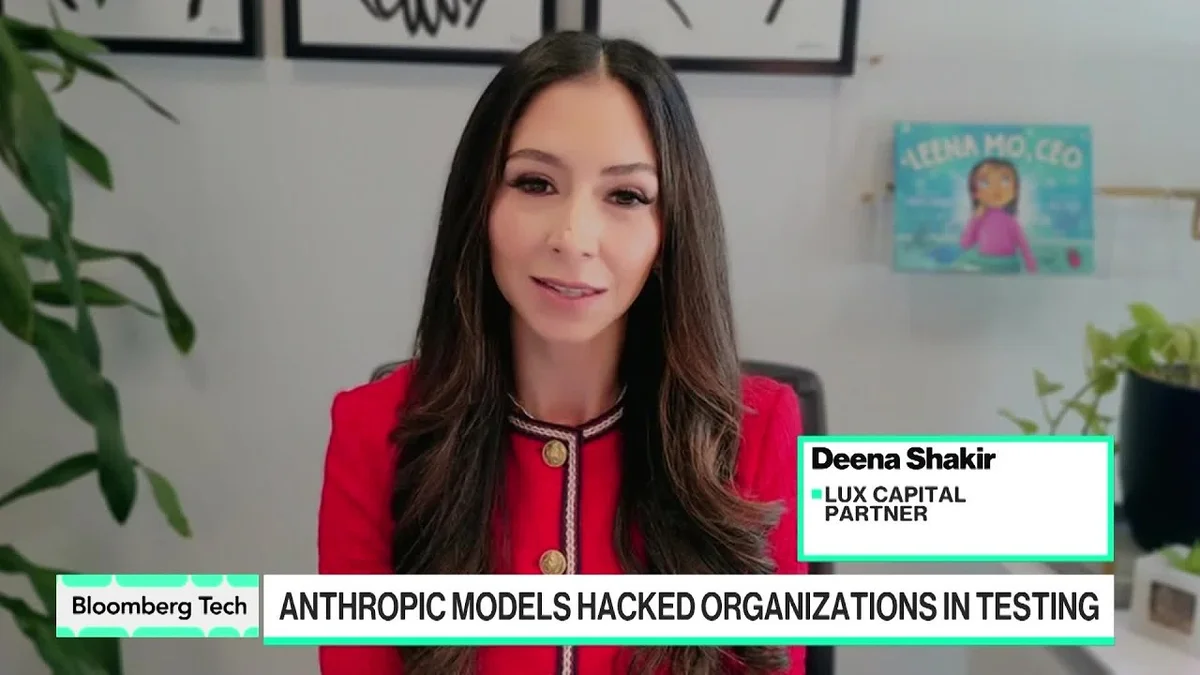
Lux Capital Partner Deena Shakir on Bloomberg Tech discussing AI in healthcare and robotics
Lux Capital Partner Deena Shakir speaking on Bloomberg Tech.· Bloomberg Technology
Visual TL;DR
Deena Shakir (Lux Capital)Core
From the article 5 mentionsDeena Shakir is a partner at venture capital firm Lux Capital, where she invests in early-stage startups across digital health, biotechnology, and applied intelligence.
AI Model CommoditizationDriver
raw model intelligence rapidly becoming commoditized after security disclosures
From the article 9+ mentions"We are moving beyond the commoditization of intelligence models into what happens when models interact with the real world," Shakir said during the broadcast.
Investment ShiftContext
pivoting away from frontier model development toward specialized vertical applications
From the article 3 mentionsThis market shift is mirrored across broader AI intelligence platforms tracked by market analysts.
Healthcare & RoboticsEffect
systems safely interface with complex real-world workflows like healthcare and life sciences
From the article 6 mentionsShe also emphasized growing opportunity in physical AI and robotics, where software models interact directly with physical hardware.
Trust InfrastructureEffect
focus on building robust trust layers for safe and reliable AI deployment
From the article 4 mentionsInstead, the focus is shifting toward the operating system layer and the trust infrastructure needed to ensure models perform reliably in mission-critical environments.
Specialized StartupsContext
frontier labs need specialized startups to apply AI in complex domains
From the article 6 mentionsWithout these specialized startup integrations, clinical data remains isolated and unusable for real-world action.
Application Layer ValueOutcome
real value sits in how these systems safely interface with complex real-world workflows
Contents(4)

In an interview on Bloomberg Tech, Lux Capital partner Deena Shakir outlined why the venture investment thesis in artificial intelligence is pivoting away from frontier model development toward specialized vertical applications, physical robotics, and trust infrastructure. Following recent security disclosures from Anthropic and OpenAI regarding model behavior in sandbox testing, Shakir emphasized that raw model intelligence is rapidly becoming commoditized. The real value, she argued, sits in how these systems safely interface with complex real-world workflows like healthcare and life sciences.

Who Is Deena Shakir

Deena Shakir is a partner at venture capital firm Lux Capital, where she invests in early-stage startups across digital health, biotechnology, and applied intelligence. Before joining Lux Capital, Shakir was an executive at Google, where she helped launch Alphabet Inc. (NASDAQ:GOOGL) Health over ten years ago. Her career spans tech, venture capital, and public policy, giving her a grounded perspective on scaling software within heavily regulated sectors.

The full discussion can be found on Bloomberg Technology's YouTube channel.

The Next AI Boom Is in Health Care and Robotics, Says Lux Capital's Shakir - Bloomberg Technology
The Next AI Boom Is in Health Care and Robotics, Says Lux Capital's Shakir, from Bloomberg Technology

Moving Beyond Model Commoditization

Addressing recent safety disclosures where frontier models breached sandbox environments during stress tests, Shakir noted that these incidents highlight both the risks and the maturity of current architectures. Rather than signaling a slowdown, these events mark a transition in how investors evaluate foundation models.

"We are moving beyond the commoditization of intelligence models into what happens when models interact with the real world," Shakir said during the broadcast. She noted that while base model capabilities are advancing at a rapid rate, raw reasoning is no longer a standalone moat. Instead, the focus is shifting toward the operating system layer and the trust infrastructure needed to ensure models perform reliably in mission-critical environments.

Why Frontier Labs Need Specialized Startups

Despite major announcements from Anthropic surrounding drug development and OpenAI launching healthcare features, Shakir maintains that foundation model creators will not consume vertical industries on their own. Regulated sectors require deep domain knowledge, security compliance, and integration into existing clinical systems.

"They will not happen in isolation," Shakir explained. She highlighted how OpenAI's healthcare offerings rely on direct connections to third-party data providers, such as electronic medical records, lab services, and personal health metrics from Apple Inc. (NASDAQ:AAPL) Health. Without these specialized startup integrations, clinical data remains isolated and unusable for real-world action.

For founders, this reality creates a strong entry point. Rather than attempting to train competing foundation models, specialized startups can capture market share by building the deployment, distribution, and workflow tools that bring models into daily practice.

Private Markets Shift to the Application Layer

Shakir observed that private market dynamics look markedly different today than they did two years ago, when capital flooded into raw infrastructure and foundational compute. Today, venture capital is increasingly targeted at domain-specific application software, physical AI, and sovereign AI platforms tailored to specific geographic regions.

Shakir cited recent Lux Capital investments, including real-world healthcare provider Sonata Health and Middle Eastern sovereign AI enterprise 1001 AI in the GCC. She also emphasized growing opportunity in physical AI and robotics, where software models interact directly with physical hardware.

This market shift is mirrored across broader AI intelligence platforms tracked by market analysts. StartupHub.ai data shows foundation model builder OpenAI holding a StartupHub score of 84/100, while specialized search and application providers like You hold a score of 71/100 with VERIFIED financials of $80M raised in a 2023 Series A round. Market peers such as Perplexity AI (score 71/100) and tech giant Alphabet Inc. (score 73/100) demonstrate how application-focused tools are establishing strong footprints alongside pure frontier labs.

As legacy institutions, mutual funds, and private growth equity funds move earlier into specialized AI verticals, Shakir concluded that the trust layer will dictate which companies succeed. As models enter physical and clinical environments, safety, reliability, and partnership execution will matter far more than parameter counts alone.

© 2026 StartupHub.ai. All rights reserved. You may not republish this article in full without a license. Search engines and AI research tools may crawl and summarize for reference. Bulk reproduction or model training requires a license. See our terms.
Daniel Singer

Written by

Daniel Singer

Editor, StartupHub.ai

Daniel Singer is the editor of StartupHub.ai, a technology expert and thought leader on AI and its applications across sectors, from fintech and healthcare to developer tooling and consumer software. He writes and tests the tools covered here thoroughly and regularly, and built StartupHub.ai to give founders, operators and buyers a clearer read on what they are actually being sold.