


Netflix's LLM Engine Revealed

Netflix reveals its custom LLM serving infrastructure built on vLLM and NVIDIA Triton, enabling flexibility and performance within its production environment.

6 min read
Diagram showing Netflix's LLM serving architecture with vLLM and Triton.
An overview of Netflix's system for serving Large Language Models in-house.· Netflix Tech Blog

Visual TL;DR. Beyond API Consumption drives Netflix LLM Engine. Netflix LLM Engine uses NVIDIA Triton Backend. NVIDIA Triton Backend integrates vLLM Chosen. vLLM Chosen provides vLLM Benefits. Netflix LLM Engine achieves Flexibility & Performance. Flexibility & Performance enables Seamless Integration.

  1. Netflix LLM Engine: custom LLM serving infrastructure built for production environment needs
  2. Beyond API Consumption: moving past typical API usage to in-house model deployment and inference
  3. NVIDIA Triton Backend: core compute engine for LLM serving architecture within Netflix
  4. vLLM Chosen: selected as the 'paved-path engine' over TensorRT-LLM
  5. vLLM Benefits: loads custom models, extensible for decoding, improved debuggability, familiar to ML practitioners
  6. Flexibility & Performance: prioritized in the comprehensive LLM infrastructure strategy
  7. Seamless Integration: integrating LLMs within existing Netflix production environment
Visual TL;DR
Visual TL;DR, startuphub.ai Netflix LLM Engine uses NVIDIA Triton Backend. NVIDIA Triton Backend integrates vLLM Chosen. Netflix LLM Engine achieves Flexibility & Performance uses integrates achieves Netflix LLM Engine NVIDIA Triton Backend vLLM Chosen Flexibility & Performance From startuphub.ai · The publishers behind this format
Visual TL;DR, startuphub.ai Netflix LLM Engine uses NVIDIA Triton Backend. NVIDIA Triton Backend integrates vLLM Chosen. Netflix LLM Engine achieves Flexibility & Performance uses integrates achieves Netflix LLMEngine NVIDIA TritonBackend vLLM Chosen Flexibility &Performance From startuphub.ai · The publishers behind this format
Visual TL;DR, startuphub.ai Netflix LLM Engine uses NVIDIA Triton Backend. NVIDIA Triton Backend integrates vLLM Chosen. Netflix LLM Engine achieves Flexibility & Performance uses integrates achieves Netflix LLM Engine custom LLM serving infrastructure builtfor production environment needs NVIDIA Triton Backend core compute engine for LLM servingarchitecture within Netflix vLLM Chosen selected as the 'paved-path engine' overTensorRT-LLM Flexibility & Performance prioritized in the comprehensive LLMinfrastructure strategy From startuphub.ai · The publishers behind this format
Visual TL;DR, startuphub.ai Netflix LLM Engine uses NVIDIA Triton Backend. NVIDIA Triton Backend integrates vLLM Chosen. Netflix LLM Engine achieves Flexibility & Performance uses integrates achieves Netflix LLMEngine custom LLM servinginfrastructurebuilt for… NVIDIA TritonBackend core compute enginefor LLM servingarchitecture within… vLLM Chosen selected as the'paved-path engine'over TensorRT-LLM Flexibility &Performance prioritized in thecomprehensive LLMinfrastructure… From startuphub.ai · The publishers behind this format
Visual TL;DR, startuphub.ai Beyond API Consumption drives Netflix LLM Engine. Netflix LLM Engine uses NVIDIA Triton Backend. NVIDIA Triton Backend integrates vLLM Chosen. vLLM Chosen provides vLLM Benefits. Netflix LLM Engine achieves Flexibility & Performance. Flexibility & Performance enables Seamless Integration drives uses integrates provides achieves enables Netflix LLM Engine custom LLM serving infrastructure builtfor production environment needs Beyond API Consumption moving past typical API usage to in-housemodel deployment and inference NVIDIA Triton Backend core compute engine for LLM servingarchitecture within Netflix vLLM Chosen selected as the 'paved-path engine' overTensorRT-LLM vLLM Benefits loads custom models, extensible fordecoding, improved debuggability, familiarto ML practitioners Flexibility & Performance prioritized in the comprehensive LLMinfrastructure strategy Seamless Integration integrating LLMs within existing Netflixproduction environment From startuphub.ai · The publishers behind this format
Visual TL;DR, startuphub.ai Beyond API Consumption drives Netflix LLM Engine. Netflix LLM Engine uses NVIDIA Triton Backend. NVIDIA Triton Backend integrates vLLM Chosen. vLLM Chosen provides vLLM Benefits. Netflix LLM Engine achieves Flexibility & Performance. Flexibility & Performance enables Seamless Integration drives uses integrates provides achieves enables Netflix LLMEngine custom LLM servinginfrastructurebuilt for… Beyond APIConsumption moving past typicalAPI usage toin-house model… NVIDIA TritonBackend core compute enginefor LLM servingarchitecture within… vLLM Chosen selected as the'paved-path engine'over TensorRT-LLM vLLM Benefits loads custommodels, extensiblefor decoding,… Flexibility &Performance prioritized in thecomprehensive LLMinfrastructure… SeamlessIntegration integrating LLMswithin existingNetflix production… From startuphub.ai · The publishers behind this format

Netflix isn't just streaming content; it's building its own sophisticated Large Language Model (LLM) infrastructure. Moving beyond typical API consumption, the company's AI Platform and Inference teams have detailed their in-house approach to serving LLMs, from model deployment to inference, all within their existing production environment. This comprehensive strategy, as outlined on the Netflix Tech Blog, prioritizes flexibility, performance, and seamless integration.

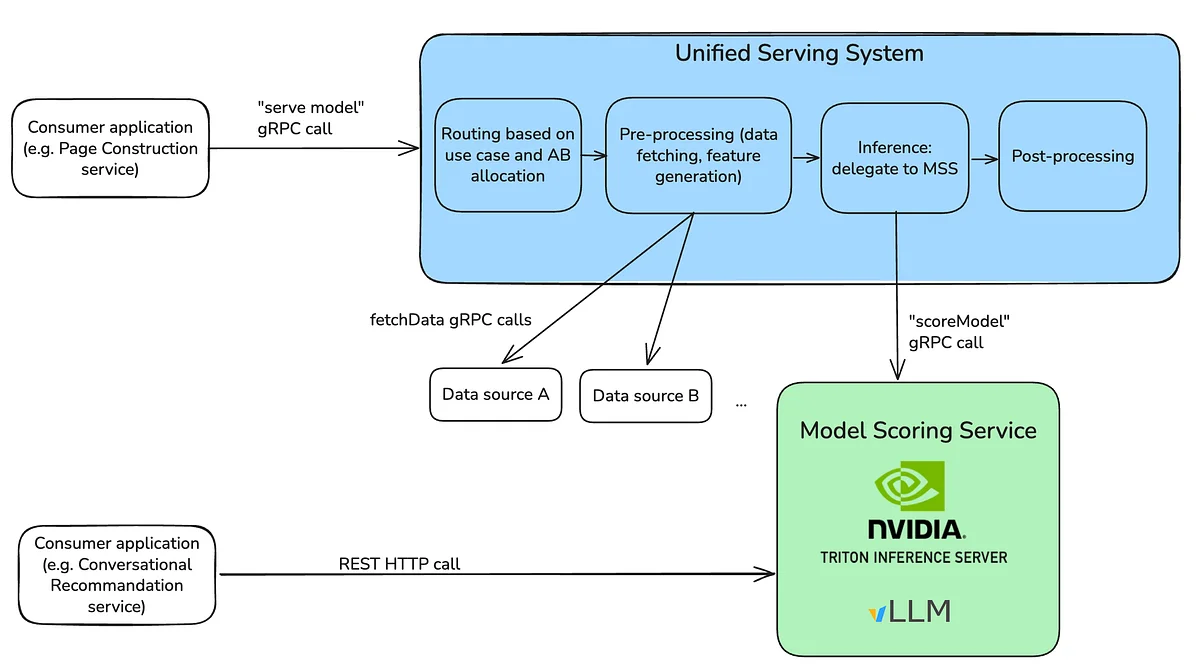
The core of Netflix's LLM serving architecture relies on NVIDIA Triton Inference Server as the backend compute engine. However, the choice of LLM inference engine was a critical decision. Initially exploring TensorRT-LLM, Netflix ultimately selected vLLM as its "paved-path engine." This decision was driven by vLLM's ability to load custom model architectures without complex compilation, its extensibility for custom decoding logic, improved debuggability, and widespread familiarity among ML practitioners.

Architecture and Integration

Netflix's serving system is a unified JVM-based platform handling the entire ML workflow. For LLMs, inference is delegated to a remote service, Model Scoring Service (MSS), which leverages Triton. A key architectural choice was integrating vLLM directly into Triton via its vLLM backend. This approach decouples model artifacts from frontend code, allowing independent evolution.

To cater to the broader LLM ecosystem, Netflix also exposes an OpenAI-compatible HTTP API alongside its internal gRPC interface. This standardization simplifies the transition for developers experimenting with hosted models to Netflix's self-hosted solutions, requiring minimal code changes.

Deployment and Operational Challenges

Deploying GPU-intensive LLM services presents unique challenges. Netflix employs two main strategies: Red-Black deployments for stable interfaces and Versioned deployments for scenarios requiring interface changes, albeit with a temporary increase in GPU costs.

Operational hurdles, such as slow model startup times and fragmented metrics collection, were addressed. Models are pre-materialized on high-performance storage to reduce cold-start latency. A unified metrics endpoint was created to consolidate metrics from both vLLM and Triton, providing a holistic view of performance.

Constrained Decoding at Scale

A significant deep-dive focuses on implementing constrained decoding, ensuring LLM outputs adhere to specific rules during generation. Initially, a per-request Python implementation in vLLM V0 created a CPU bottleneck under load. The migration to vLLM V1 enabled batch-level processing and a C++ implementation, resolving the scaling issue.

This shift required careful operational hardening to manage stateful constraints, particularly addressing partial prefills and preemption scenarios where the model's internal state could be disrupted. Netflix's vLLM Netflix implementation showcases a robust, adaptable approach to LLM serving.

© 2026 StartupHub.ai. All rights reserved. Do not enter, scrape, copy, reproduce, or republish this article in whole or in part. Use as input to AI training, fine-tuning, retrieval-augmented generation, or any machine-learning system is prohibited without written license. Substantially-similar derivative works will be pursued to the fullest extent of applicable copyright, database, and computer-misuse laws. See our terms.