


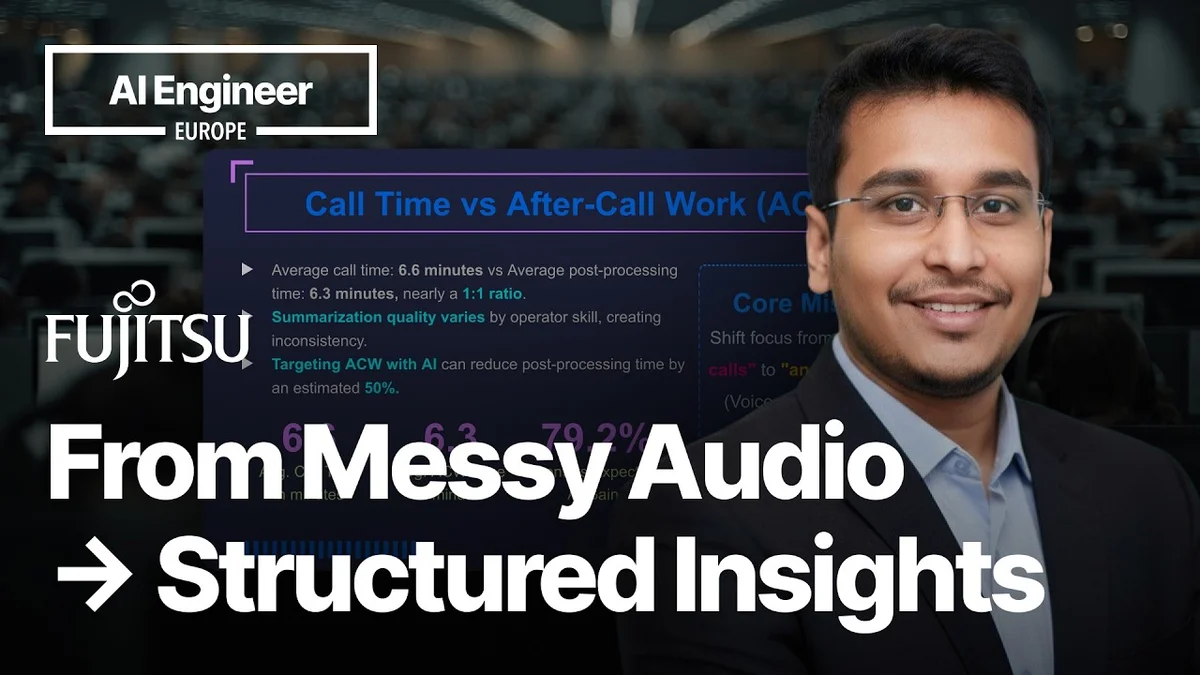
Dippu Kumar Singh, Leader of Emerging Technologies at Fujitsu North America Inc., presented a detailed look at "VoiceOps-fying Low-Latency Intelligence Extraction from Messy Audio Streams." The discussion focused on how artificial intelligence can be applied to the complex data found in customer service calls to extract actionable business intelligence with minimal human intervention.
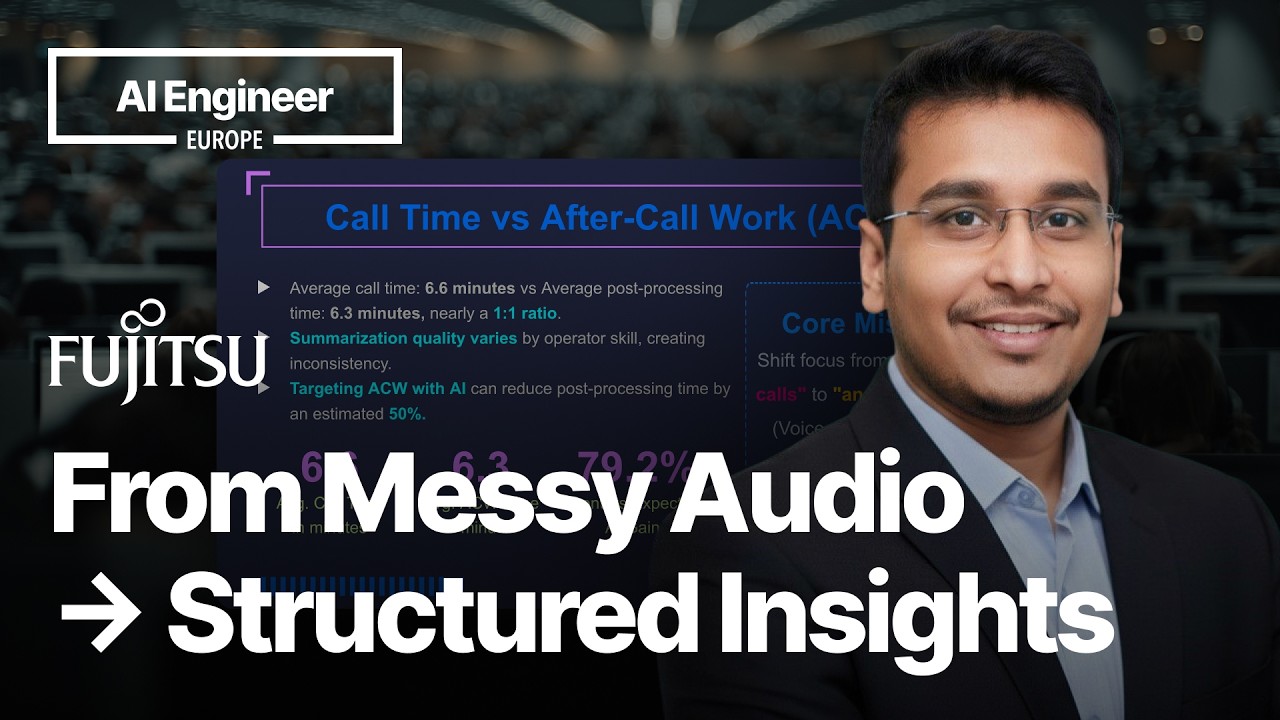
Understanding Contact Center Challenges
Singh highlighted the current operational challenges faced by contact centers. These include difficulties with recruitment and training, maintaining quality and productivity, operational efficiency, and staff retention. Data indicates that over 50% of contact centers identify hiring and productivity as critical barriers to success.
The core mission is to shift focus from merely "handling calls" to "analyzing VOC (Voice of Customer)" for business growth. This requires transforming raw conversational audio into structured business intelligence.
The Proposed AI Solution Architecture
Fujitsu's solution is structured around a four-component pipeline:
- Voice Capture: This initial step involves capturing raw, high-fidelity audio data. It includes audio intake with normalization and noise filtering to standardize audio levels and remove background chatter. A crucial security layer ensures secure streaming and early-stage sensitive data protection, including buffer management and PII masking.
- Speech-To-Text (STT) Engine: This component converts speech phonemes to high-accuracy digital text. It comprises acoustic modeling for interpreting raw sound into linguistic units across dialects, language logic for applying language-specific dictionaries for accuracy, and post-processing for tasks like inverse text normalization and auto-punctuation.
- Generative AI Core: This is the LLM-driven reasoning engine for intent, sentiment, and summary extraction. It involves orchestration using prompt engines and few-shot libraries to guide the LLM. Reasoning involves intent extraction and sentiment scoring to determine the "why" behind the call and customer emotion. A trust layer ensures the summary is factually grounded in the transcript through hallucination checks and token optimization.
- Customer Data Sync: This final component translates AI insights into enterprise system actions. It utilizes an API gateway with schema mappers and REST bridges to map AI fields to CRM database fields. Verification steps include field validation and agent confirmation to allow operators to review and approve auto-summaries. Business intelligence is then generated through VOC aggregation and FAQ generation, feeding categorized data into executive dashboards and FAQs.
The system's overarching goal is to transform raw conversational audio into structured business intelligence with minimal human intervention.