

Consumer AI: Still Early Days

Consumer AI adoption is in its early stages, with only 3% of households paying for services, yet younger demographics are driving significant spending growth.

3 min read
Consumer AI: Still Early Days
a16z Blog

The consumer AI landscape is in its infancy, with paid subscription adoption just beginning to take hold.

According to BofA data, a mere 3% of households subscribe to an AI service, a figure that has grown nearly 40% since February 2024.

This nascent stage suggests substantial potential for expansion in the consumer AI adoption trends market.

Among those paying for AI, a larger share are now becoming big spenders. Over 40% of paying households spend more than $20 monthly, with all high-spending brackets increasing their relative contribution.

Younger demographics are leading this charge.

Gen Z and younger Millennials have increased their median AI spending by approximately 54% over the past year, far outpacing older households.

Even within this younger cohort, paid AI service penetration stands at only 5%, underscoring the early market phase.

SaaS Shake-up Continues

The enterprise software market, often dubbed the 'SaaSpocalypse,' is proving more complex than a simple narrative suggests.

While some software companies face headwinds, AI integration offers a potential accelerant for incumbents.

Related startups

Companies like Hubspot, which has heavily invested in AI, are showing growth among large software buyers, potentially validating their strategy and perhaps avoiding the existential threat discussed in relation to AI agent impacts on other software stocks.

However, data indicates tougher conditions for software not embracing AI.

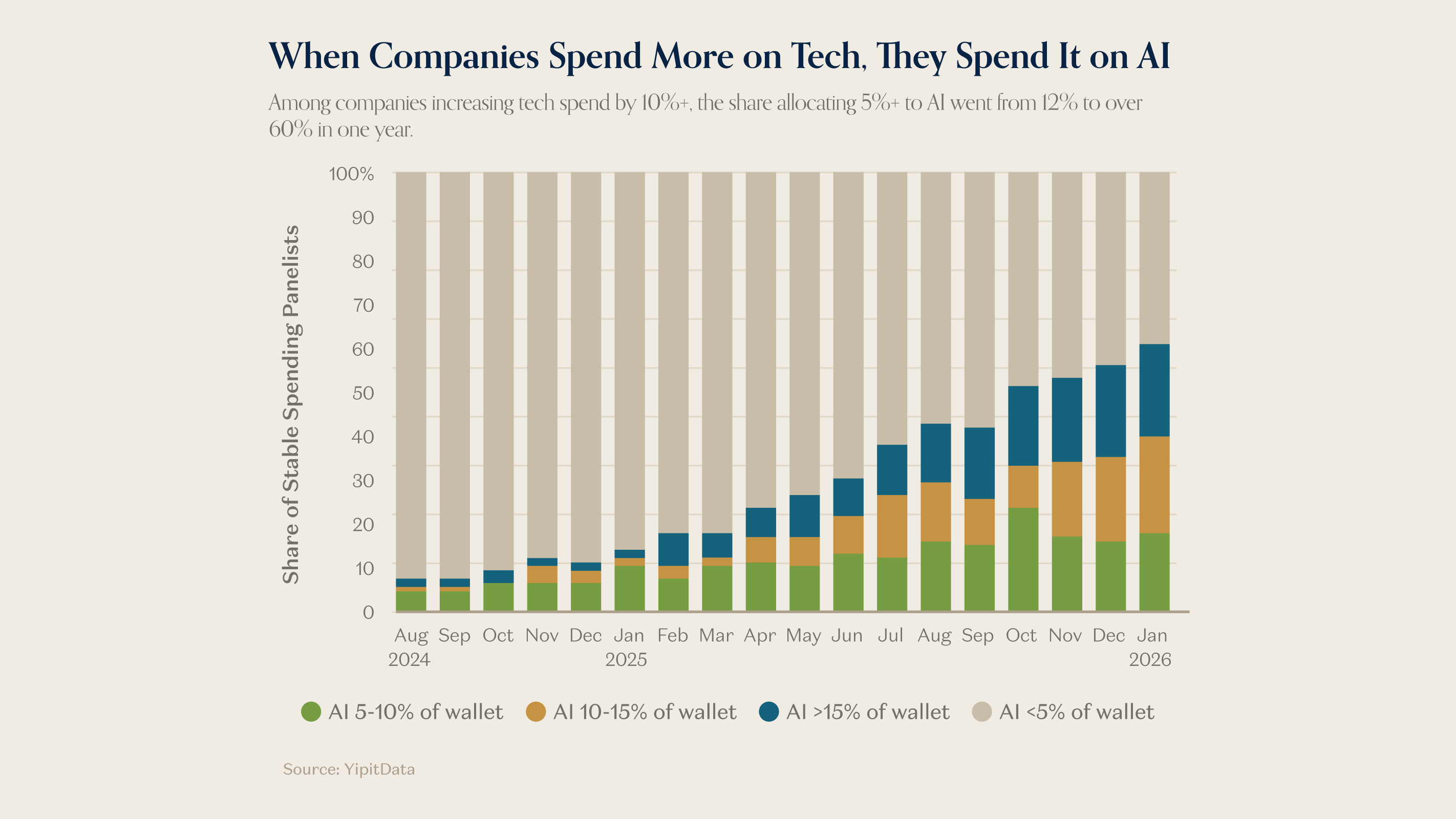
Over 60% of surveyed companies now allocate at least 5% of their tech spend to AI, up from just 12% a year ago.

This shift means AI is capturing a larger portion of incremental IT budgets.

Systems integrators are most exposed to budget reallocations, while front-office, vertical SaaS, and infrastructure face moderate impact.

Back-office, cloud, and cybersecurity appear relatively insulated for now.

Streaming's Ad-Supported Pivot

Streaming services are increasingly adopting ad-supported tiers as subscription prices rise.

Netflix and Disney+ have seen significant increases in users opting for cheaper, ad-inclusive plans.

Prime Video already boasts an 86% ad-supported user base, partly due to default settings.

This strategy aims to maximize revenue from both price-sensitive and ad-tolerant consumers, mirroring trends seen with emerging AI advertising models.

The expectation is that ad-supported tiers will dominate most major platforms within two years.

Physical Economy Signals

Tangible signs suggest a pickup in manufacturing activity, with freight markets showing surging demand.

The national outbound tender rejection index has more than doubled year-over-year.

Flatbed trucking rejection rates, particularly tied to industrial and construction, have reached nearly 50%, surpassing early 2022 levels.

Intermodal rates also spiked approximately 10% in March.

While fewer trucks due to a market downturn play a role, strong domestic demand for shipping is evident.

Market Dynamics: Earnings vs. Valuations

The S&P 500's forward earnings have hit an all-time high, yet the index price is declining, indicating multiple compression.

This divergence suggests factors like geopolitical risk, volatile commodity prices, and general uncertainty are impacting valuations.

A key driver is the decline in free cash flow, especially for hyperscalers investing heavily in AI infrastructure.

Despite rising profits, the significant capital expenditure for AI buildouts is pressuring market sentiment.

© 2026 StartupHub.ai. All rights reserved. Do not enter, scrape, copy, reproduce, or republish this article in whole or in part. Use as input to AI training, fine-tuning, retrieval-augmented generation, or any machine-learning system is prohibited without written license. Substantially-similar derivative works will be pursued to the fullest extent of applicable copyright, database, and computer-misuse laws. See our terms.