
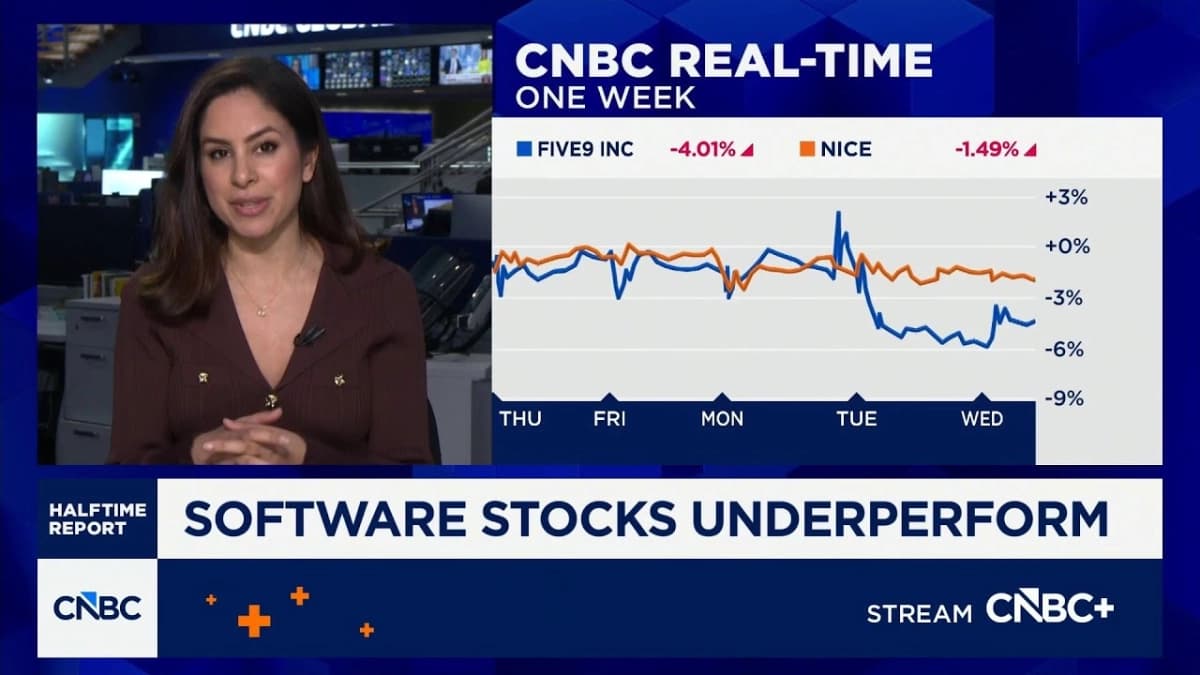
The market has delivered a stark verdict on the current state of enterprise software: artificial intelligence is no longer a theoretical competitor—it is a direct, disruptive force driving incumbent valuations downward. Within a 48-hour span, major announcements confirmed long-held fears, sending giants like Salesforce and Adobe into deep declines. CNBC’s Seema Mody, delivering a sharp analysis during the Halftime Report, detailed how new AI agents and aggressive pricing strategies are amplifying concerns around competition, particularly for companies that rely on high-margin workflow and design dominance.
The core of the recent pressure stems from two distinct product launches targeting established monopolies. First, Anthropic, a leading AI research entity, unveiled Claude Cowork, an AI agent engineered to automate basic tasks. This launch directly challenges Salesforce’s own Agentforce product, signaling that foundational AI model developers are skipping the traditional partnership route and moving straight into the application layer, aiming for direct customer acquisition. This shift means that the very tasks that formed the revenue backbone for automation-focused SaaS platforms are now being replicated and often executed more efficiently by raw AI capabilities.
The second major catalyst came from Apple, which launched a studio of design applications priced considerably cheaper than Adobe’s existing product lineup. For years, Adobe has maintained a powerful lock on the creative economy, sustained by its comprehensive Creative Cloud suite and its subscription pricing model. Apple’s move is a classic squeeze play: offering a low-cost, high-quality alternative that undermines Adobe’s pricing power and threatens to chip away at its user base, especially among emerging professionals and smaller studios. The market reaction was immediate and punishing: Adobe shares have fallen significantly over the past year, while Salesforce is on track for its worst start to the year since 2022.
The competitive landscape is rapidly evolving from co-existence to displacement. Mody noted that Anthropic’s new offering is designed to “basically automate basic tasks, similar to what Salesforce’s agents are trying to accomplish.” This isn't just about improved features; it's about eliminating the need for complex, siloed software workflows entirely. The threat is not isolated to CRM or design; analysts are increasingly pointing to other areas vulnerable to AI-driven robotic process automation (RPA) and workflow agents. Companies like Asana and HubSpot, focused on project management and marketing automation, along with call center names such as Five9 and Nice, have seen their stocks underperform significantly, dragged down by the specter of AI agents replacing human-centric interfaces and automating customer interaction entirely. For founders and venture capitalists evaluating the next wave of investments, this trend underscores a critical lesson: any software company whose primary value proposition is simple workflow automation or data routing is now fundamentally at risk of being swallowed by a large language model agent.
This existential threat forces a reckoning during quarterly earnings calls, where CEOs face the uncomfortable necessity of defending their roadmaps. They must demonstrate that their costly internal AI integrations are truly additive and protect their core business, rather than merely delaying the inevitable disruption. Mody observed that “CEOs will have to defend their products and show that AI is not displacing their business.” This defensive posture is already manifesting in a rapid increase in M&A activity and consolidation, as incumbents realize that building competitive AI infrastructure internally is often too slow or too expensive. Recent acquisitions by Palo Alto Networks and IBM highlight this defensive consolidation strategy, where established players are attempting to buy their way into advanced AI capabilities to stave off obsolescence.
The ultimate measure of disruptive momentum often resides in capital markets, and the forthcoming fundraising round for OpenAI is viewed as a key indicator of future software volatility. Analysts suggest that if the funding is “bigger than expected, that would suggest it’s got the capital to continue to work on apps and products that take aim at the business customer which is so crucial to software’s bottom line.” This massive infusion of capital allows the frontier AI players to sustain aggressive research and development, ensuring that the pace of innovation targeting enterprise functions remains breakneck. The current environment demands that enterprise software leaders pivot aggressively toward genuine intelligence augmentation—where AI dramatically expands human capability—rather than relying on incremental automation improvements that are now easily commoditized by large model agents. The market is clearly signaling that the days of entrenched, high-margin software monopolies, protected by switching costs and feature superiority, are rapidly drawing to a close under the relentless pressure of generative AI.



