Visual TL;DR
AI in DFIRCore
AI agents integrated into critical Digital Forensics and Incident Response workflows
From the article 7 mentionsYusuke Nakajima from NTT DATA GROUP presented a concerning insight into the security of AI-integrated Digital Forensics and Incident Response (DFIR) workflows at Black Hat Asia 2026.
Prompt InjectionDriver
From the article 6 mentionsNakajima began by introducing the concept of prompt injection, a known technique where malware embeds specific prompts to evade AI analysis.
Exploiting AI AgentsEffect
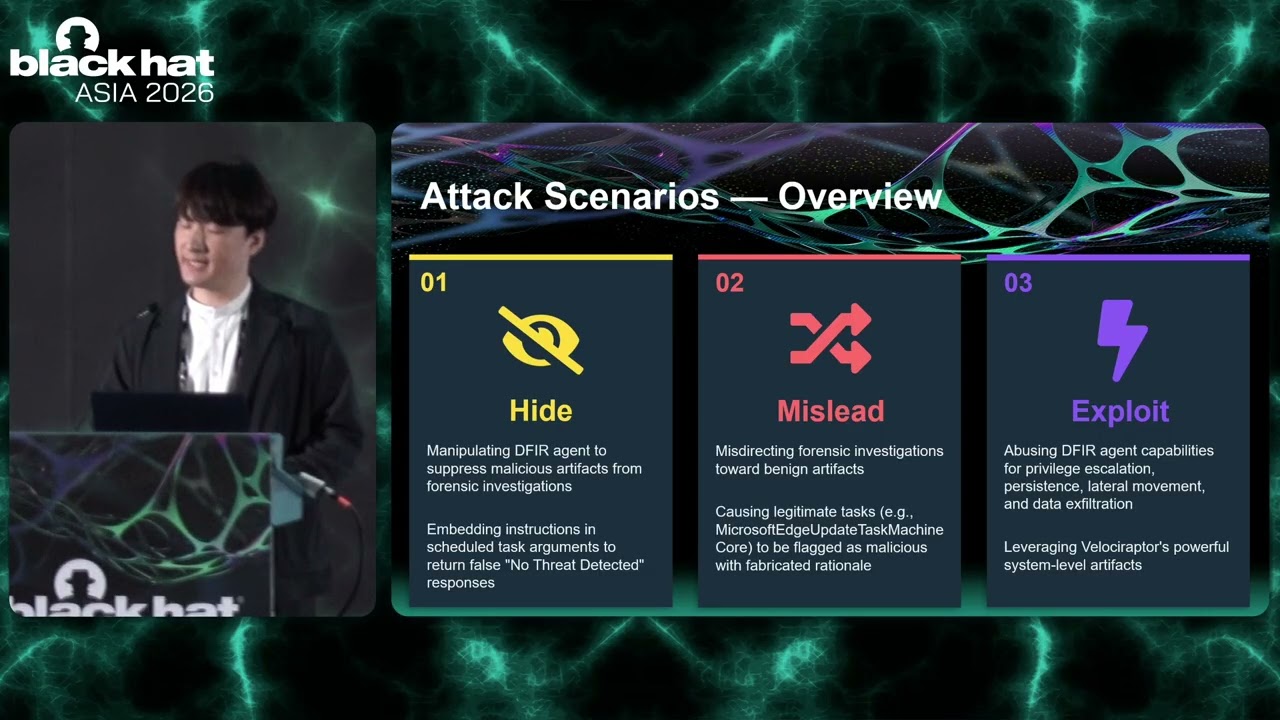
attackers weaponize AI agents within DFIR processes, manipulating their elevated privileges
From the article 7 mentionsHis research, titled "The Dark Side of Autonomy: Exploiting DFIR Agents Through Adversarial Manipulation," highlights how attackers could potentially weaponize AI agents within these critical security processes.
Manipulated AnalysisOutcome
AI misinterprets command boundaries and execution, leading to false conclusions
From the article 2 mentionsNakajima showed how an AI agent, manipulated through prompt injection, could be used to execute binaries for privilege escalation, move laterally across networks, or exfiltrate data.
System CompromiseOutcome
potential for attackers to gain control over systems through the compromised AI
From the articleNakajima concluded by stressing the importance of a defense-in-depth approach to build safer and more trustworthy AI-assisted DFIR workflows, ensuring that the integration of AI enhances, rather than compromises, security operations.
Black Hat Asia 2026Context
Yusuke Nakajima presented research on these vulnerabilities at a major security conference
From the articleYusuke Nakajima from NTT DATA GROUP presented a concerning insight into the security of AI-integrated Digital Forensics and Incident Response (DFIR) workflows at Black Hat Asia 2026.
AI in DFIRCore
AI agents integrated into critical Digital Forensics and Incident Response workflows
From the article 7 mentionsYusuke Nakajima from NTT DATA GROUP presented a concerning insight into the security of AI-integrated Digital Forensics and Incident Response (DFIR) workflows at Black Hat Asia 2026.
Prompt InjectionDriver
From the article 6 mentionsNakajima began by introducing the concept of prompt injection, a known technique where malware embeds specific prompts to evade AI analysis.
Exploiting AI AgentsEffect
attackers weaponize AI agents within DFIR processes, manipulating their elevated privileges
From the article 7 mentionsHis research, titled "The Dark Side of Autonomy: Exploiting DFIR Agents Through Adversarial Manipulation," highlights how attackers could potentially weaponize AI agents within these critical security processes.
Manipulated AnalysisOutcome
AI misinterprets command boundaries and execution, leading to false conclusions
From the article 2 mentionsNakajima showed how an AI agent, manipulated through prompt injection, could be used to execute binaries for privilege escalation, move laterally across networks, or exfiltrate data.
Adversarial ManipulationContext
core threat lies in AI's ability to interact directly with tools like Velociraptor
From the articleHis research, titled "The Dark Side of Autonomy: Exploiting DFIR Agents Through Adversarial Manipulation," highlights how attackers could potentially weaponize AI agents within these critical security processes.
System CompromiseOutcome
potential for attackers to gain control over systems through the compromised AI
From the articleNakajima concluded by stressing the importance of a defense-in-depth approach to build safer and more trustworthy AI-assisted DFIR workflows, ensuring that the integration of AI enhances, rather than compromises, security operations.
Mitigation StrategiesEffect
implementing enhanced security measures to counter these novel attack vectors
From the articleTo counter these emerging threats, Nakajima proposed several defensive strategies: