


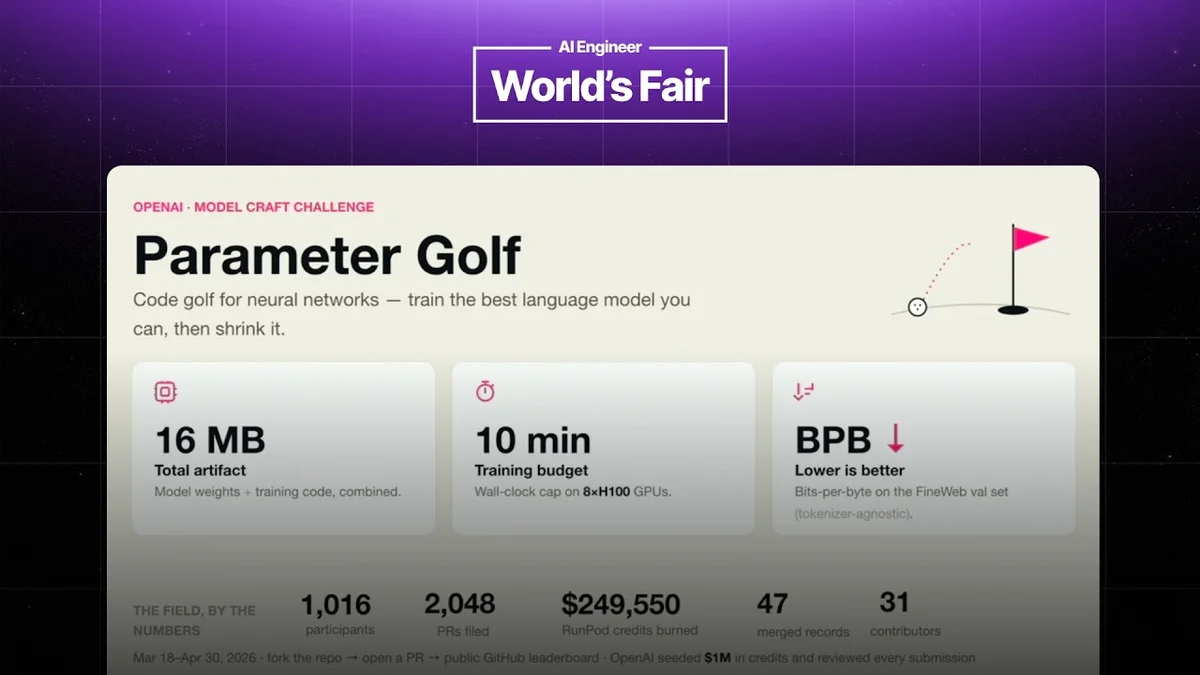
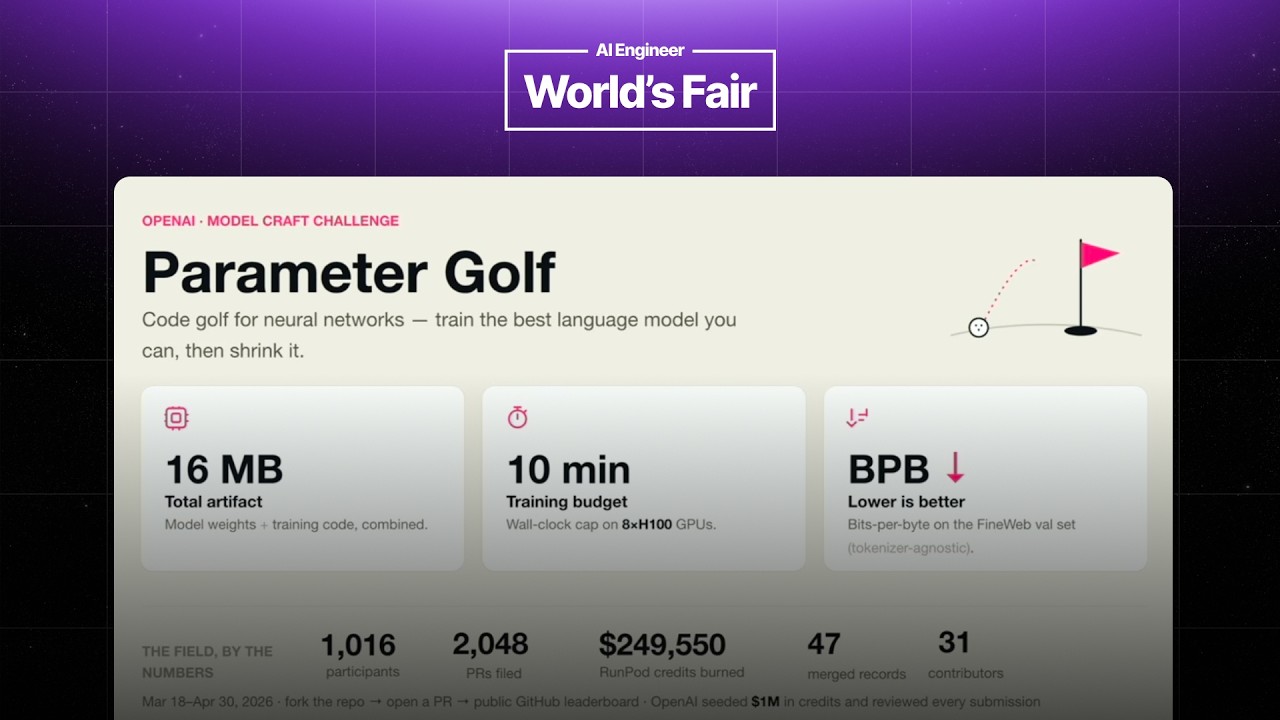
Weco AI's Zhengyao Jiang and Dixing Xu used AI Engineer to dissect how their agent Aiden became the top contributor to OpenAI's Parameter Golf, a model-craft challenge where weights plus code must fit in 16 megabytes and training must finish in 10 minutes.
It won by spending less.
Dixing Xu said the 44-day contest drew around 1,006 researchers who filed 248 pull requests and burned roughly $250,000 in GPU compute, with only 47 merges from 31 contributors. Aiden, a self-improving multi-agent system built on the Claude and GPT families, landed seven merged leaderboard records. That was twice the next best human, and Xu said 435 downstream PRs built on Aiden's work, giving it the highest PR H-index in the competition.
Cost was the tell. Aiden used 4% of community compute to take 15% of merged records, or 3.7 times the field average for efficiency, and scored lowest bits per byte on the FineWeb validation set. Zhengyao Jiang framed AutoResearch as a tight loop: give the model code and a replayable eval script, it keeps ideas that improve a single scalar and discards the rest. The pattern is not new. Andrej Karpathy popularized the same loop for training scripts, and OpenAI had already evaluated Weco's earlier agent AID on MLE-Bench in April 2024, where it scored about four times the medal rate of the next best agent.
Context matters because two other teams have pushed the same idea in production. Instacart runs a three-stage agentic modeling loop that it said cut delivery error by 4.8%, while a MindStudio guide traces the AutoResearch loop directly to Karpathy's edit-run-keep-or-discard cycle now copied for backend, prompt and inference work. Weco's twist is structure. Jiang and colleagues described a tree search where every node is a code version with a score, plus observability into diffs and steerability that lets a human inject ideas mid-run.