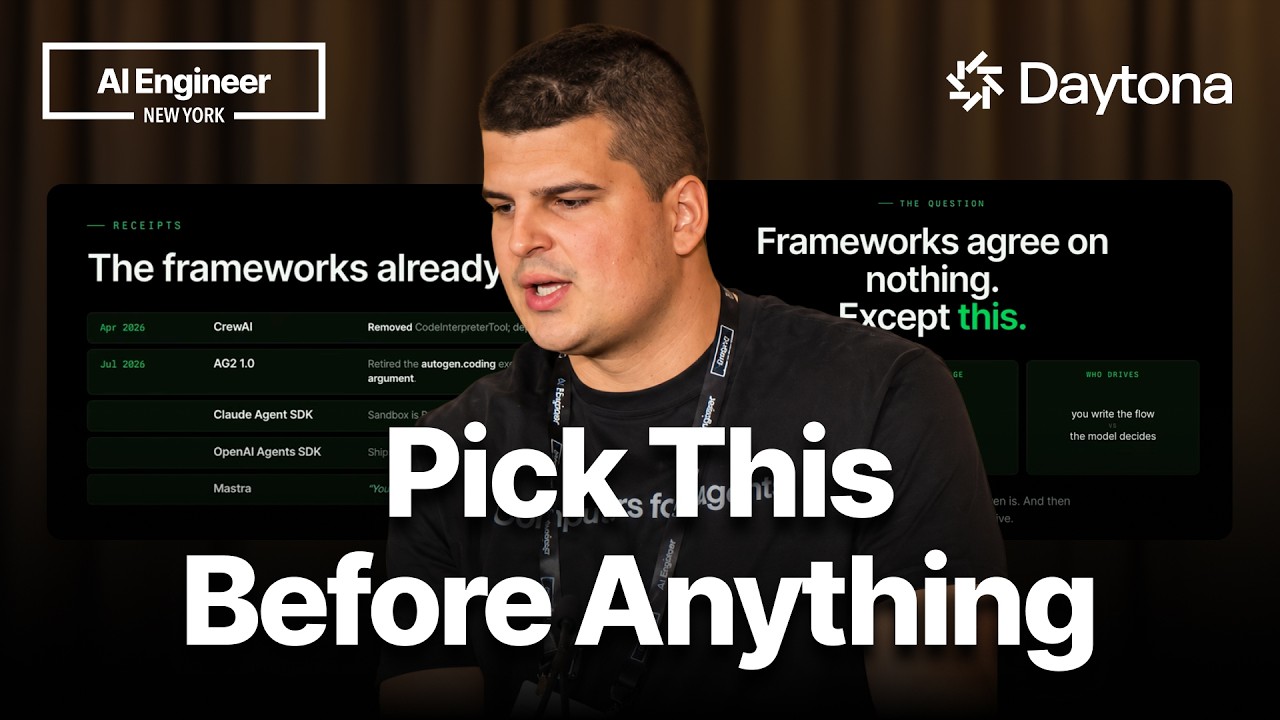
The obvious read is that agents finally found consensus. Mislav Ivanda, developer experience engineer at Daytona, told AI Engineer that rival frameworks now share the same three calls: create a sandbox, run code, delete it.
I do not buy consensus as proof.
His description of the failure modes is accurate and worth keeping. Local allowlists that prompt for approval still let a Python one-liner open sockets and rewrite files. Embedded runtimes like V8 or QuickJS isolate the glue code, while the real email or database tool calls still run outside them.
Frameworks do disagree on almost everything else. LangChain and LangGraph differ from CrewAI role-playing agents and OpenAI loop-around-model designs, and Mastra wants explicit workflows where others let agents choose. Ivanda argued that split makes shared sandbox calls a necessity, not fashion.
He leaves price and operations unstated, and that is the hole. List prices tracked by Lizard put 2 vCPU and 4 GiB sandboxes at $0.1656 an hour for both Daytona and E2B, against $0.0162 for Lizard and $0.238 for Modal, as of that comparison. To be fair, Ivanda cited real direction: CrewAI removed its local code interpreter in April 2026, AG2 retired local executors, and OpenAI and Claude options now default toward sandboxes or Docker.
Pick your boundary before your framework, but price the boundary first.