
NVIDIA used CoRL in Austin to push robot learning from walking to fine manipulation with new models, simulation tools and benchmarks. The core is Isaac Lab 3.0, paired with GR00T 2 and two open evaluation frameworks, NVIDIA said.
GR00T 2 is a world action model, a system that perceives surroundings, predicts how actions change them and executes multistep tasks. It was trained on diverse robot and human data including 100,000 hours of open egocentric video, NVIDIA said. It completed 40 of 50 evaluated tasks at least once with no task demos, reached 71% average success with one demo per task and 95% with five, NVIDIA said. Early testers include Foxconn for server manufacturing, Siemens for industrial cases and Nexuni for laundry handling.
Simulation does the heavy practice.
Isaac Lab is an open robot learning framework that trains and tests policies before hardware deployment. Version 3.0 lets users switch between PhysX and Newton physics, choose renderers and apply reinforcement post-training to foundation models, NVIDIA said. It also introduces a PresetCfg pattern for writing one environment config that runs on both PhysX and Newton, per NVIDIA docs. On a vision-based dexterous task, Isaac Lab 3.0 with Newton hit up to 2.5x the throughput of 2.3 with PhysX, NVIDIA said. AlphaNIST shows the payoff, with one policy learning all 20 NIST assembly board tasks at over 98% success versus 81% for per-task policies using about 39x less GPU time, NVIDIA said.
Evaluation is the other push. DexBench from RLWRLD offers 15 tasks across retail, logistics, manufacturing and hospitality, while VABAR from UC Berkeley offers six industrial tasks with tiers and metrics, NVIDIA said. Both run on Isaac Lab-Arena, now in 0.4 preview, to expose failure conditions across thousands of variations. Ken Goldberg, UC Berkeley robotics professor and a lead on VABAR and the Graph-as-Policy framework, said: "To me, agentic robotics is the most exciting technological development since the internet in 1995." Throughput claims still reflect NVIDIA lab benchmarks, not factory floors.
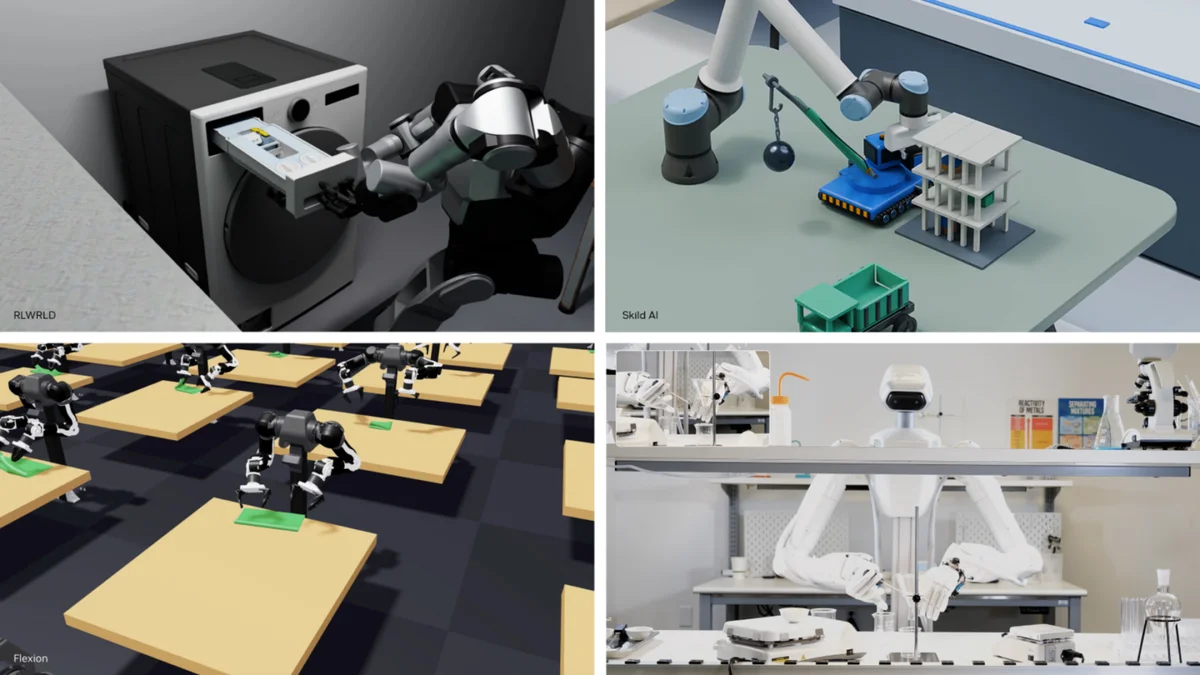
StartupHub.ai data describes Skild AI, FieldAI and Flexion as simulation-first robotics software firms rather than chip vendors, so physics accuracy lands directly on their training bills, per StartupHub.ai data. Skild AI answered with STEEL, a Newton-based solver for faster training, while MicroAGI post-trained GR00T 2 for Ethernet cable swapping. If DexBench and VABAR stick, buyers will compare simulation speed and failure analysis alongside model scores.






