

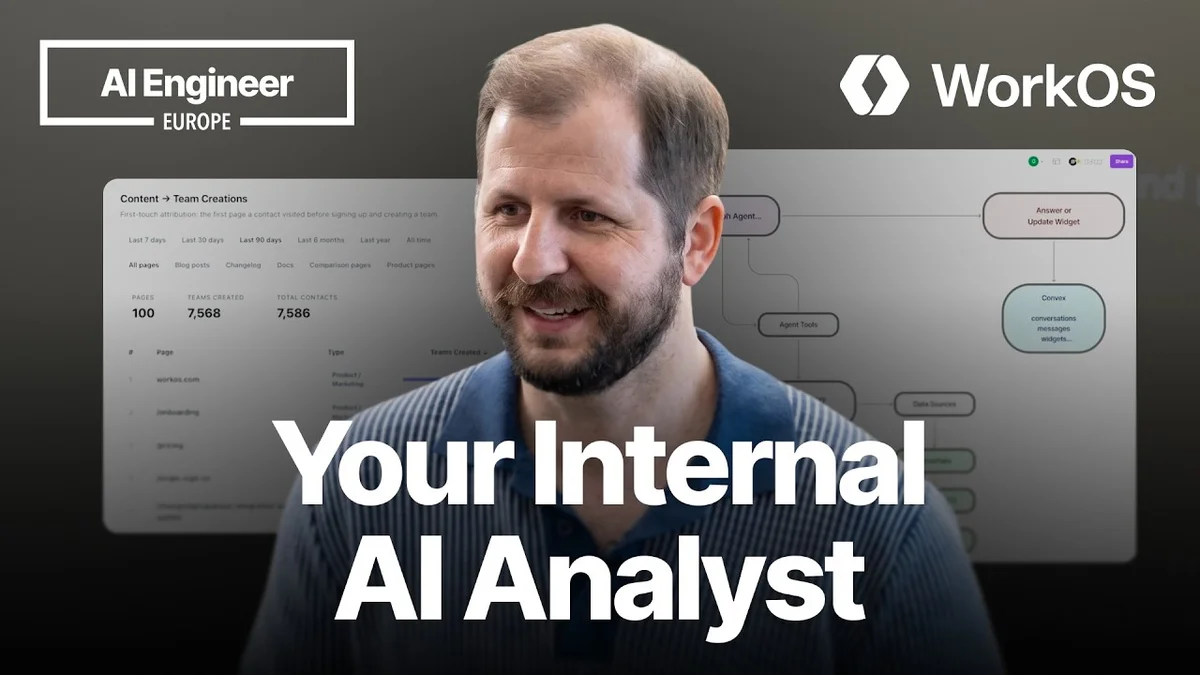
WorkOS CEO on Business Communication Gaps

WorkOS CEO Garrett Galow discusses why many businesses struggle to answer fundamental questions, highlighting the cost of information silos.

Garrett Galow, CEO of WorkOS, speaking on business communication challenges.
AI Engineer
Visual TL;DR
WorkOS CEOCore
Garrett Galow discusses the business communication gaps
From the article 2 mentionsGarrett Galow, CEO of WorkOS, has pinpointed a pervasive problem plaguing many organizations: the inability of employees to readily answer fundamental questions about the business.
Information SilosDriver
From the article 6 mentionsIn a recent discussion, Galow articulated the frustration and inefficiency that arises when critical information is siloed, inaccessible, or simply unknown to those who need it most.
Inability to Answer QuestionsDriver
From the article 3 mentionsGarrett Galow, CEO of WorkOS, has pinpointed a pervasive problem plaguing many organizations: the inability of employees to readily answer fundamental questions about the business.
Organizational DysfunctionOutcome
signals a deeper organizational dysfunction in how business operates
From the articleWhen asked simple questions like "What is our target market?" or "Who is responsible for X?" and the answers are met with hesitation, confusion, or a complete lack of knowledge, it signals a deeper organizational dysfunction.
Drag on ProductivityOutcome
From the articleThis lack of transparency, he argues, acts as a significant drag on productivity and strategic execution.
Knowledge-Centric OrgContext
building a knowledge-centric organization is the proposed solution
Strategic ExecutionOutcome
hinders strategic execution and business growth
From the articleThis lack of transparency, he argues, acts as a significant drag on productivity and strategic execution.

Garrett Galow, CEO of WorkOS, has pinpointed a pervasive problem plaguing many organizations: the inability of employees to readily answer fundamental questions about the business. In a recent discussion, Galow articulated the frustration and inefficiency that arises when critical information is siloed, inaccessible, or simply unknown to those who need it most. This lack of transparency, he argues, acts as a significant drag on productivity and strategic execution.

WorkOS CEO on Business Communication Gaps - AI Engineer
WorkOS CEO on Business Communication Gaps, AI Engineer

The core of Galow's argument centers on the idea that a healthy business should have its foundational knowledge readily available. When asked simple questions like "What is our target market?" or "Who is responsible for X?" and the answers are met with hesitation, confusion, or a complete lack of knowledge, it signals a deeper organizational dysfunction. This isn't merely an inconvenience; it's a symptom of a business that is not adequately structured to support its own operations or growth.

The Cost of Information Silos

Galow's perspective suggests that the inability to answer basic business questions is more than just an operational hiccup. It represents a significant cost. Employees waste valuable time searching for information, duplicating efforts, or making decisions based on incomplete or incorrect data. This inefficiency can slow down product development, hinder customer support, and impede sales efforts. Furthermore, it can lead to a lack of alignment across different teams, as individuals may operate with different understandings of the company's goals and priorities.

The implication is that businesses, especially those scaling rapidly, must invest in systems and culture that promote open and accessible knowledge. This includes not only formal documentation like wikis and internal knowledge bases but also fostering an environment where asking questions and sharing information is encouraged and rewarded. The ability to quickly access and understand core business tenets is directly tied to an organization's agility and its capacity to respond to market changes.

Building a Knowledge-Centric Organization

The challenge Galow describes points to a need for deliberate action. Companies need to move beyond ad-hoc information sharing and implement structured approaches to knowledge management. This might involve:

  • Establishing clear ownership for different areas of business knowledge.
  • Implementing robust internal documentation platforms.
  • Training employees on how to access and contribute to shared knowledge.
  • Regularly reviewing and updating critical business information.

WorkOS, as a company focused on enabling seamless internal operations, is likely addressing these very challenges. Galow's insights suggest that the future of efficient businesses lies in their ability to create a transparent and easily navigable information environment, ensuring that everyone can contribute effectively because they have the information they need.

© 2026 StartupHub.ai. All rights reserved. You may not republish this article in full without a license. Search engines and AI research tools may crawl and summarize for reference. Bulk reproduction or model training requires a license. See our terms.
Daniel Singer

Written by

Daniel Singer

Editor, StartupHub.ai

Daniel Singer is the editor of StartupHub.ai, a technology expert and thought leader on AI and its applications across sectors, from fintech and healthcare to developer tooling and consumer software. He writes and tests the tools covered here thoroughly and regularly, and built StartupHub.ai to give founders, operators and buyers a clearer read on what they are actually being sold.