

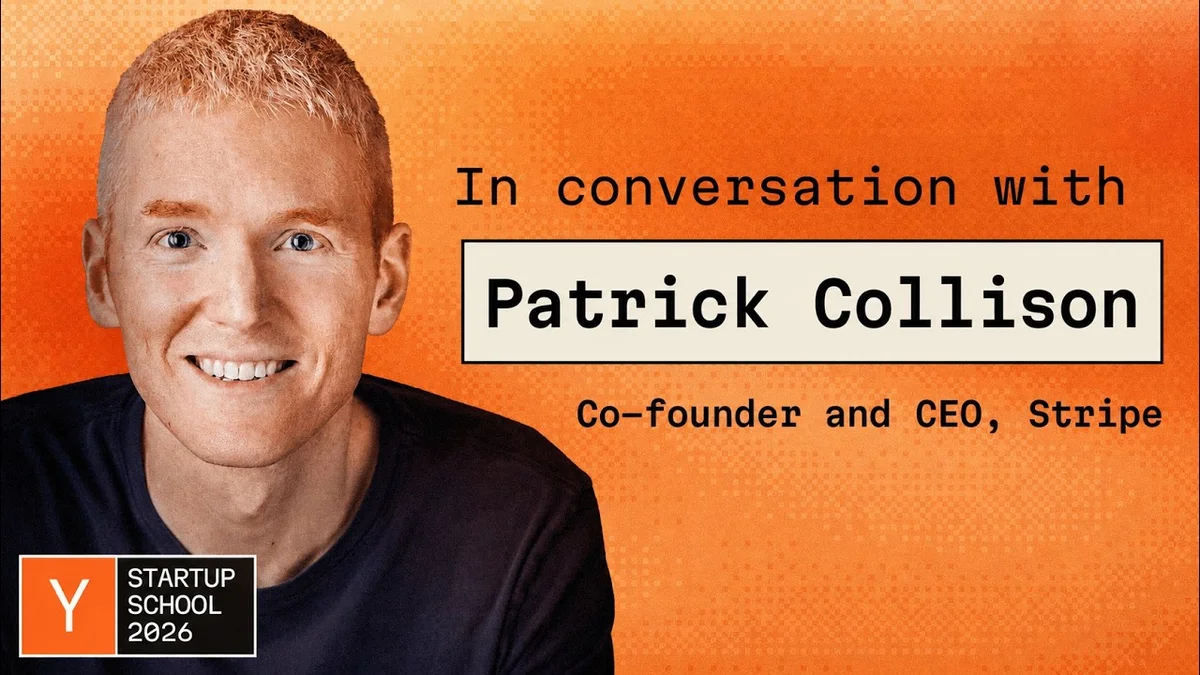
Patrick Collison on AI Agents Dropouts and Stripe Growth

Stripe CEO Patrick Collison discusses AI cognitive limits, founder mindsets, and platform data showing a 2x jump in new business formation at Startup School.

Patrick Collison speaking on stage at Y Combinator Startup School
Patrick Collison, Co-Founder and CEO of Stripe, speaking at Y Combinator Startup School.· YC
Visual TL;DR
Patrick Collison: Stripe CEOCore
discusses AI cognitive limits, founder mindsets, and platform data insights
From the article 7 mentionsPatrick Collison is an Irish entrepreneur best known as the co-founder and CEO of Stripe, a global financial infrastructure company that powers online payments for millions of businesses worldwide.
Human vs. AI AgentsContext
critiques AI-assisted workflows, highlighting human cognitive advantages and limits
From the article 6 mentionsFine, yes, you can ask the agent to compute something for you or to look something up for you, but that is a hell of a lot slower than knowing it in cognitive L1 cache.", Patrick Collison
Founder MindsetContext
reflects on dropping out of college, overcoming 'schlep blindness' in building Stripe
From the article 6 mentionsStartupHub.ai data tracks MIT with a score of 19/100, highlighting the contrast between traditional academic paths and founder trajectories.
Stripe Platform DataCore
reveals new metrics pointing to an unprecedented surge in business creation
From the article 3 mentionsSharing recent data from Stripe's global network, Collison revealed that new business creation on the platform is growing at roughly 2x year-over-year.
Startup Creation SurgeOutcome
shows a 2x jump in new business formation at Y Combinator Startup School
From the articleReflecting on his own journey dropping out of college to found companies, Collison offered a detailed critique of AI-assisted workflows while revealing new platform metrics that point to an unprecedented surge in business creation.
Overcoming Schlep BlindnessContext
identifying and solving difficult, unglamorous problems essential for building platforms
From the articleBy deploying just-in-time development based on immediate user requests for dashboards and refunds, Stripe systematically resolved what YC co-founder Paul Graham termed "schlep blindness", the tendency of founders to avoid unglamorous, complex operational problems.
AI Era StrategyEffect
discusses future of startup strategy, leveraging AI for enterprise adoption
From the articleAddressing how young engineers should approach learning in an era where AI models can generate code on command, Collison framed the issue through computer architecture.
Contents(6)

At Y Combinator Startup School, Stripe co-founder and chief executive officer Patrick Collison joined YC managing partner Harj Taggar for a wide-ranging conversation on the mechanics of founder decision-making, human cognition in the age of artificial intelligence, and the operational realities of building global software platforms. Reflecting on his own journey dropping out of college to found companies, Collison offered a detailed critique of AI-assisted workflows while revealing new platform metrics that point to an unprecedented surge in business creation.

Who Is Patrick Collison

Patrick Collison is an Irish entrepreneur best known as the co-founder and CEO of Stripe, a global financial infrastructure company that powers online payments for millions of businesses worldwide. Raised in County Tipperary, Ireland, Collison gained early recognition as a prodigy in software development, creating a dialect of Lisp called Chroma as a teenager. He enrolled at Alphabet Inc. (NASDAQ:GOOGL) competitor labs' hiring ground, the Massachusetts Institute of Technology, before dropping out to co-found Auctomatic, an auction management startup acquired in 2008. In 2010, alongside his brother John Collison, he founded Stripe, which has grown into one of the most valuable private software enterprises in tech history.

The full discussion can be found on YC's YouTube channel.

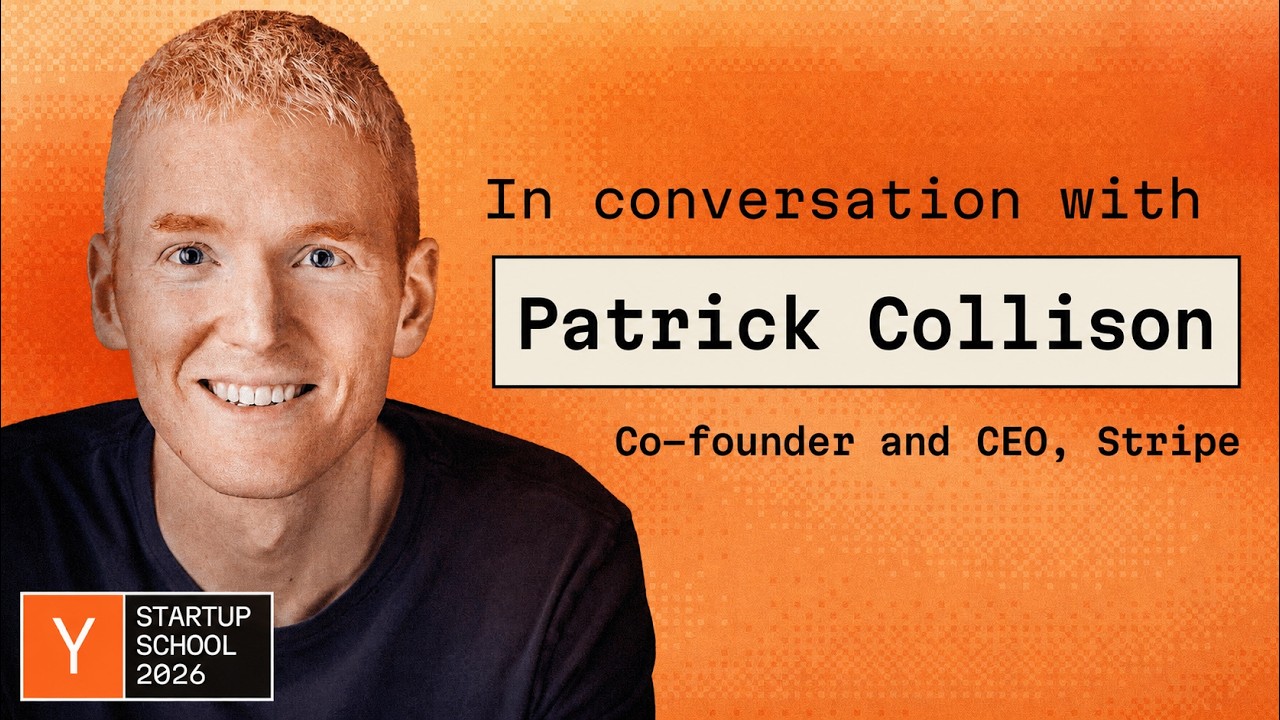
Patrick Collison: "What If You Succeed?" - YC
Patrick Collison: "What If You Succeed?", from YC

Human Cognitive L1 Cache Versus AI Agents

Addressing how young engineers should approach learning in an era where AI models can generate code on command, Collison framed the issue through computer architecture. Drawing on computer scientist Jeff Dean's famous system constants, Collison explained that human knowledge functions like an L1 processor cache.

"Retrieving something from L1 cache is very different to retrieving from RAM is very different from retrieving across the network. Fine, yes, you can ask the agent to compute something for you or to look something up for you, but that is a hell of a lot slower than knowing it in cognitive L1 cache.", Patrick Collison

Collison emphasized that direct mental recall allows for rapid, multi-step round trips in the human brain that text prompting or voice input cannot replicate. He pointed out that leading technology firms and research labs continue to place an enormous premium on raw cognitive ability. While AI systems can prove complex mathematical proofs, Collison noted that model-generated writing remains deficient in handling the multi-dimensional nuances of human communication. Collison revealed that he continues to write all his own prose and has never sent an auto-suggested text prompt from messaging tools.

Dropping Out and the Myth of Ephemeral Opportunity

Having dropped out of college twice, first from MIT to build Auctomatic and later to start Stripe, Collison addressed the anxieties common among university students. StartupHub.ai data tracks MIT with a score of 19/100, highlighting the contrast between traditional academic paths and founder trajectories. Collison noted that dropping out is rarely an irreversible decision, as universities routinely permit students to return.

Reflecting on his motivation at nineteen, Collison admitted that his intense sense of urgency stemmed from a flawed assumption that Silicon Valley opportunities were fleeting. Decades of historical evidence show that tech hubs maintain a constant surplus of viable startup opportunities. He rejected social media narratives suggesting students must immediately launch ventures or face permanent economic stagnation, drawing parallels to historical technological breakthroughs like aviation where early proponents wrongly predicted the immediate rewriting of society.

Building Stripe and Overcoming Schlep Blindness

Recalling the origins of Stripe, Collison described how he and his brother decided to build the company during a walk after attending YC Startup School in 2009. What they initially assumed would be a temporary side project took nearly two years of engineering before public launch in September 2011.

To navigate the regulatory, security, and banking partnerships required for financial systems, the founders operated in private beta, serving their first live production user in January 2010. By deploying just-in-time development based on immediate user requests for dashboards and refunds, Stripe systematically resolved what YC co-founder Paul Graham termed "schlep blindness", the tendency of founders to avoid unglamorous, complex operational problems.

StartupHub.ai data shows Stripe holding a StartupHub score of 74/100 with a verified post-money valuation of $159B, positioning it ahead of tracked payment infrastructure competitors such as Payoneer (score 69/100), Paymentology (score 67/100), Stax Payments (score 64/100), Balance (score 63/100), and SafeCharge (score 50/100).

Surge in Startup Creation and Enterprise Adoption

Sharing recent data from Stripe's global network, Collison revealed that new business creation on the platform is growing at roughly 2x year-over-year. This growth rate represents the largest relative jump Stripe has ever recorded, surpassing even the 50% year-over-year increase observed during the initial wave of the 2020 pandemic. Furthermore, metrics indicate that median business performance and time-to-first-revenue for new companies incorporated via Stripe Atlas are actively improving.

Collison attributed this velocity to a fundamental shift in enterprise buyer behavior. Unlike past decades, where enterprise buyers hesitated to procure software from early-stage vendors, incumbent executives today fear falling behind on AI capabilities. Consequently, established organizations are far more willing to sign contracts with early-stage software companies, creating an optimal sales environment for new founders.

The Future of Startup Strategy in the AI Era

Regarding concerns that primary AI labs will overwrite specialized startup software, Collison drew comparisons to historical fears around major platforms. He argued that human organizations are inherently limited in their capacity to execute hundreds of competing priorities simultaneously, leaving vast territory open for focused startups.

However, Collison suggested that traditional "lean startup" playbooks centered on micro-niche validation are becoming overly competitive. Instead, he advised modern founders to use AI capabilities to pursue more ambitious, decorrelated starting points upfront, pointing to successful non-lean companies in defense and frontier technology as evidence that high-ambition models are increasingly viable.

© 2026 StartupHub.ai. All rights reserved. You may not republish this article in full without a license. Search engines and AI research tools may crawl and summarize for reference. Bulk reproduction or model training requires a license. See our terms.
Daniel Singer

Written by

Daniel Singer

Editor, StartupHub.ai

Daniel Singer is the editor of StartupHub.ai, a technology expert and thought leader on AI and its applications across sectors, from fintech and healthcare to developer tooling and consumer software. He writes and tests the tools covered here thoroughly and regularly, and built StartupHub.ai to give founders, operators and buyers a clearer read on what they are actually being sold.